Let $f: \mathbb{R} \rightarrow \mathbb{R}$ be a function such that
(i) For all $x, y \in \mathbb{R}$,
$$
f(x)+f(y)+1 \geq f(x+y) \geq f(x)+f(y)
$$
(ii) For all $x \in [0,1)$, $f(0) \geq f(x)$,
(iii) $-f(-1)=f(1)=1$.
Find all such functions $f$.
You are given three lists $A$, $B$, and $C$. List $A$ contains the numbers of the form $10^{k}$ in base 10, with $k$ any integer greater than or equal to $1$. Lists $B$ and $C$ contain the same numbers translated into base $2$ and $5$ respectively:
Let $n$ be an integer of the form $a^{2}+b^{2}$, where $a$ and $b$ are relatively prime integers and such that if $p$ is a prime, $p \leq \sqrt{n}$, then $p$ divides $a b$. Determine all such $n$.
The edges of a cube are labeled from $1$ to $12$ in an arbitrary manner. Show that it is not possible to get the sum of the edges at each vertex the same. Show that we can get eight vertices with the same sum if one of the labels is changed to $13$.
Call a super-integer an infinite sequence of decimal digits: $\ldots d_n \ldots d_3 d_2 d_1$. Given two super-integers $\ldots c_n \ldots c_3 c_2 c_1$ and $\ldots d_n \ldots d_3 d_2 d_1$, their product $\ldots p_n \ldots p_3 p_2 p_1$ is formed by taking $p_n \ldots p_3 p_2 p_1$ to be the last $n$ digits of the product $c_n \ldots c_3 c_2 c_1$ and $d_n \ldots d_3 d_2 d_1$. Can we find two non-zero super-integers with zero product? A zero super-integer has all its digits zero.
Show that for any integer $a \geq 5$ there exist integers $b$ and $c$, $c \geq b \geq a$, such that $a, b, c$ are the lengths of the sides of a right-angled triangle.
Let $p(x)$ be a polynomial with integer coefficients such that both equations $p(x)=1$ and $p(x)=3$ have integer solutions. Can the equation $p(x)=2$ have two different integer solutions?
Let $a \circ b = a + b - a b$. Find all triples $(x, y, z)$ of integers such that $(x \circ y) \circ z + (y \circ z) \circ x + (z \circ x) \circ y = 0$.
Let $NS$ and $EW$ be two perpendicular diameters of a circle $\mathcal{C}$. A line $l$ touches $\mathcal{C}$ at point $S$. Let $A$ and $B$ be two points on $\mathcal{C}$, symmetric with respect to the diameter $EW$. Denote the intersection points of $l$ with the lines $NA$ and $NB$ by $A'$ and $B'$, respectively. Show that $|SA'| \cdot |SB'| = |SN|^2$.
In a certain kingdom, the king has decided to build 25 new towns on 13 uninhabited islands so that on each island there will be at least one town. Direct ferry connections will be established between any pair of new towns which are on different islands. Determine the least possible number of these connections.
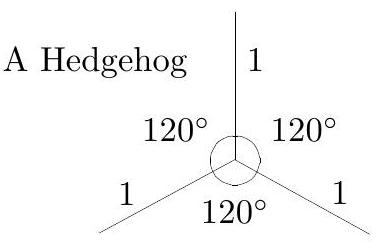
The Wonder Island is inhabited by Hedgehogs. Each Hedgehog consists of three segments of unit length having a common endpoint, with all three angles between them equal to $120^{\circ}$ (see Figure 3). Given that all Hedgehogs are lying flat on the island and no two of them touch each other, prove that there is a finite number of Hedgehogs on Wonder Island.
How many positive integers satisfy the following three conditions:
(i) All digits of the number are from the set $\{1,2,3,4,5\}$;
(ii) The absolute value of the difference between any two consecutive digits is $1$;
(iii) The integer has $1994$ digits?
An equilateral triangle is divided into $9000000$ congruent equilateral triangles by lines parallel to its sides. Each vertex of the small triangles is coloured in one of three colours. Prove that there exist three points of the same colour being the vertices of a triangle with its sides parallel to the sides of the original triangle.