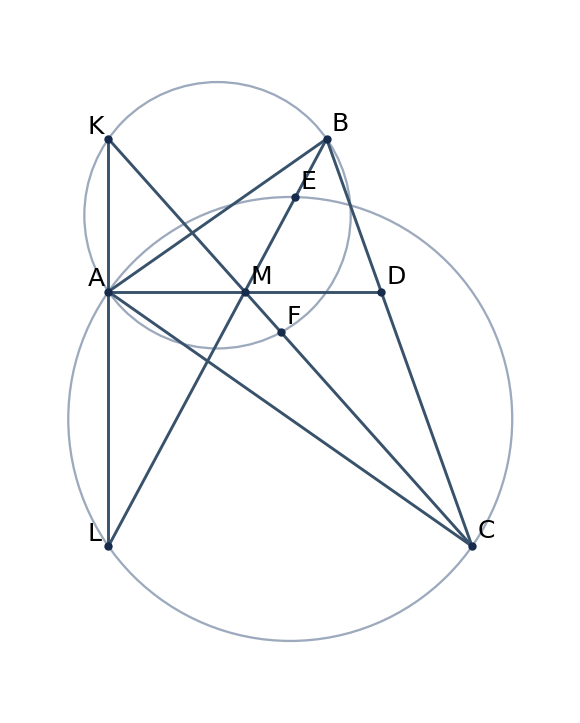
In triangle $ABC$, let $D\in BC$ with $AD$ the internal bisector of $\angle BAC$, and let $M$ be the midpoint of $AD$. Circle $\omega_1$ with diameter $AC$ intersects $BM$ at $E$, and circle $\omega_2$ with diameter $AB$ intersects $CM$ at $F$. Prove that $B,E,F,C$ are concyclic.
Natalie has a copy of the unit interval $[0,1]$ that is colored white. She also has a black marker, and she colors the interval in the following manner: at each step, she selects a value $x \in [0,1]$ uniformly at random, and
a. If $x \leq \frac{1}{2}$ she colors the interval $\left[x, x+\frac{1}{2}\right]$ with her marker.
b. If $x \gt \frac{1}{2}$ she colors the intervals $[x, 1]$ and $\left[0, x-\frac{1}{2}\right]$ with her marker.
What is the expected value of the number of steps Natalie will need to color the entire interval black?
Let $n$ be a positive integer and $a_1,\ldots,a_{n-1}$ arbitrary real numbers. Define $u_0,\ldots,u_n$ and $v_0,\ldots,v_n$ by $u_0=u_1=v_0=v_1=1$ and, for $k=1,\ldots,n-1$,
$$u_{k+1}=u_k+a_ku_{k-1},\qquad v_{k+1}=v_k+a_{n-k}v_{k-1}.$$
Prove that $u_n=v_n$.
Determine all natural numbers $n$ with this property: for every prime $p\lt n$, the number $n-\left\lfloor n/p\right\rfloor p$ is not divisible by the square of any natural number greater than $1$.
A deck of $8056$ cards has $2014$ ranks numbered $1$-$2014$. Each rank has four suits—hearts, diamonds, clubs, and spades. Each card has a rank and a suit, and no two cards have the same rank and the same suit. How many subsets of the set of cards in this deck have cards from an odd number of distinct ranks?
Bob writes a random string of 5 letters, where each letter is either $A$, $B$, $C$, or $D$. The letter in each position is independently chosen, and each of the letters $A$, $B$, $C$, $D$ is chosen with equal probability. Given that there are at least two $A$'s in the string, find the probability that there are at least three $A$'s in the string.
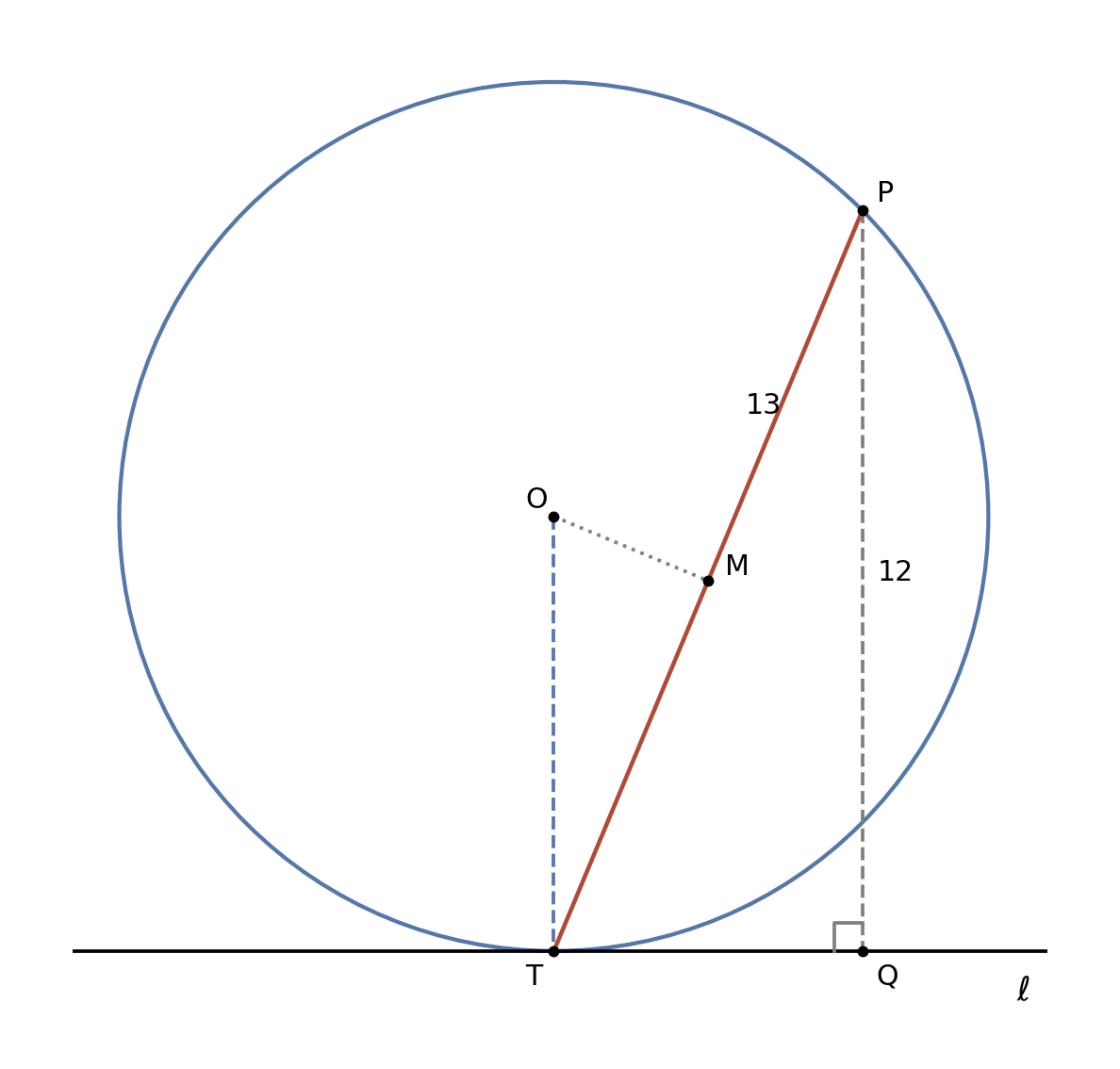
Point $P$ and line $\ell$ are such that the distance from $P$ to $\ell$ is $12$. Given that $T$ is a point on $\ell$ such that $PT = 13$, find the radius of the circle passing through $P$ and tangent to $\ell$ at $T$.
There are 10 people who want to choose a committee of 5 people among them. They do this by first electing a set of $1, 2, 3$, or $4$ committee leaders, who then choose among the remaining people to complete the 5-person committee. In how many ways can the committee be formed, assuming that people are distinguishable? (Two committees that have the same members but different sets of leaders are considered to be distinct.)
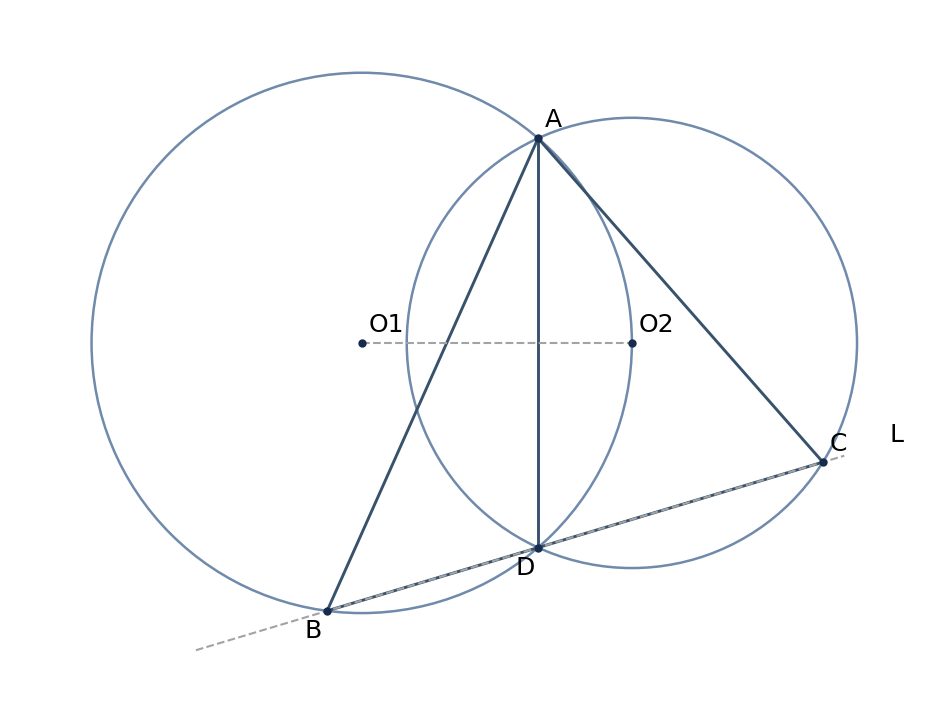
Two circles with centers $O_1,O_2$ and fixed radii $R_1,R_2$ intersect at $A,D$. A line $L$ through $D$ meets them again at $B,C$, respectively. The distance between the centers and the line $L$ may both vary. Find $AD$ when the area of triangle $ABC$ is maximal.
A crazy physicist discovers particles called imons. Some pairs are entangled, and an imon may be entangled with many others. He can perform either operation:
(1) Destroy an imon entangled with an odd number of other imons.
(2) Double the entire family: create a copy $I'$ of each imon $I$. Copies $I',J'$ are entangled exactly when $I,J$ are entangled; each $I'$ is also entangled with $I$. No other entanglements occur or disappear.
Prove that a sequence of operations can leave a family in which no two imons are entangled.
Let $a_i\gt0$ for $i=1,\ldots,n$ and $\sum_{i=1}^n a_i=1$. Prove that for every positive integer $k$,
$$\prod_{i=1}^n\left(a_i^k+\frac1{a_i^k}\right)\ge\left(n^k+\frac1{n^k}\right)^n.$$
Let $x$ be a complex number such that $x + x^{-1}$ is a root of the polynomial $p(t) = t^{3} + t^{2} - 2 t - 1$. Find all possible values of $x^{7} + x^{-7}$.
Let $z$ be a complex number and $k$ a positive integer such that $z^{k}$ is a positive real number other than $1$. Let $f(n)$ denote the real part of the complex number $z^{n}$. Assume the parabola $p(n) = a n^{2} + b n + c$ intersects $f(n)$ four times, at $n = 0, 1, 2, 3$. Assuming the smallest possible value of $k$, find the largest possible value of $a$.
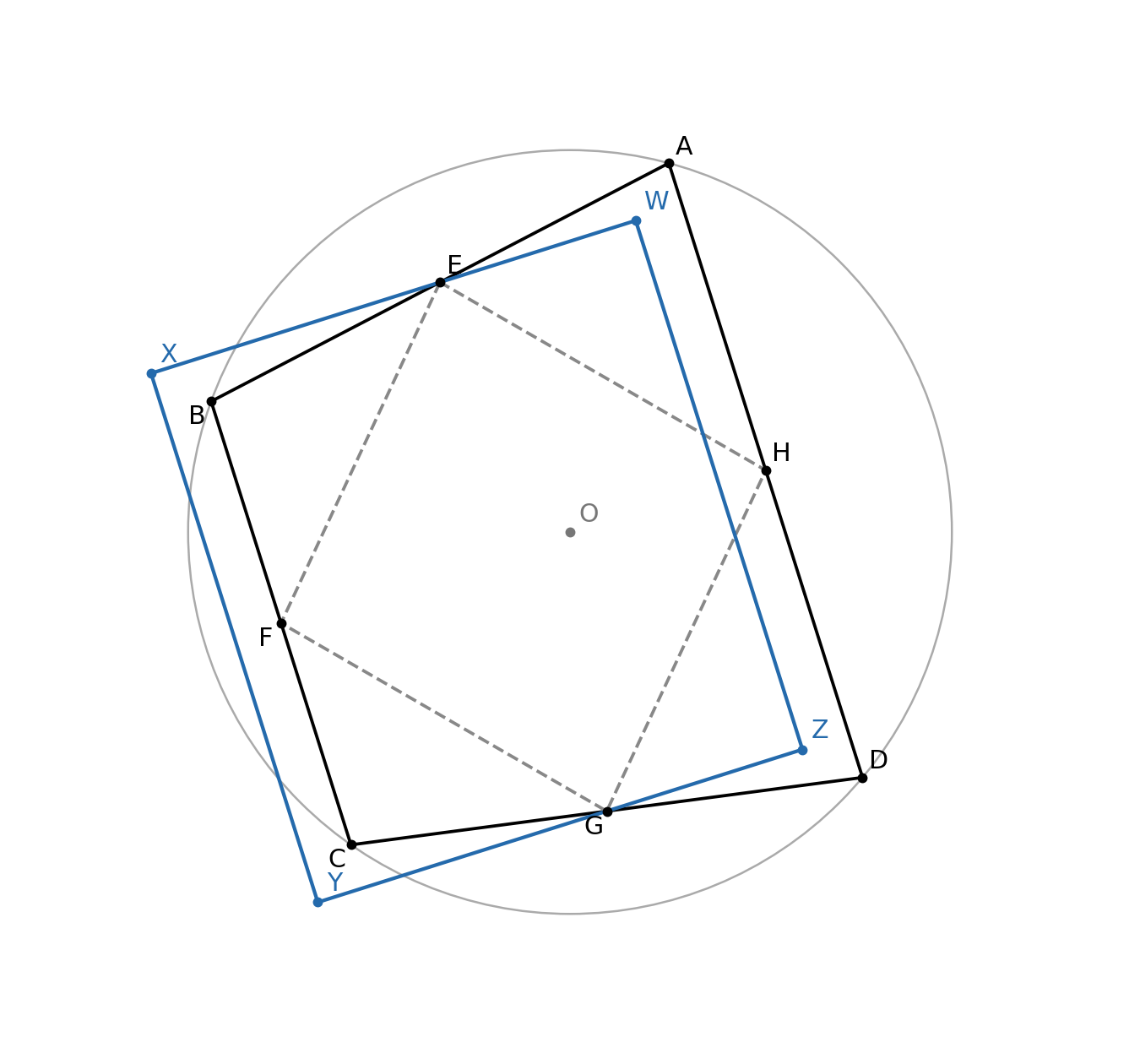
Let $ABCD$ be a cyclic quadrilateral, and let $E, F, G$, and $H$ be the midpoints of $AB, BC, CD$, and $DA$, respectively. Let $W, X, Y$, and $Z$ be the orthocenters of triangles $AHE, BEF, CFG$, and $DGH$, respectively. Prove that quadrilaterals $ABCD$ and $WXYZ$ have the same area.
(This problem was suggested by Zhonghao Ye)
Ten points are equally spaced on a circle. A graph is a set of segments (possibly empty) drawn between pairs of points, so that every two points are joined by either zero or one segments. Two graphs are considered the same if we can obtain one from the other by rearranging the points.
Let $N$ denote the number of graphs with the property that for any two points, there exists a path from one to the other among the segments of the graph. Estimate the value of $N$. If your answer is a positive integer $A$, your score on this problem will be the larger of 0 and $\lfloor 20-5|\ln (A / N)|\rfloor$. Otherwise, your score will be zero.
Given a natural number $n$ and natural numbers $a_1,\ldots,a_n$, extend the sequence periodically by $a_{n+i}=a_i$ for all $i\ge1$. Suppose:
(i) $a_1\le a_2\le\cdots\le a_n\le a_1+n$.
(ii) $a_{a_i}\le n+i-1$ for $i=1,2,\ldots,n$.
Prove $a_1+a_2+\cdots+a_n\le n^2$.