It is given that $\log_{6} a + \log_{6} b + \log_{6} c = 6,$ where $a,$ $b,$ and $c$ are positive integers that form an increasing geometric sequence and $b - a$ is the square of an integer. Find $a + b + c.$
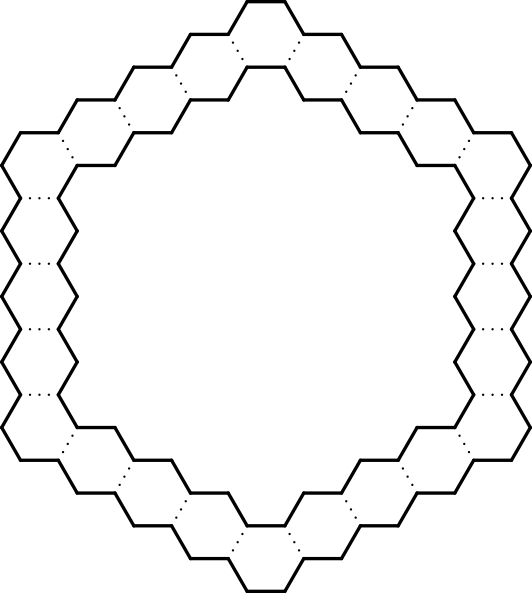
Patio blocks that are regular hexagons $1$ unit on a side are used to outline a garden by placing the blocks edge to edge with $n$ on each side. The diagram indicates the path of blocks around the garden when $n = 5.$
If $n = 202,$ then the area of the garden enclosed by the path, not including the path itself, is $m\left(\frac{\sqrt{3}}{2}\right)$ square units, where $m$ is a positive integer. Find the remainder when $m$ is divided by $1000.$
It is known that, for all positive integers $k,$ $$
\begin{aligned} &1^2 + 2^2 + 3^2 + \cdots + k^2 \\ &= \frac{k(k+1)(2k+1)}{6}. \end{aligned}
$$ Find the smallest positive integer $k$ such that $1^2 + 2^2 + 3^2 + \cdots + k^2$ is a multiple of $200.$
Find the least positive integer $k$ for which the equation $\left\lfloor \frac{2002}{n} \right\rfloor = k$ has no integer solutions for $n.$ (The notation $\lfloor x \rfloor$ means the greatest integer less than or equal to $x.$)
Let $S$ be the set $\{1, 2, 3, \ldots, 10\}.$ Let $n$ be the number of sets of two non-empty disjoint subsets of $S.$ (*Disjoint sets* are defined as sets that have no common elements.) Find the remainder obtained when $n$ is divided by $1000.$
While finding the sine of a certain angle, an absent-minded professor failed to notice that his calculator was not in the correct angular mode. He was lucky to get the right answer. The two least positive real values of $x$ for which the sine of $x$ degrees is the same as the sine of $x$ radians are $\frac{m\pi}{n - \pi}$ and $\frac{p\pi}{q + \pi},$ where $m,$ $n,$ $p,$ and $q$ are positive integers. Find $m + n + p + q.$
Two distinct, real, infinite geometric series each have a sum of $1$ and have the same second term. The third term of one of the series is $\frac{1}{8},$ and the second term of both series can be written in the form $\frac{\sqrt{m} - n}{p},$ where $m,$ $n,$ and $p$ are positive integers and $m$ is not divisible by the square of any prime. Find $100m + 10n + p.$
A basketball player has a constant probability of $0.4$ of making any given shot, independent of previous shots. Let $a_n$ be the ratio of shots made to shots attempted after $n$ shots. The probability that $a_{10} = 0.4$ and $a_n \le 0.4$ for all $n$ such that $1 \le n \le 9$ is given to be $\frac{p^a q^b r}{\left(s^c\right)},$ where $p,$ $q,$ $r,$ and $s$ are primes, and $a,$ $b,$ and $c$ are positive integers. Find $(p + q + r + s)(a + b + c).$
In triangle $ABC,$ point $D$ is on $\overline{BC}$ with $CD = 2$ and $DB = 5,$ point $E$ is on $\overline{AC}$ with $CE = 1$ and $EA = 3,$ $AB = 8,$ and $\overline{AD}$ and $\overline{BE}$ intersect at $P.$ Points $Q$ and $R$ lie on $\overline{AB}$ so that $\overline{PQ}$ is parallel to $\overline{CA}$ and $\overline{PR}$ is parallel to $\overline{CB}.$ It is given that the ratio of the area of triangle $PQR$ to the area of triangle $ABC$ is $\frac{m}{n},$ where $m$ and $n$ are relatively prime positive integers. Find $m + n.$
The perimeter of triangle $APM$ is $152,$ and angle $PAM$ is a right angle. A circle of radius $19$ with center $O$ on $\overline{AP}$ is drawn so that it is tangent to $\overline{AM}$ and $\overline{PM}.$ Given that $OP = \frac{m}{n},$ where $m$ and $n$ are relatively prime positive integers, find $m + n.$
Circles $C_1$ and $C_2$ intersect at two points, one of which is $(9, 6),$ and the product of their radii is $68.$ The $x$-axis and the line $y = mx,$ where $m \gt 0,$ are tangent to both circles. It is given that $m$ can be written in the form $\frac{a\sqrt{b}}{c},$ where $a,$ $b,$ and $c$ are positive integers, $b$ is not divisible by the square of any prime, and $a$ and $c$ are relatively prime. Find $a + b + c.$