Two circles with centres $O_1,O_2$ intersect at $A,B$. Segments $AP_1,AP_2$ are diameters of the two circles. At most how many of these six points can lie on one circle?
In triangle $ABC$, $AB=30$ cm, $AC=32$ cm. Points $D,E,F,G$ lie respectively on $AB,AC,AD,AE$, so that $BCD,CDE,DEF,EFG,FGA$ have equal areas. Find $FD$ in centimetres.
License plates use seven distinct digits and cannot start with zero. Available molds are $0,1,2,3,5,7,9$; the mold for nine may be inverted to make six, so a plate cannot contain both six and nine. The smallest numbers are $1023567,1023576,1023579,\ldots$. Find the seven-thousandth smallest plate number.
You have sufficiently many $2\times5$ and $1\times3$ rectangles. How many integer pairs $(m,n)$, with $2\le n\le m$, give an $m\times n$ rectangle that cannot be tiled without overlap?
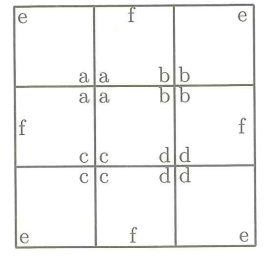
Use each integer from one to nine once in the $3\times3$ table, so the sum in each set of four cells containing an identical letter is the same. Find the central cell’s number.
Five people divide $83$ diamonds, all receiving different shares. All ten pairwise differences of the shares are distinct. Any three people together receive more than half the diamonds. How many diamonds are in the smallest share?
Sixteen dots form a $4\times4$ array. Select as many as possible so that no three selected points are the vertices of an isosceles triangle. Find the largest number selected.
In an increasing sequence of positive integers, terms in odd positions are odd and terms in even positions are even. There are seven such sequences with no term exceeding four: $(1),(3),(1,2),(1,4),(3,4),(1,2,3),(1,2,3,4)$. How many are there with no term exceeding twenty?
A triangle has sides $9,12,15$ cm. Each side is divided into $n$ equal parts, $n\ge2$. Sum the squared distances from all interior partition points to their opposite vertices. If the sum in cm$^2$ is a positive integer, find all possible $n$.
In triangle $ABC$, $BC=a$ cm, $CA=b$ cm, $AB=c$ cm. Points $D,E,F$ lie on $BC,CA,AB$ respectively, with $DE\perp CA$ and $DF\perp AB$. Let $P=BE\cap CF$. If $AP\perp BC$, determine $BD$ in terms of $a,b,c$.