A $6$ cm by $6$ cm square can cover at most $60\%$ of a triangle. When the triangle is placed on the square, it can cover at most $\frac23$ of the square. Find the triangle’s area in square centimetres.
Four consecutive positive integers have the following properties: the smallest is a multiple of $5$, the second of $7$, the third of $9$, and the largest of $11$. Find the minimum possible largest number.
Between five and six o’clock, a lady looked at her watch and mistook the hour hand for the minute hand and vice versa. She thought the time was approximately $55$ minutes earlier. Exactly how many minutes earlier was the mistaken time?
The incircle of triangle $ABC$ touches $BC,CA,AB$ at $D,E,F$ respectively. Its radius is $4$ cm. If the lengths $BD,CE,AF$ in cm are consecutive integers, find the perimeter in cm.
A square has all four vertices on the perimeter of an acute scalene triangle: one on each of two sides and two on the third side. To make the square as large as possible, should the side containing two vertices be the longest, shortest, or neither? Justify your answer.
Put the numbers $1$ to $16$ on the vertices of two cubes, one number per vertex without repetition, so that the four vertices of every face have the same sum.
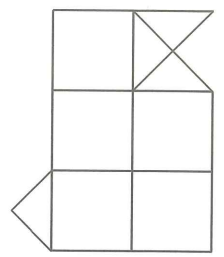
The figure below is a $2\times3$ rectangle with one quarter of its top-right square cut away and attached to its bottom-left square. Cut the figure along a polygonal line into two identical pieces.
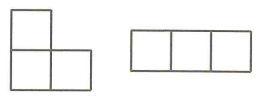
A $1\times1$ cell is removable if deleting it from an $8\times8$ square leaves a figure that can be tiled by $21$ copies of each of the two figures below. How many removable cells are there?
The four-digit number $3025$ is the square of the sum of the number formed by its first two digits and that formed by its last two digits: $(30+25)^2=3025$. Find all other four-digit numbers with this property.
The fraction $\frac14$ has this property: appending the digit $6$ to its numerator $n$ times and prefixing that digit to its denominator $n$ times gives $\frac{166\cdots6}{66\cdots64}=\frac14$ for all $n\ge1$. Its numerator and denominator are single digits, the denominator larger. Find all other such fractions; the repeated digit need not be $6$.