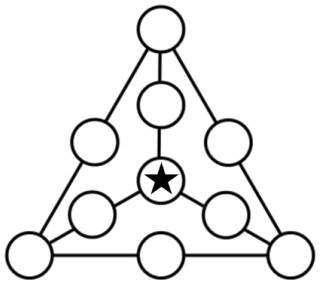
Fill in the ten circles in the following diagram with the numbers from 1 to 10. Each number can be used exactly once. There are six segments such that each segment connects three numbers and the sum of the numbers that lies on each segment are equal. How many possible value that can be fill in the circle with ★ symbol so that all of the requirements hold?
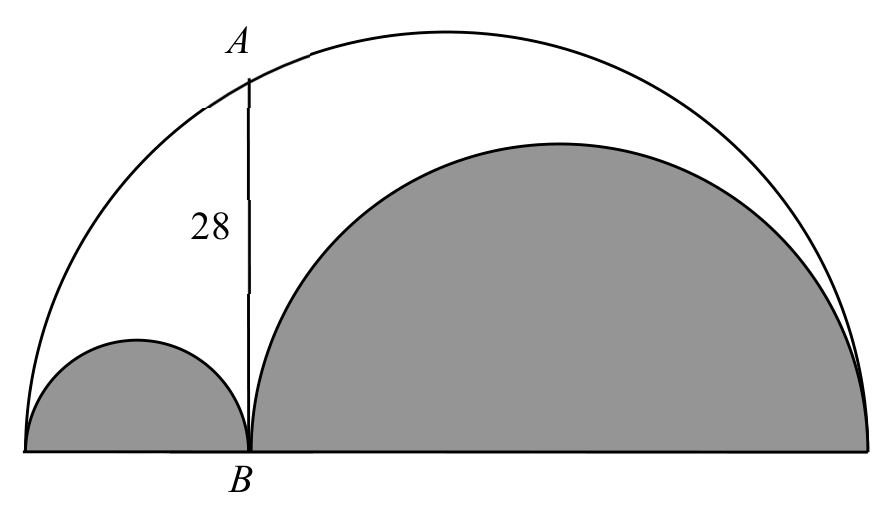
Three semicircles are drawn as in the diagram below. Let AB be a segment which is drawn from the diameter to the circumference of the largest semicircle and tangent to two shaded semicircles. What is the area, in cm², of the largest semicircle that is not covered by the smaller semicircles if the length of AB is 28 cm? (Use $\pi=\frac{22}{7}$)
If a four-digit number, $\overline{abcd}$, is equal to the product of the two-digit number $\overline{ad}$ and the three-digit number $\overline{ada}$, then this four-digit number is called an IMSO number. What is the sum of all possible IMSO numbers?
Consider the sequence of perfect square numbers 1, 4, 9, 16, ... . Now, we add 50 to each of the terms and obtain a new sequence 51, 54, 59, 66, ... , after that, we calculate the greatest common divisor (gcd) of each pair of neighboring numbers, for example 51 has 54 as the neighbor so we calculate gcd(51, 54) = 3, 54 has 51 and 59 as the neighbor so we calculate gcd(51, 54) = 3 and gcd(54, 59)=1, and so on. What is the largest possible gcd value that we can get for this sequence?
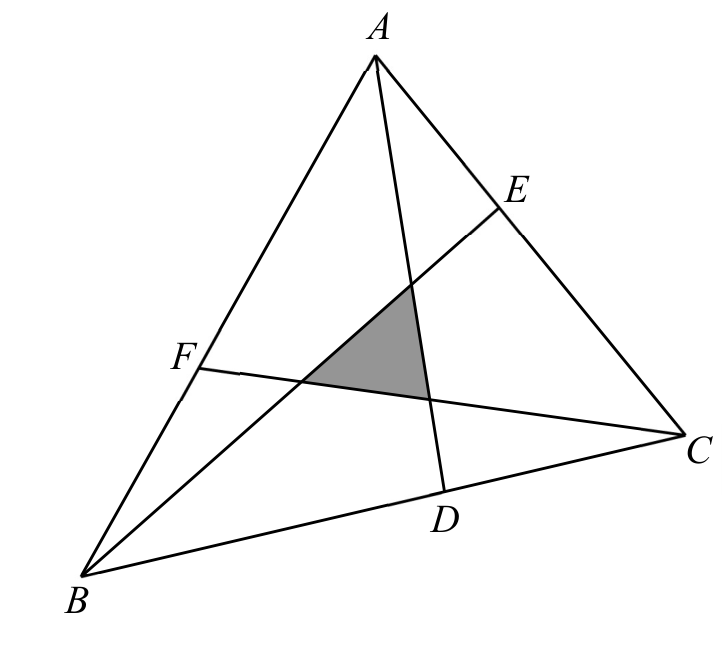
In the triangle ABC, points D, E and F are on $\overline{BC}$, $\overline{CA}$ and $\overline{AB}$, respectively, so that BD : DC = CE : EA = AF : FB = 3 : 2, as shown in the figure. If the area of the shaded area is 100 cm², what is the area, in cm², of the triangle ABC?
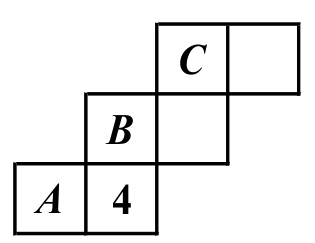
In the diagram below, how many ways are there to colour the diagram using 4 colours (red, yellow, green, and blue) such that no adjacent tiles (square sharing the same side) use the same colour and the colour in A, B, and C are all different?
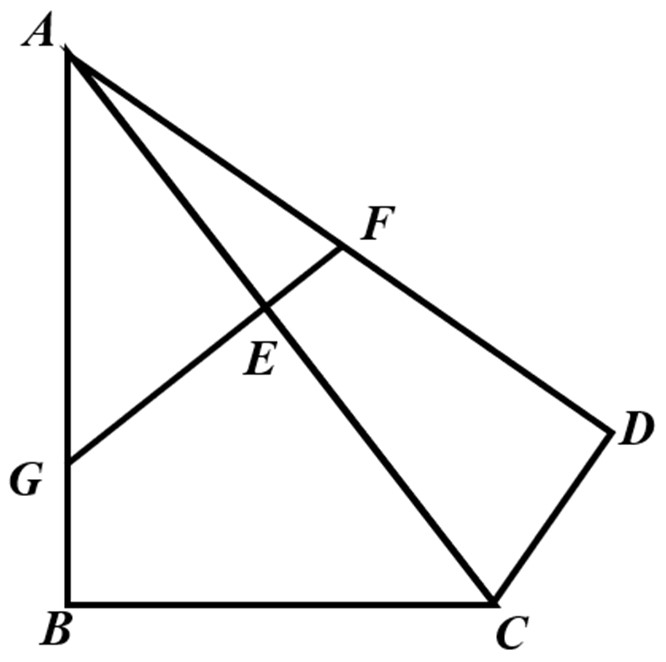
In the diagram, ABC and ACD are right-angled triangles with $\angle ABC=\angle ADC=90^\circ$, AB = 20, BC = 15, and CD = 7. Point E is the intersection of $\overline{AC}$ and $\overline{GF}$, where AE : EC = 2 : 3 and $\overline{AC}$ is perpendicular to $\overline{GF}$. What is the ratio of area BCG to area CEF?
Given an 8 × 8 square grid. For each cell, we can draw 1 diagonal, 2 diagonals or nothing. What is the largest possible number of diagonals that we can draw so that no pair of diagonals share their end point? Give the reason and draw the diagram.
Andy, Benn, Chloe, and Drian want to distribute 14 identical balls among them with following rules:
- Every person must get at least one ball.
- No one can have more balls than the sum of the balls from the other three people.
Asep was given a 2 × 7 grid of unit squares. Two different squares are adjacent if they share a side. How many ways can Asep mark exactly 5 of the squares so that no two marked squares are adjacent?
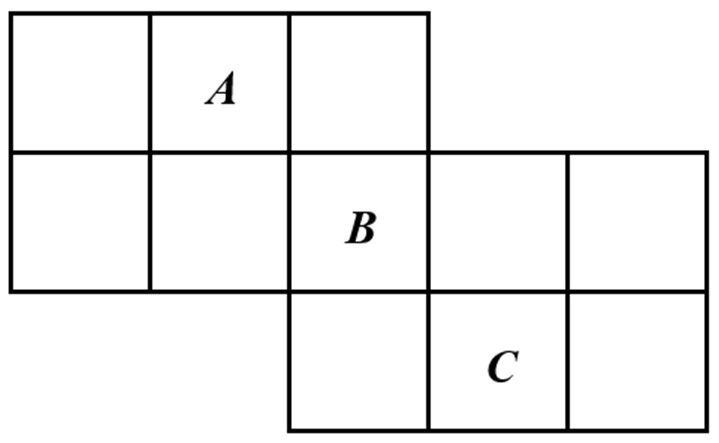
The diagram below is the expanded net of a cube. We label each of the faces of the cube by using the numbers 1, 2, 3, 4, 5, and 6 exactly once, so that the sum of any two opposite faces is always 7. What is the largest possible value of $A\times(B^2+C)$?
The average of 20 numbers is 18. If the first number is increased by 2, the second number is increased by 4, the third number is increased by 6, …, the twentieth number is increased by 40. What is the average of the 20 numbers now?
Twelve consecutive positive integers are written on a board. Maria erases one of the numbers. If the sum of the remaining numbers is 2023, what number did Maria erase?
The left-most digit of a six-digit number is 5. If you remove the left-most digit, the original number is 26 times the new number. What is the sum of the digits of the new number?
Mrs. Anne has two kinds of fruits: apples and oranges. The number of apples is 4 times the number of oranges. If some of the fruits were eaten by the children, then the number of remaining apples is 7 times the number of remaining oranges. What is the smallest possible total number of fruits that Mrs. Anne had at the beginning?
Given that $\frac{a+b+c+d-29}{6}=21$, where a, b, c, and d are positive integers. If $(a+c):(b+d)=2:3$, $a<c$ and $b<d$, then what is the largest possible value of $a+b$?
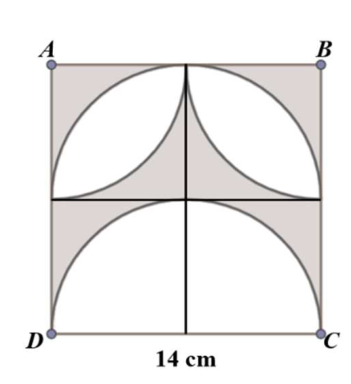
In the diagram, ABCD is a square. If all the arcs in the figure are the arcs of the circles with the same size, what is the area, in $\mathrm{cm}^2$, of the shaded region? (Use $\pi=\frac{22}{7}$.)