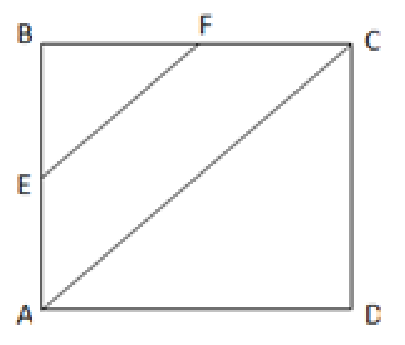
The area of a square $ABCD$ is $36\text{ cm}^2$. Let $E$ be the midpoint of $AB$, and $F$ be the midpoint of $BC$. What is the area of the trapezoid $AEFC$, in $\text{cm}^2$?
Let $P=1\times2\times3\times4\times5\times6\times7\times8\times9\times10\times11\times12\times13\times14\times15$ and $Q=1+2+3+4+5+6+7+8+9+10+11+12+13+14+15$. What is the remainder when $P$ is divided by $Q$?
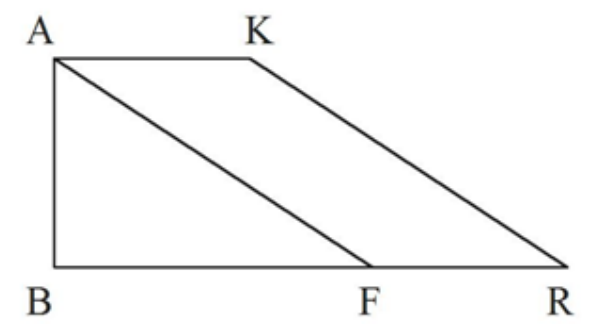
In the figure, angle $ABF$ is a right angle. The area of triangle $ABF$ is equal to the area of parallelogram $FRKA$. The lengths of $AB$, $BF$ and $FA$ are 3 cm, 4 cm and 5 cm respectively. What is the length of $FR$, in cm?
Six bags of marbles contain 18, 19, 21, 23, 25 and 34 marbles, respectively. One bag contains red marbles only. The other five bags contain no red marbles. Jane takes three of the bags and George takes two of the others. Only the bag of red marbles remains. If Jane gets twice as many marbles as George, how many red marbles are there?
One day Joko drove at the average speed of 50 km/hour from his house to his office. He arrived two minutes late. On the next day, he drove to his office at the average speed of 60 km/hour and arrived one minute early. What is the distance between Joko’s house and his office, in km?
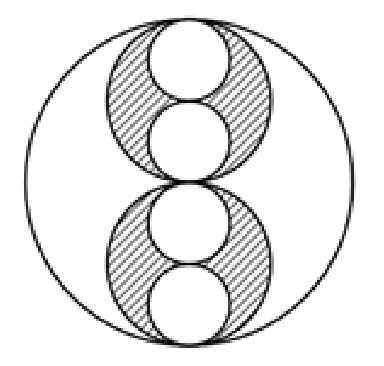
In the figure, the diameter of the largest circle is 28 cm. Two circles of diameter 14 cm are inscribed in it. Two circles of diameter 7 cm are inscribed in each of the circles of diameter 14 cm. What is the area of the shaded region, in $\text{cm}^2$? [Use $\pi=\frac{22}{7}$.]
The ratio of Amin’s money to Budi’s money was $5:4$. They donated a part of their money for charity. Amin’s donation was two times Budi’s donation. After that, each of them had 15 dollars. How much money was donated by Amin?
A solid rectangular iron is put into a cylinder. The solid has a square base of side length 10 cm and height of 15 cm. The diameter and height of the cylinder are 14 cm and 16 cm, respectively. If water fills $\frac34$ of the cylinder, how many $\text{cm}^3$ of water will be spilled out? [Use $\pi=\frac{22}{7}$.]
Siti had 60 green apples and 90 red apples for sale. The cost of every three green apples was 10 dollars, and every five red apples was 8 dollars. She mixed the apples and sold them all. If the selling price of every five mixed apples was 15 dollars, how much profit did Siti get from selling all the apples?
Ary and friends are having dinner together. They agree to share the bill among them. If they contribute 16 dollars each, then they still need 4 dollars more for paying the bill. But, if they contribute 19 dollars each, then the total collected money is enough to pay the bill, give a tip that is 15% of the bill, and pay a parking fee of 2 dollars. How much is the bill?
Peter has a three-digit code for a padlock. He has forgotten the code but he knows that all three digits are different. He also knows that if you divide the first digit by the second digit and then square the result, you get the third digit. Find all three-digit codes having this property.
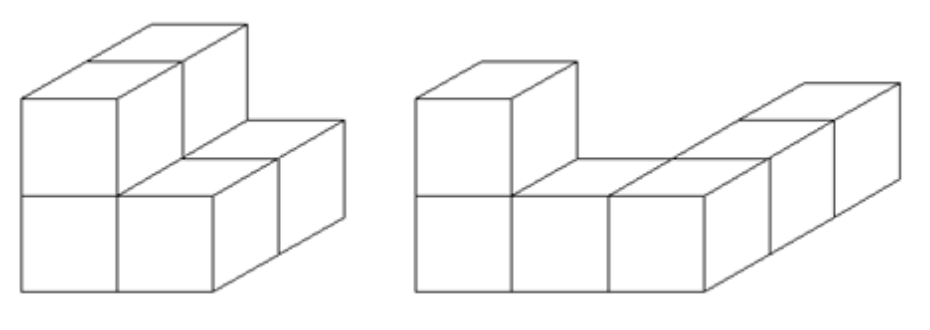
Faces of identical dice are labeled by digits 1, 2, 3, 4, 5 and 6. The digit 1 is opposite the digit 6, the digit 2 is opposite the digit 5, and the digit 3 is opposite digit 4. A three-dimensional shape can be formed by putting together a number of these dice in such a way that only two faces with the same digits are glued. Two dice can be put together either horizontally or vertically. After putting the dice together, the digits on the glued faces cannot be seen anymore. If we put the shape on the floor, the digits on the bottom faces cannot be seen as well. In the figure below we see two examples of the shapes.
Questions:
(a) Construct a shape by putting together three dice, then place it on the floor so that the sum of the visible digits on the side and the top faces of the shape is minimum.
(b) Construct a shape by putting together four dice, then place it on the floor so that the sum of the visible digits on the side and the top faces of the shape is minimum.
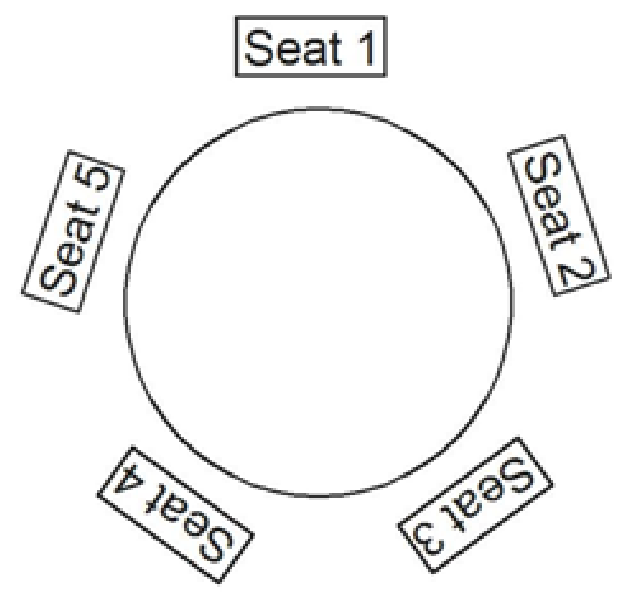
Five scientists, Ms. Anna, Mr. Bill, Ms. Chelsea, Mr. Danny, and Mr. Ewing sit at a round table. Determine where each person sits and what his or her profession is, if:
- Ms. Anna sits in Seat 1.
- Ms. Chelsea, who is not the mathematician, sits next to at least one man.
- Mr. Danny is not the physician.
- The biologist and the physician are both men and sit next to each other.
- The astronomer sits to immediate right of a woman.
- The mathematician sits in Seat 3.
- Mr. Bill, who is not the physician, sits two seats away to the right of the chemist.
| Seat Number | Name of the Scientist | Profession |
|---|---|---|
| 1 | | |
| 2 | | |
| 3 | | |
| 4 | | |
| 5 | | |
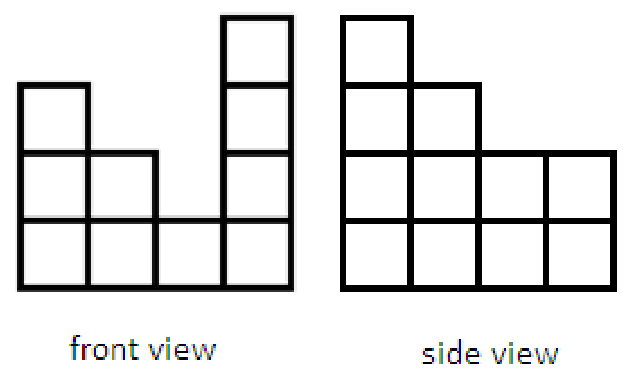
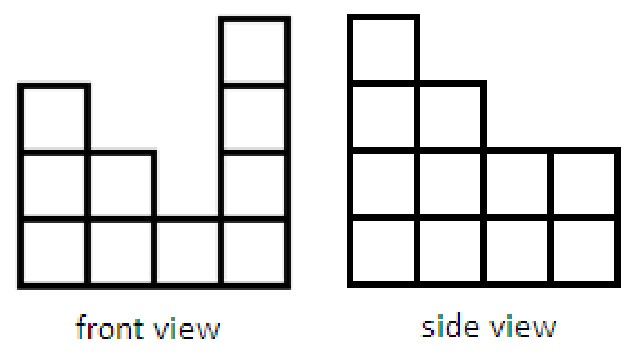
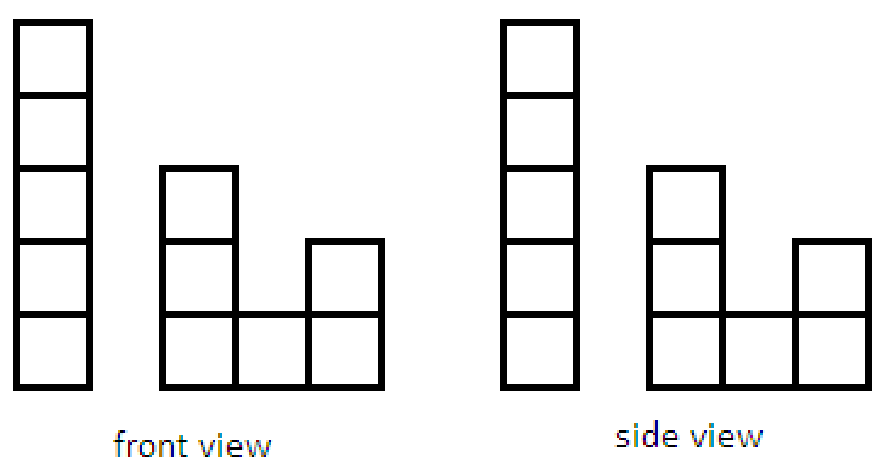
A three-dimensional shape is formed from a number of cubes.
Questions:
(a) What is the maximum number of cubes that may be used to form a shape so that the front view and the side view of the shape follow the figures below?
(b) What is the minimum number of cubes that may be used to form a shape so that the front view and the side view of the shape follow the figures below?
(c) What is the minimum number of cubes that may be used to form a shape so that the front view and the side view of the shape follow the figures below?
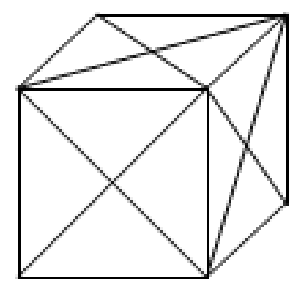
The figure shows a cube with sides of 1 unit length on which all 12 face diagonals have been drawn, creating a network with 14 points (the original eight vertices, plus the six points of intersection of diagonals) and 36 segments (the original 12 edges of the cube plus four extra half diagonal segments on each face). Find a shortest path along the segments of the network which passes through all 14 points.
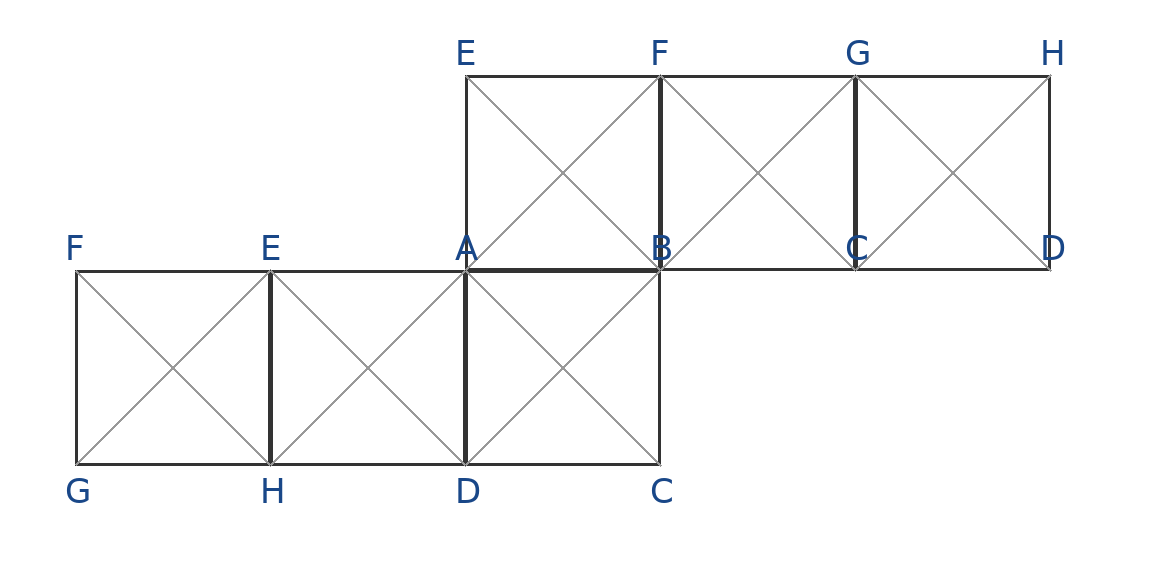
Draw the path that you have found in the given cube net.
An airline has a flight schedule for October 16, 2010, which is shown in the following table.
| Flight no | From airport | To airport | Departure time | Arrival time | Flight time (hour) |
|---:|---|---|---|---|---:|
| 1 | A | B | 5:00 | 7:00 | 2 |
| 2 | A | C | 7:30 | 9:00 | 1.5 |
| 3 | C | A | 9:45 | 11:15 | 1.5 |
| 4 | C | B | 10:30 | 11:30 | 1 |
| 5 | A | C | 12:00 | 13:30 | 1.5 |
| 6 | B | C | 12:15 | 13:15 | 1 |
| 7 | B | A | 12:30 | 14:30 | 2 |
| 8 | C | A | 14:15 | 15:45 | 1.5 |
| 9 | A | D | 16:30 | 17:15 | 0.75 |
| 10 | D | A | 18:00 | 18:45 | 0.75 |
A sequence of non-overlapping flights leaving and returning to airport A in which the airport of arrival of a flight is the same as the airport of departure of the flight succeeding it is called a pairing. A pairing must satisfy the following labor regulations:
1. The maximum of total flying time for one day is 9 hours.
2. The maximum duty time for one day is 12 hours.
The duty time is a period of time which consists of flying time of the first flight, transit time 1, flying time of the second flight, transit time 2, flying time of the third flight, ..., flying time of the $n$th flight $(n\ge2)$.
The transit time between two non-overlapping consecutive flights $x$ and $y$ is the length of time between the arrival time of the flight $x$ and the departure time of the flight $y$.
An example of a pairing is given in the table below.
| Flight | Total flying time (hour) | Duty time (hour) |
|---|---|---|
| 2-3-5-8 | $1.5+1.5+1.5+1.5=6$ | $1.5+0.75$ (transit time 1) $+1.5+0.75$ (transit time 2) $+1.5+0.75$ (transit time 3) $+1.5=8.25$ |
The sequence of flights $1-6$ is not a pairing since it is not returning to airport A. The sequence of flights $6-8$ is not a pairing since it is not starting from airport A. The sequence of flights $1-7-9-10$ is also not a pairing since the duty time is more than 12 hours. Find all possible pairings on October 16, 2010.
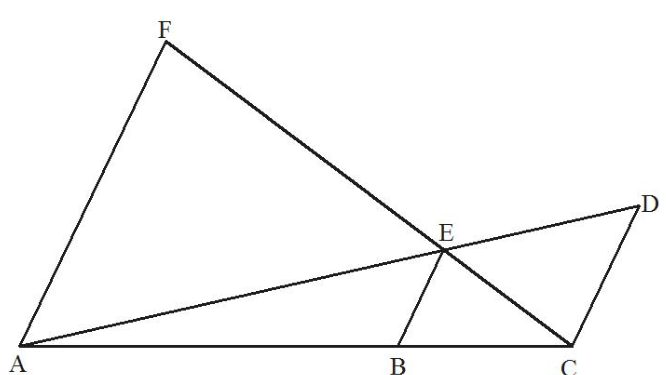
$E$ is the midpoint of side $BC$ of triangle $ABC$. Point $F$ lies on $AC$ and $AC=3FC$. Find the ratio of the area of quadrilateral $ABEF$ to the area of triangle $ABC$.