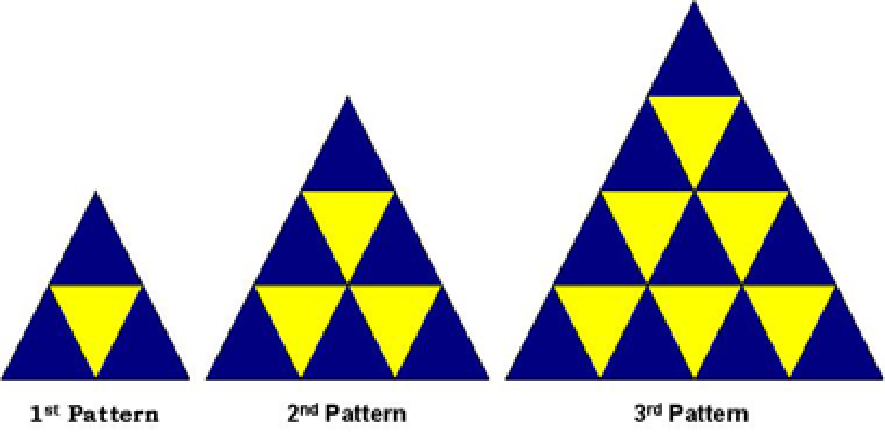
We are given a number of equilateral triangles with lateral length 1 cm. They come in two colors, yellow and blue. Three blue and one yellow triangles can be arranged to make an equilateral triangle of lateral size 2 cm (see 1st Pattern below). Six blue and three yellow triangles are arranged to form an equilateral triangle of lateral size 3 cm (see 2nd Pattern below).
(a) How many blue triangles and yellow triangles are required in the arrangement with lateral length 6 cm?
(b) If you would like to make a similar arrangement to form an equilateral triangle of lateral size 10 cm, how many blue triangles and yellow triangles are needed?
(c) If you would like to make equilateral triangle of lateral size 20 cm, how many blue triangles and yellow triangles are needed?
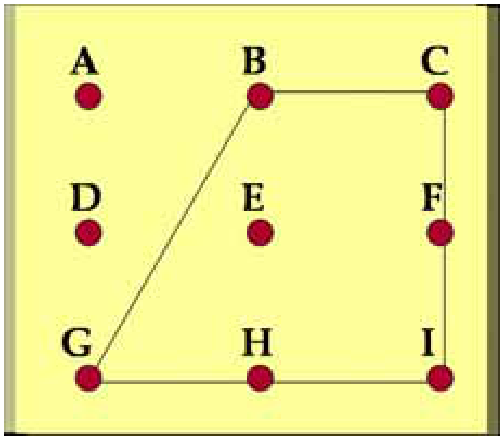
We define a trapezoid as a quadrilateral, which has a pair of parallel laterals; another pair of laterals are not parallel. In the rectangular arrangement below, there are exactly three noncongruent trapezoids. One of them is BCIG.
(a) Find the other two non-congruent trapezoids.
(b) Find the other 7 trapezoids which are congruent to BCIG.
(c) What is the total number of trapezoids that can be made on the arrangement (both congruent and non-congruent, including BCIG)?
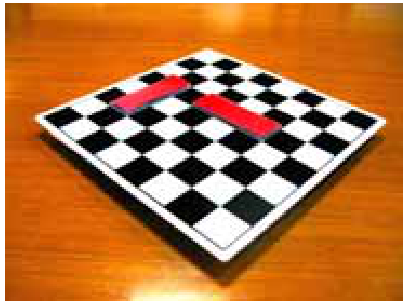
There are 96 distinct ways an I-tromino (1 × 3 rectangular tile) can be positioned on squares of an 8 × 8 chessboard, along the lines of the chessboard. There are 48 vertical positions and 48 horizontal positions. (See picture.)
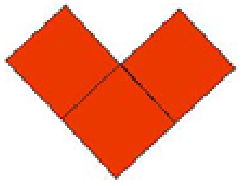
(a) In how many distinct ways can a V-tromino (see picture) be positioned on squares of the chessboard?
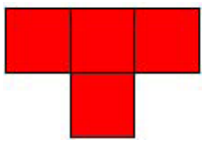
(b) In how many distinct ways can a T-tetramino (see picture) be positioned on squares of the chessboard?
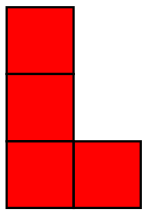
(c) In how many distinct ways can an L-tetramino (see picture) be positioned on squares of the chessboard?
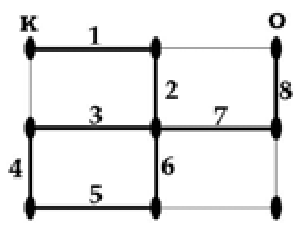
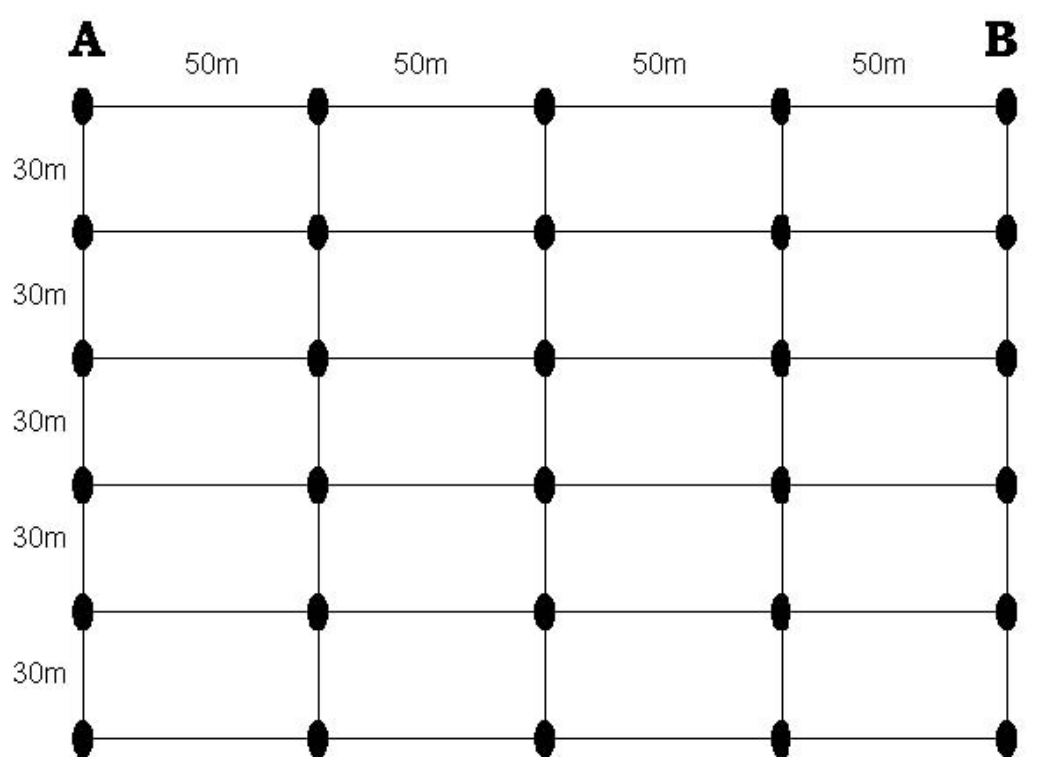
Popon is to deliver newspapers along the streets in his neighborhood. He is paid by the distance he makes, and thus the farther he makes, the higher the pay is. While he can cross any intersection as many times as he likes, he cannot pass any street more than once (a street is one segment between 2 adjacent points).
For example, in a neighborhood which looks like this, Popon is to start from K and to finish at O. To get the highest payment, he takes the longest possible route. One possibility is indicated by 1-2-3-4-5-6-7-8 in the figure below.
If the neighborhood looks like the following picture, what is the longest possible route from A to B? Trace and indicate the route by writing numbers 1, 2, 3, ... on the streets of the route.
Diagram labels: each horizontal street is 50 m; each vertical street is 30 m.
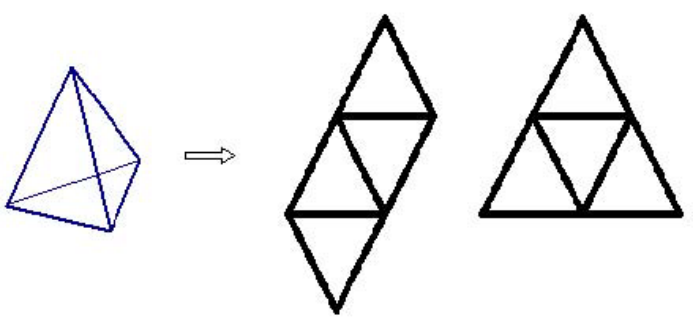
The following figures show a triangular pyramid and some of its nets.
You are given 3 sheets of graph paper to work on (you may not use them all), and one sheet of pink paper. You are asked to draw the largest cube net on the graph paper, such that the cube net fits the pink paper.
Two people play a game with marbles in a box. They alternate turns. Each person can take one or two marbles at a time. The loser is the person who takes the last marble.
On your turn, how many marbles will you take to be sure of winning if there are:
(a) 6 marbles left;
(b) 8 marbles left;
(c) 20 marbles left?
(d) Change the rule: there are 100 marbles and each player can take 1, 2, 3 or 4 marbles per turn. You play first. How many marbles will you take to be sure of winning?
Explain how your strategy responds to the other player's later moves.
Now we are in the year 2004. The ratio of ages of my father, my mother, and my younger brother is $12:9:1$. Five years from now, my father will be 41 years old. In what year was my younger brother born?
Laila's savings in a bank is 100 dollars. Tina's savings is 40 dollars. Every end of the week, Laila withdraws 3 dollars from her savings. At the same time, Tina always deposits 2.40 dollars into her savings. After how many weeks will Laila's savings be 6 dollars more than Tina's savings?
On the table, there are 6 coins each of the values 5, 10, and 50 dollars. Deni takes 75 dollars. The number of coins Deni takes is more than 5, but less than 9. Does Deni take all three types of coins? If not, which type does he not take?
The weight of a small box, two medium boxes and a large box altogether is 10 kg. The weight of a small box, two medium boxes and two large boxes altogether is 15 kg. What is the total weight of two small boxes and four medium boxes?
Replace the letter $A$ with an odd digit and the letter $B$ with an even digit, so that 12 is a factor of the number $A579B$. Find all possible values of $A579B$.
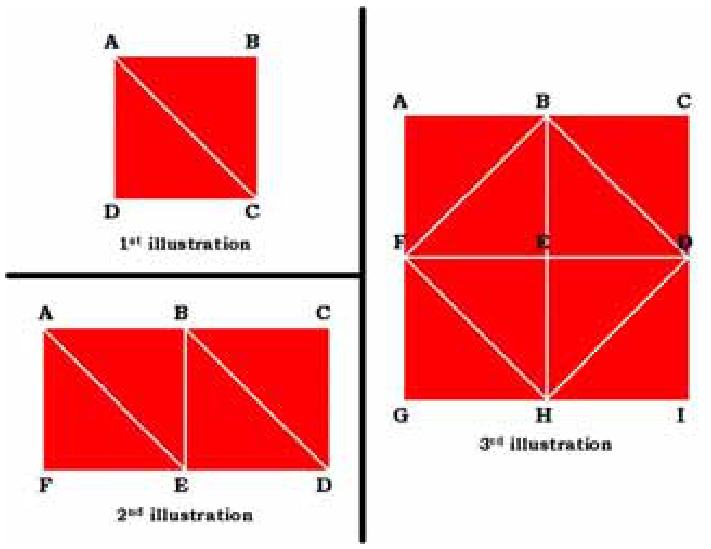
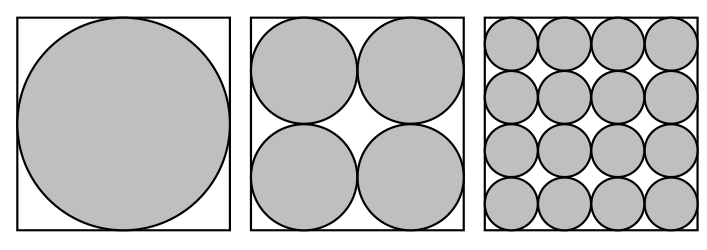
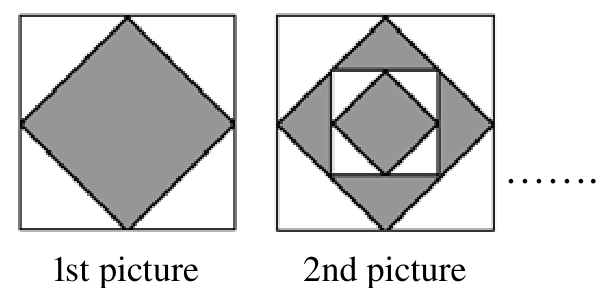
If the pattern below is continued, what is the percentage of the area of the shaded regions in the third picture compared to the area of the largest square?