Teams $T_1,$ $T_2,$ $T_3,$ and $T_4$ are in the playoffs. In the semifinal matches, $T_1$ plays $T_4,$ and $T_2$ plays $T_3.$ The winners of those two matches will play each other in the final match to determine the champion. When $T_i$ plays $T_j,$ the probability that $T_i$ wins is $\frac{i}{i+j},$ and the outcomes of all the matches are independent. The probability that $T_4$ will be the champion is $\frac{p}{q},$ where $p$ and $q$ are relatively prime positive integers. Find $p + q.$
A triangle has vertices $A(0, 0),$ $B(12, 0),$ and $C(8, 10).$ The probability that a randomly chosen point inside the triangle is closer to vertex $B$ than to either vertex $A$ or vertex $C$ can be written as $\frac{p}{q},$ where $p$ and $q$ are relatively prime positive integers. Find $p + q.$
A set contains four numbers. The six pairwise sums of distinct elements of the set, in no particular order, are $189,$ $320,$ $287,$ $234,$ $x,$ and $y.$ Find the greatest possible value of $x + y.$
Find the number of integer values of $k$ in the closed interval $[-500, 500]$ for which the equation $\log(kx) = 2\log(x + 2)$ has exactly one real solution.
Find the number of positive integers $n$ less than $2017$ such that $$
\begin{aligned} &1 + n + \frac{n^2}{2!} + \frac{n^3}{3!} + \frac{n^4}{4!} \\ &{}+ \frac{n^5}{5!} + \frac{n^6}{6!} \end{aligned}
$$ is an integer.
A special deck of cards contains $49$ cards, each labeled with a number from $1$ to $7$ and colored with one of seven colors. Each number-color combination appears on exactly one card. Sharon will select a set of eight cards from the deck at random. Given that she gets at least one card of each color and at least one card with each number, the probability that Sharon can discard one of her cards and *still* have at least one card of each color and at least one card with each number is $\frac{p}{q},$ where $p$ and $q$ are relatively prime positive integers. Find $p + q.$
Rectangle $ABCD$ has side lengths $AB = 84$ and $AD = 42.$ Point $M$ is the midpoint of $\overline{AD},$ point $N$ is the trisection point of $\overline{AB}$ closer to $A,$ and point $O$ is the intersection of $\overline{CM}$ and $\overline{DN}.$ Point $P$ lies on the quadrilateral $BCON,$ and $\overline{BP}$ bisects the area of $BCON.$ Find the area of $\triangle CDP.$
Five towns are connected by a system of roads. There is exactly one road connecting each pair of towns. Find the number of ways there are to make all the roads one-way in such a way that it is still possible to get from any town to any other town using the roads (possibly passing through other towns on the way).
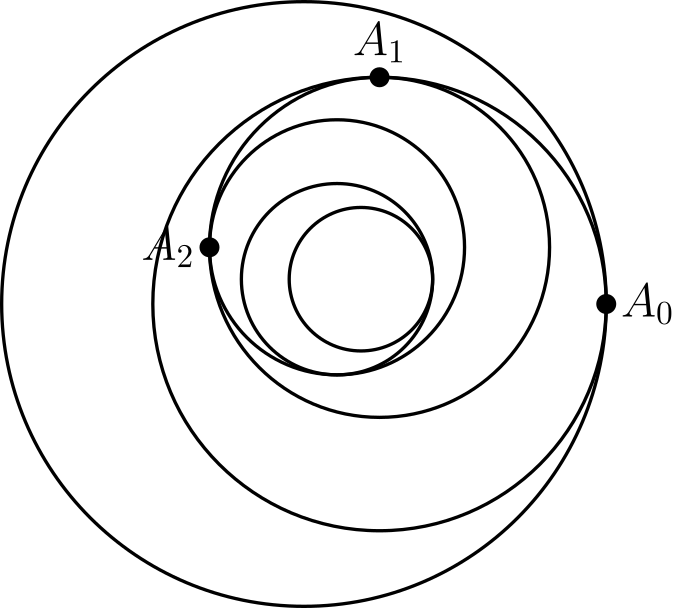
Circle $C_0$ has radius $1,$ and the point $A_0$ is a point on the circle. Circle $C_1$ has radius $r \lt 1$ and is internally tangent to $C_0$ at point $A_0.$ Point $A_1$ lies on circle $C_1$ so that $A_1$ is located $90^\circ$ counterclockwise from $A_0$ on $C_1.$ Circle $C_2$ has radius $r^2$ and is internally tangent to $C_1$ at point $A_1.$ In this way a sequence of circles $C_1,$ $C_2,$ $C_3,$ $\ldots$ and a sequence of points on the circles $A_1,$ $A_2,$ $A_3,$ $\ldots$ are constructed, where circle $C_n$ has radius $r^n$ and is internally tangent to circle $C_{n-1}$ at point $A_{n-1},$ and point $A_n$ lies on $C_n$ $90^\circ$ counterclockwise from point $A_{n-1},$ as shown in the figure below. There is one point $B$ inside all of these circles. When $r = \frac{11}{60},$ the distance from the center of $C_0$ to $B$ is $\frac{m}{n},$ where $m$ and $n$ are relatively prime positive integers. Find $m + n.$
For each integer $n \ge 3,$ let $f(n)$ be the number of $3$-element subsets of the vertices of a regular $n$-gon that are the vertices of an isosceles triangle (including equilateral triangles). Find the sum of all values of $n$ such that $f(n+1) = f(n) + 78.$
A $10 \times 10 \times 10$ grid of points consists of all points in space of the form $(i, j, k),$ where $i,$ $j,$ and $k$ are integers between $1$ and $10,$ inclusive. Find the number of different lines that contain exactly $8$ of these points.
Tetrahedron $ABCD$ has $AD = BC = 28,$ $AC = BD = 44,$ and $AB = CD = 52.$ For any point $X$ in space, define $f(X) = AX + BX$ $+ CX + DX.$ The least possible value of $f(X)$ can be expressed as $m\sqrt{n},$ where $m$ and $n$ are positive integers, and $n$ is not divisible by the square of any prime. Find $m + n.$
Fifteen distinct points are designated on $\triangle ABC:$ the $3$ vertices $A,$ $B,$ and $C;$ $3$ other points on side $\overline{AB};$ $4$ other points on side $\overline{BC};$ and $5$ other points on side $\overline{CA}.$ Find the number of triangles with positive area whose vertices are among these $15$ points.
When each of $702,$ $787,$ and $855$ is divided by the positive integer $m,$ the remainder is always the positive integer $r.$ When each of $412,$ $722,$ and $815$ is divided by the positive integer $n,$ the remainder is always the positive integer $s \neq r.$ Find $m + n + r + s.$
For a positive integer $n,$ let $d_n$ be the units digit of $1 + 2 + 3 + \cdots + n.$ Find the remainder when $$
\sum_{n=1}^{2017} d_n
$$ is divided by $1000.$
A pyramid has a triangular base with side lengths $20,$ $20,$ and $24.$ The three edges of the pyramid from the three corners of the base to the fourth vertex of the pyramid all have length $25.$ The volume of the pyramid is $m\sqrt{n},$ where $m$ and $n$ are positive integers, and $n$ is not divisible by the square of any prime. Find $m + n.$
A rational number written in base eight is $\underline{a}\,\underline{b}.\underline{c}\,\underline{d},$ where all digits are nonzero. The same number in base twelve is $\underline{b}\,\underline{b}.\underline{b}\,\underline{a}.$ Find the base-ten number $\underline{a}\,\underline{b}\,\underline{c}.$