Find all such functions $f: \mathbb{R} \rightarrow \mathbb{R}$ such that for any real $x, y$ the following equality holds:
$$
f(x + y f(x + y)) = f(y^2) + x f(y) + f(x).
$$
The country has $n \ge 3$ airports, some pairs of which are connected by bidirectional flights. Every day, the government closes the airport from which the largest number of flights is flying. What is the maximum number of days this can continue?
You are given a set of $m$ positive integers such that they all give distinct remainders modulo some positive integer $n$. Prove that for any positive integer $k \leq m$ this set can be partitioned into $k$ nonempty subsets such that the sums of the numbers in these subsets are also distinct modulo $n$.
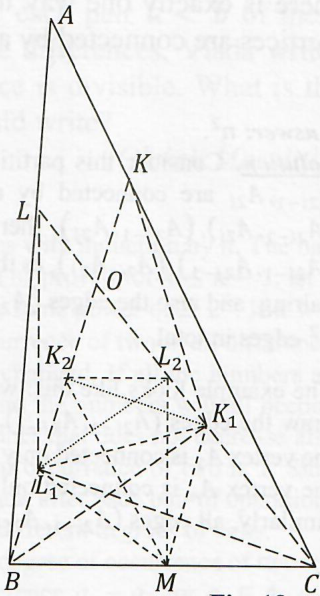
Inside the triangle $ABC$ there exists a point $O$ such that $\angle BOC = 90^\circ - \angle BAC$. The rays $BO$ and $CO$ intersect the sides $AC$ and $AB$ at the points $K$ and $L$ respectively. The points $K_1$ and $L_1$ are selected on the segments $LC$ and $BK$ respectively, so that $BK_1 = K_1K$ and $CL_1 = L_1L$. Let $M$ be the midpoint of the side $BC$. Prove that $\angle K_1ML_1$ is a right angle.
You are given $n \ge 2$ distinct positive integers. A pair of integers is called *elegant* if their sum is $2^k$ for some positive integer $k$. For each $n$ find the largest possible number of *elegant* pairs.
(Oleksii Masalitin)
What is the maximum possible number of edges in a graph with $2n$ vertices, if there is exactly one way to divide its vertices into $n$ pairs such that in each pair the vertices are connected by an edge?
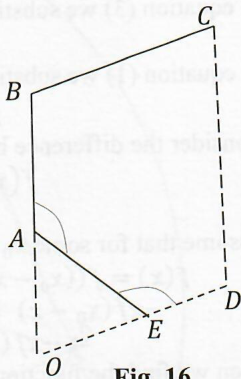
In a convex pentagon $ABCDE$ the following conditions are satisfied: $AB \parallel CD$, $BC \parallel DE$ and $\angle BAE = \angle AED$. Prove that $AB + BC = CD + DE$.
Let $P(x)$, $Q(x)$ and $R(x)$ be polynomials with integer coefficients such that the equality $P(x) = Q(x)R(x)$ holds. We denote by $a$ and $b$ the maximum of the absolute values of the coefficients of the polynomials $P(x)$ and $Q(x)$ respectively. Does the condition $b \le 2023a$ always hold?
You are given $n \ge 2$ distinct positive integers. For each pair $a \lt b$ of these numbers, consider the difference $b - a$. For each of these differences, Vlada writes down the maximum power of two by which this difference is divisible. What is the largest possible number of distinct numbers that Vlada could write?
(Oleksii Masalitin)
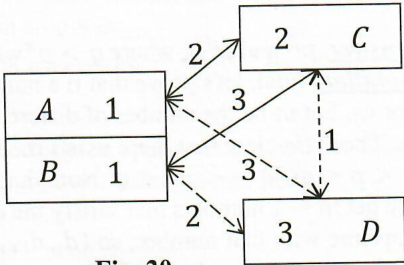
Consider a complete graph with 4046 vertices whose edges are colored in some colors. We call the graph $k$-good if all the vertices of the graph can be divided into 2023 pairs in such a way that among the colors of the 2023 edges connecting the vertices in the pairs there are exactly $k$ distinct colors. Is it possible that the graph is 999-good and 1001-good, but not 1000-good?
We call a polynomial *mixed* if it has both positive and negative coefficients (we do not consider zero to be either positive or negative). Is it true that the product of two mixed polynomials is always a mixed polynomial?
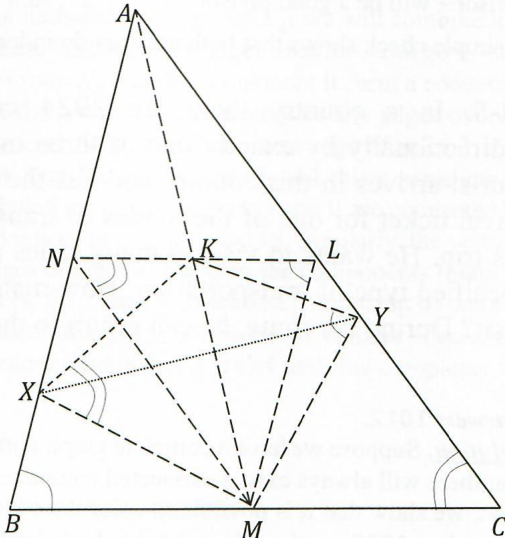
Let $K$ be the midpoint of the median $AM$ of the triangle $ABC$. On the side $AB$ there is a point $X$ such that $\angle KXM = \angle ACB$ and $AX \gt BX$, and on the side $AC$ there is a point $Y$ such that $\angle KYM = \angle ABC$ and $AY \gt CY$. Prove that the points $B, X, C, Y$ lie on the same circle.
For a positive integer $n$ we write out all its divisors $1 = d_1 \lt d_2 \lt \cdots \lt d_k = n$. A divisor $d_i$, $2 \le i \le k-1$, is called a good divisor if $d_{i-1}d_{i+1}$ is not divisible by $d_i$. Find all $n$ for which the number of their good divisors is smaller than the number of their different prime divisors.
In a country there are $2024$ cities, each two of which are connected bidirectionally by exactly one of three modes of transportation: rail, air, or road. A tourist arrives in this country and has the entire transportation scheme. He chooses a travel ticket for one of the modes of transportation and the city from which he starts his trip. He wants to visit as many cities as possible but using only the ticket for the specified type of transportation. How many cities is the tourist guaranteed to be able to visit? During the route, he can return to the cities he has already visited.
For a natural number $n \ge 2$, consider an $n \times n$ board. Let $n^2$ points denote the centers of each of the $1 \times 1$ squares on this board. What is the largest number of these points that can be marked in such a way that no three marked points form the vertices of a right triangle?
*(Mykhailo Shtandenko)*
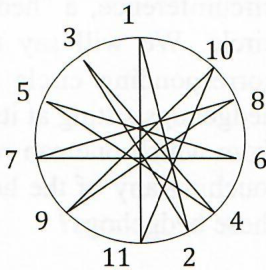
11 points are given on a circle. Petryk numbered them with the numbers $1, 2, \ldots, 11$. After that, pairs of points were connected by segments: $1$ and $2$, $2$ and $3$, $\ldots$, $10$ and $11$, $11$ and $1$. What is the largest possible number of intersection points of these segments? The given 11 points are not counted as intersection points.
Find the integer closest to the value of the expression:
$$
((7 + \sqrt{48})^{2023} + (7 - \sqrt{48})^{2023})^2 - ((7 + \sqrt{48})^{2023} - (7 - \sqrt{48})^{2023})^2.
$$