Five spheres of radius $r$ are inside a right circular cone. Four of the spheres lie on the base of the cone. Each touches two of the others and the sloping sides of the cone. The fifth sphere touches each of the other four and also the sloping sides of the cone. Find the volume of the cone.
Any positive integer $n$ can be written in the form $n = 2^b(2c + 1)$. We call $2c + 1$ the *odd part of* $n$. Given an odd integer $n \gt 0$, define the sequence $a_0, a_1, a_2, \ldots$ as follows: $a_0 = 2^n - 1$, $a_{k+1}$ is the odd part of $3a_k + 1$. Find $a_n$.
The angles of the triangle $ABC$ satisfy $\frac{\angle A}{\angle C} = \frac{\angle B}{\angle A} = 2$. The incenter is $O$. $K$, $L$ are the excenters of the excircles opposite $B$ and $A$ respectively. Show that triangles $ABC$ and $OKL$ are similar.
Let $p$ be a permutation of the set $S_{n} = \{1, 2, \ldots, n\}$. An element $j \in S_{n}$ is called a fixed point of $p$ if $p(j) = j$. Let $f_{n}$ be the number of permutations having no fixed points, and $g_{n}$ be the number with exactly one fixed point. Show that $\left|f_{n} - g_{n}\right| = 1$.
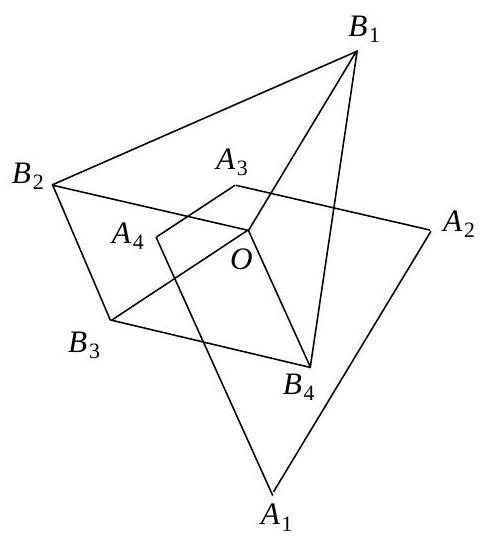
In the diagram, $OB_{i}$ is parallel and equal in length to $A_{i}A_{i+1}$ for $i=1,2,3$ and $4$ ($A_{5}=A_{1}$). Show that the area of $B_{1}B_{2}B_{3}B_{4}$ is twice that of $A_{1}A_{2}A_{3}A_{4}$.
The altitudes of a tetrahedron $ABCD$ are extended externally to points $A'$, $B'$, $C'$ and $D'$ respectively, where $AA' = k / h_a$, $BB' = k / h_b$, $CC' = k / h_c$ and $DD' = k / h_d$. Here, $k$ is a constant and $h_a$ denotes the length of the altitude of $ABCD$ from vertex $A$, etc. Prove that the centroid of the tetrahedron $A'B'C'D'$ coincides with the centroid of $ABCD$.
Let $\mathbb{R}^n$ be the $n$-dimensional Euclidean space. Determine the smallest number $g(n)$ of points of a set in $\mathbb{R}^n$ such that every point in $\mathbb{R}^n$ is at irrational distance from at least one point in that set.
A real number is assigned to each unit square in an infinite sheet of squared paper. Show that some cell contains a number that is less than or equal to at least four of its eight neighbors.
Let $\{a\}$ denote the difference between $a$ and the nearest integer. For example $\{3.8\} = 0.2$, $\{-5.4\} = 0.4$. Show that
$$
\{a\}\{2a\}\{3a\}\ldots\{na\} \geq \frac{\{a\}^n}{2^n}
$$
$\{a\}_1, \{a\}_2, \ldots, \{a\}_{1982}$ is a permutation of $1, 2, \ldots, 1982$. If $\{a\}_1 \gt \{a\}_2$, we swap $\{a\}_1$ and $\{a\}_2$. Then if$\,$(the new)$\, \{a\}_2 \gt \{a\}_3$ we swap $\{a\}_2$ and $\{a\}_3$. And so on. After $1981$ potential swaps we have a new permutation $\{b\}_1, \{b\}_2, \ldots, \{b\}_{1982}$. We then compare $\{b\}_{1982}$ and $\{b\}_{1981}$. If $\{b\}_{1981} \gt \{b\}_{1982}$, we swap them. We then compare $\{b\}_{1980}$ and (the new) $\{b\}_{1981}$. So we arrive finally at $\{c\}_1, \{c\}_2, \ldots, \{c\}_{1982}$. We find that $\{a\}_{100} = \{c\}_{100}$. What value is $\{a\}_{100}$?
The circle $C$ has center $O$ and radius $r$ and contains the points $A$ and $B$. The circle $C'$ touches the rays $OA$ and $OB$ and has center $O'$ and radius $r'$. Find the area of the quadrilateral $OAOB$.