Define a sequence $(a_n)$ as follows
$$
\begin{cases} a_1 = 1, \\ a_{n+1} = 3 - \frac{a_n + 2}{2^{a_n}} \quad \text{for } n \ge 1. \end{cases}
$$
Prove that this sequence has a finite limit and find this limit.
Let $ABC$ be a triangle with $AC \gt AB$. Let a circle $\omega$ tangent to the sides $AB$ and $AC$ at $D$ and $E$ respectively, intersects the circumcircle of $ABC$ at $K$ and $L$ and $X$ and $Y$ be points on the sides $AB$ and $AC$ respectively, such that
$$
\frac{AX}{AB} = \frac{CE}{BD + CE} \quad \text{and} \quad \frac{AY}{AC} = \frac{BD}{BD + CE}.
$$
Show that the lines $XY$, $BC$ and $KL$ are concurrent.
The circle $\omega_1$ with diameter $[AB]$ and the circle $\omega_2$ with center $A$ intersect at points $C$ and $D$. Let $E$ be a point on the circle $\omega_2$, which is outside $\omega_1$ and at the same side with $C$ with respect to the line $AB$. Let the second point of intersection of the line $BE$ with $\omega_2$ be $F$. Suppose that a point $K \in \omega_1$ is on the same side with $A$ with respect to the diameter of $\omega_1$ passing through $C$ and $2 \cdot CK \cdot AC = CE \cdot AB$. Let the second point of intersection of the line $KF$ with $\omega_1$ be $L$. Show that a point symmetric to $D$ with respect to the line $BE$ lies on the circumcircle of the triangle $LFC$.
Alice chooses an odd number $k = 2l+1$, places $k$ plates around a circle and distributes 2013 beads into some of these plates as she wishes. After that Bob marks one of the plates. Determine the maximal possible value of $N$ such that no matter how Bob marks a plate Alice can choose exactly $l$ unmarked non-neighbouring plates containing at least $N$ beads in total.
For a positive integer $n \ge 3$ plot $n$ equally spaced points around a circle. Label one of them $A$, and place a marker at $A$. One may move the marker forward in a clockwise direction to either the next point or the point after that. Hence there are a total of $2n$ distinct moves available; two from each point. Let $a_n$ count the number of ways to advance around the circle exactly twice, beginning and ending at $A$, without repeating a move. Prove that $a_{n-1} + a_n = 2^n$ for all $n \ge 4$.
(This problem was suggested by Sam Vandervelde.)
Let $\omega$ be the incircle of a triangle $ABC$ with $\omega$ tangent to $BC$ and $AC$ at the points $D$ and $E$, respectively. Draw a line perpendicular to $BC$ at $D$ to meet the circle $\omega$ at a point $P$ closer to $A$. The line $AP$ meets $BC$ at $M$. Let $N$ be a point on the segment $AC$ such that $AE = CN$, whereas
$BN$ intersects the circle $\omega$ at a point $Q$ closer to $B$ and intersects $AM$ at the point $R$. Show that the area of the triangle $ABR$ is equal to the area of the quadrilateral $PQMN$.
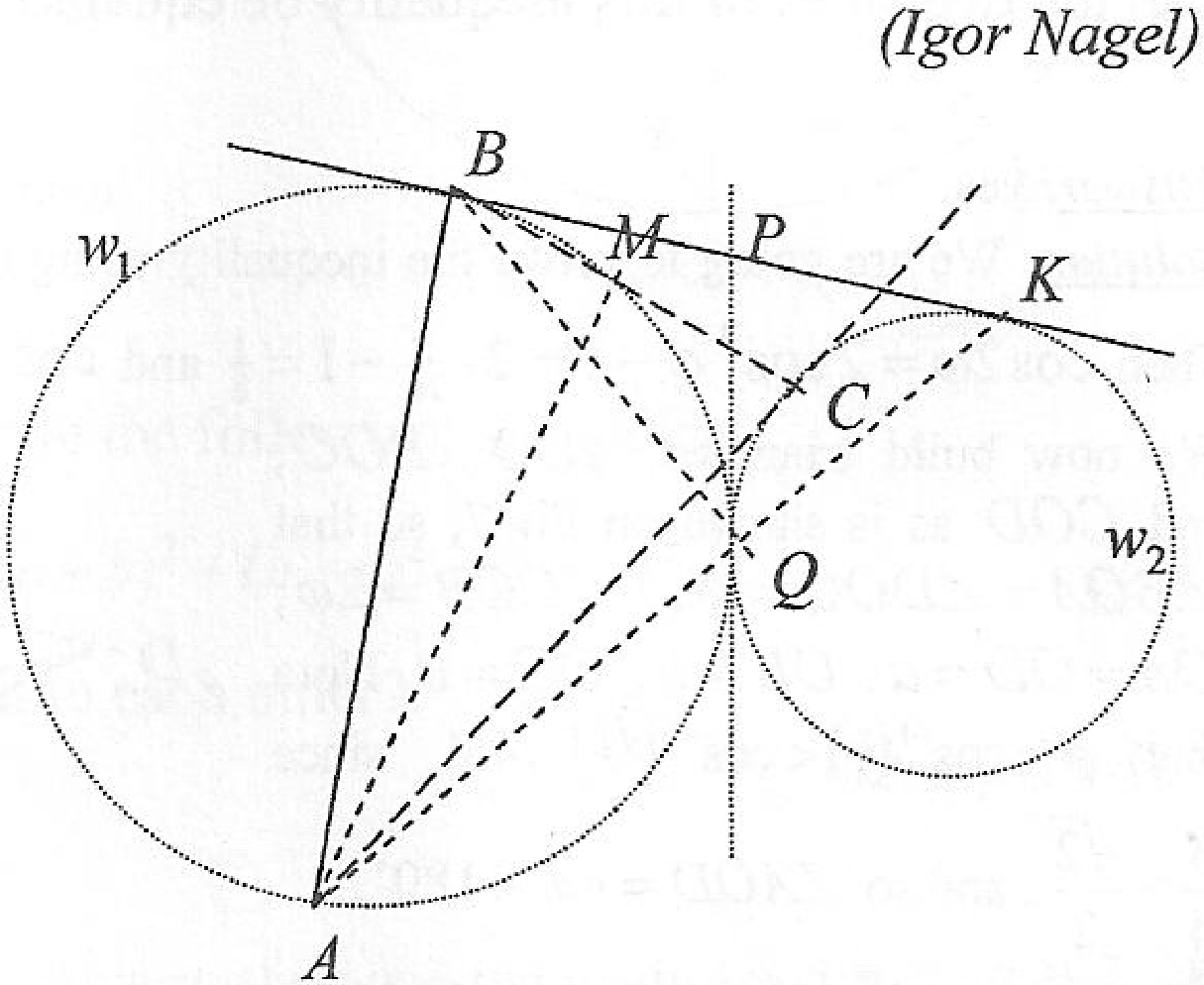
Two circles $w_1, w_2$ are externally tangent at a point $Q$. A common external tangent line to these circles (that doesn't pass through $Q$) is tangent to $w_1$ at a point $B$, and $BA$ is a diameter of this circle. The point $A$ belongs to the line tangent to the circle $w_2$ at a point $C$ such that $B$ and $C$ are in the same half-plane with respect to the line $AQ$. Prove that the circle $w_1$ bisects the segment $BC$.
Let be given an integer $n \ge 4$ and $x_1, x_2, x_3, \dots, x_n$ be nonnegative real numbers.
a) Prove that we have inequality
$$
\left(\sum_{i=1}^{n} x_i\right)^2 \ge \min\left\{\frac{n}{3}, \frac{8}{3}\right\} \sum_{i=1}^{n} x_i (x_{i+1} + x_{i+2} + x_{i+3})
$$
where $x_{n+1} = x_1$, $x_{n+2} = x_2$, $x_{n+3} = x_3$.
b) When does the equality hold?
Let $ABC$ be an acute triangle with circumcircle ($O$). $D$ is a point on arc $BC$ that does not contain $A$. A moving line $l$ through orthocenter $H$ of triangle $ABC$ cuts the circumcircles of triangle $ABH$ and triangle $ACH$ again at $M, N$ respectively ($M \neq H, N \neq H$).
a) Define the position of $l$ such that the area of $AMN$ has maximal value.
b) Denote $d_1, d_2$ be the lines through $M$ and perpendicular to $DB$, through $N$ perpendicular to $DC$ respectively. Prove that the intersection $P$ of $d_1$ and $d_2$ belongs to a fixed circle.
Let $ABC$ be a triangle. Find all points $P$ on segment $BC$ satisfying the following property: If $X$ and $Y$ are the intersections of line $PA$ with the common external tangent lines of the circumcircles of triangles $PAB$ and $PAC$, then
$$
\left( \frac{PA}{XY} \right)^2 + \frac{PB \cdot PC}{AB \cdot AC} = 1.
$$
(This problem was suggested by Titu Andreescu and Cosmin Pohoata.)
A rectangle with dimensions $5 \times 6$ is divided into eight rectangles whose sides are parallel to the sides of the original rectangle, and the lengths of their sides are positive integers. Prove that at least two of the eight rectangles are congruent.
Given positive integers $m$ and $n$, prove that there is a positive integer $c$ such that the numbers $cm$ and $cn$ have the same number of occurrences of each non-zero digit when written in base ten.
In a mathematical competition some competitors are friends; friendship is always mutual, that is to say that when $A$ is a friend of $B$, then also $B$ is a friend of $A$. We say that $n \geq 3$ different competitors $A_{1}, A_{2}, \ldots, A_{n}$ form a weakly-friendly cycle if $A_{i}$ is not a friend of $A_{i+1}$, for $1 \leq i \leq n\left(A_{n+1}=A_{1}\right)$, and there are no other pairs of non-friends among the components of this cycle.
The following property is satisfied:
for every competitor $C$, and every weakly-friendly cycle $\mathcal{S}$ of competitors not including $C$, the set of competitors $D$ in $\mathcal{S}$ which are not friends of $C$ has at most one element.
Prove that all competitors of this mathematical competition can be arranged into three rooms, such that every two competitors that are in the same room are friends.
Problem (Romanian duplicate in the source, translated):
In a mathematical competition some students are friends; friendship is always mutual, that is to say that when $A$ is a friend of $B$, then also $B$ is a friend of $A$. We say that $n \geq 3$ different students $A_{1}, A_{2}, \ldots, A_{n}$ form a weakly-friendly cycle if $A_{i}$ is not a friend of $A_{i+1}$, for $1 \leq i \leq n\left(A_{n+1}=A_{1}\right)$, and there are no other pairs of non-friends among the components of this cycle.
The following property is satisfied:
for every student $C$, and every weakly-friendly cycle $\mathcal{S}$ of students not including $C$, the set of students $D$ in $\mathcal{S}$ which are not friends of $C$ has at most one element.
Prove that all students of this mathematical competition can be arranged into three rooms, such that every two students that are in the same room are friends.
Find the exact value of the expression below:
$$
\frac{(6!+5!)(5!+4!)(4!+3!)(3!+2!)(2!+1!)}{(6!-5!)(5!-4!)(4!-3!)(3!-2!)(2!-1)!}
$$
if $n!$ denotes the product $1 \cdot 2 \cdot 3 \cdots n$ for every natural number $n$.