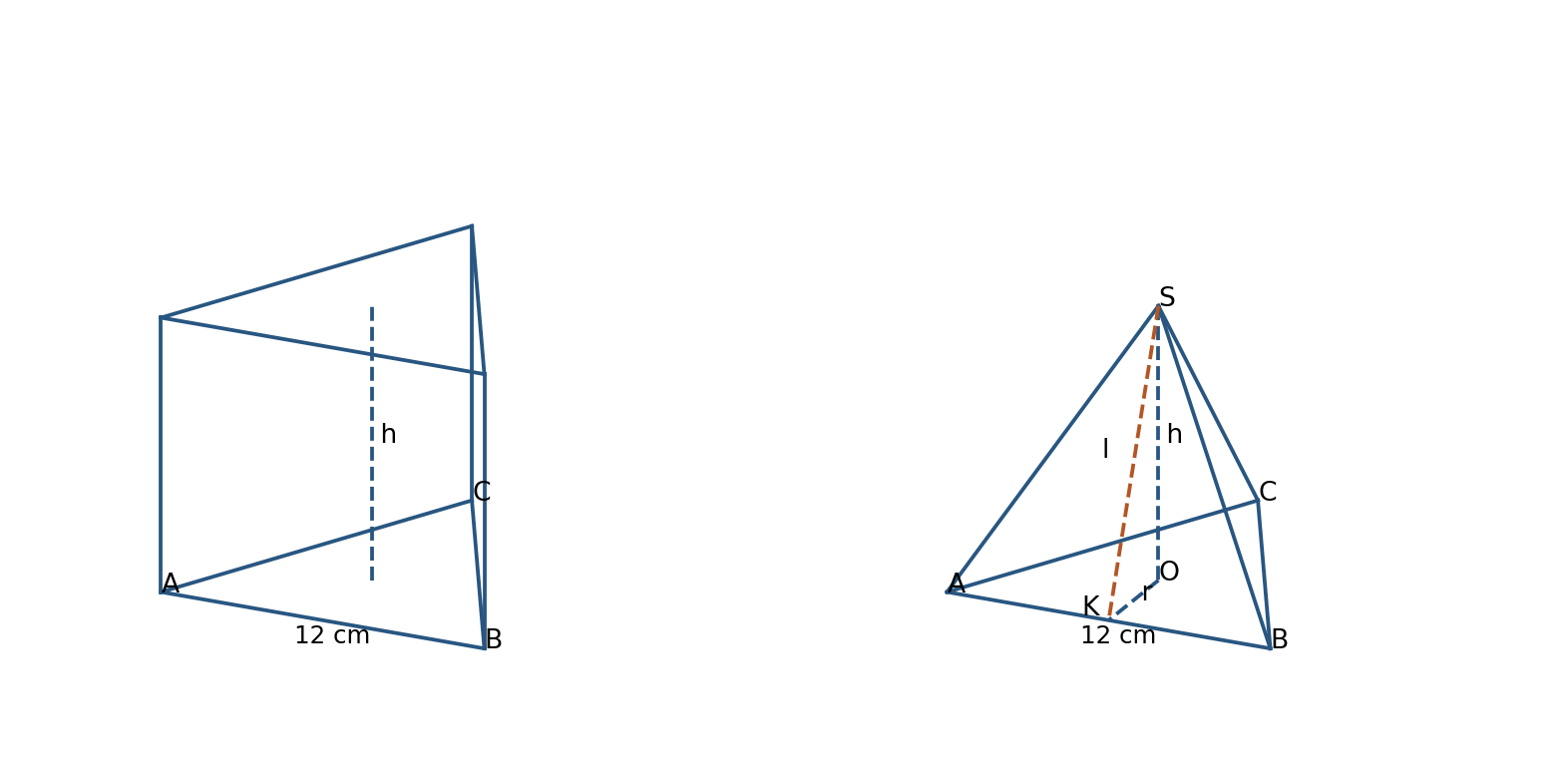
A right prism has an equilateral triangular base of side length $12~\mathrm{cm}$. Calculate the height of a right regular pyramid having the same height, the same base and the same lateral surface area as the given right prism.
Let $D$ be a point on the side $AB$ of the triangle $ABC$. The circumcircles of the triangles $BCD$ and $ACD$ meet the lines $AC$ and $BC$ again at points $E$ and $F$, respectively. The bisector of the segment $EF$ intersects the line $AB$ at $M$ and meets the altitude to $AB$ from $D$ at $N$. Let $T$ be the intersection of the lines $AB$ and $EF$, and let $U$ be the intersection of the line $CT$ and the circumcircle of the triangle $CDM$. Prove that $|NC| = |NU|$.
Find all pairs of positive integers $(m, n)$, such that
$$
m + 3n - 5 = 2v - 11d.
$$
Here $v$ is the least common multiple of the numbers $m$ and $n$, and $d$ is the greatest common divisor of $m$ and $n$.
Let $ABC$ be an isosceles triangle with $AC = BC$. Let $D$ be a point on a line $BA$ such that $A$ lies between $B$ and $D$. Let $O_1$ be the circumcircle of triangle $DAC$. $O_1$ meets $BC$ at point $E$. Let $F$ be the point on the line $BC$ such that $FD$ is tangent to circle $O_1$, and let $O_2$ be the circumcircle of triangle $DBF$. Two circles $O_1, O_2$ meet at point $G$ ($G \neq D$). Let $O$ be the circumcenter of triangle $BEG$. Prove that the line $FG$ is tangent to circle $O$ if and only if $DG$ is perpendicular to $FO$.
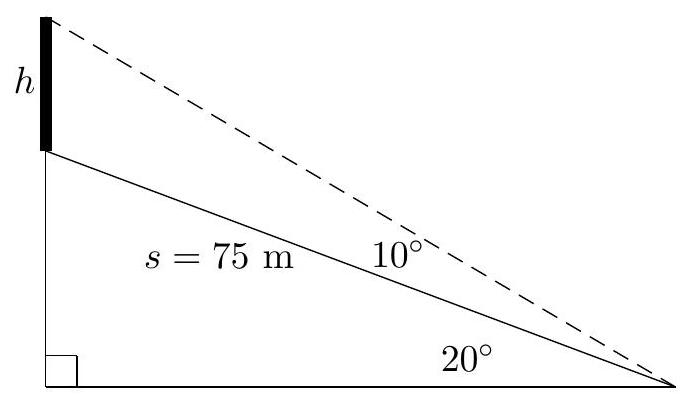
At the top of a slope $75~\mathrm{m}$ long there is a transmitter mast which subtends an angle of $10^\circ$ when viewed from the foot of the slope (see the figure). How tall is the mast (its height is marked $h$ in the figure), if the slope is inclined at $20^\circ$? Round the result to two decimal places.
Let $x_1$ and $x_2$ be two different roots of the polynomial $p(x) = x^2 + a x + b$, and let $x_1^2 - \frac{1}{2}$ and $x_2^2 - \frac{1}{2}$ be the roots of $q(x) = x^2 + (a^2 - \frac{1}{2}) x + b^2 - \frac{1}{2}$. Find $a$ and $b$.
For a real number $x$ let $[x]$ denote the greatest integer not greater than $x$.
a. Prove that for all positive integers $a$, $b$ and $c$ we have
$$
\left\lfloor \frac{\left\lfloor \frac{c}{a} \right\rfloor}{b} \right\rfloor \le \left\lfloor \frac{c}{ab} \right\rfloor.
$$
b. Find an example showing that the above equality does not hold for all positive real numbers $a$, $b$ and $c$.
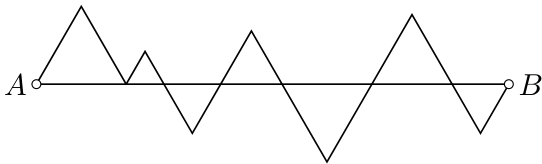
The segment $AB$ measures $20$ cm. The polygonal curve connecting the points $A$ and $B$ together with the segment $AB$ forms $7$ equilateral triangles. No segment of the polygonal curve lies on the segment $AB$. How long, in centimeters, is this polygonal curve?
There are three piles of tokens on the table: the first contains $a$, the second $b$ and the third one $c$ tokens, and $a \ge b \ge c \gt 0$. Two players $A$ and $B$ take turns moving the tokens around. Player $A$ goes first. For each move, the active player first chooses two piles and then moves at least one token from the pile with fewer tokens into the pile containing more tokens. If the numbers of tokens in the two chosen piles are equal, then the player moves at least one token from any of them onto the other. A player wins if there is only one pile remaining after their move. Who has the winning strategy for different values of $a, b$ and $c$?
Let $\{x_n\}_{n\ge1}$ be the sequence of positive integers defined by $x_1=2$ and $x_{n+1}=2x_n+x_n$ for every $n\ge1$. Determine the largest power of $5$ dividing $x_{2014}^2+1$.
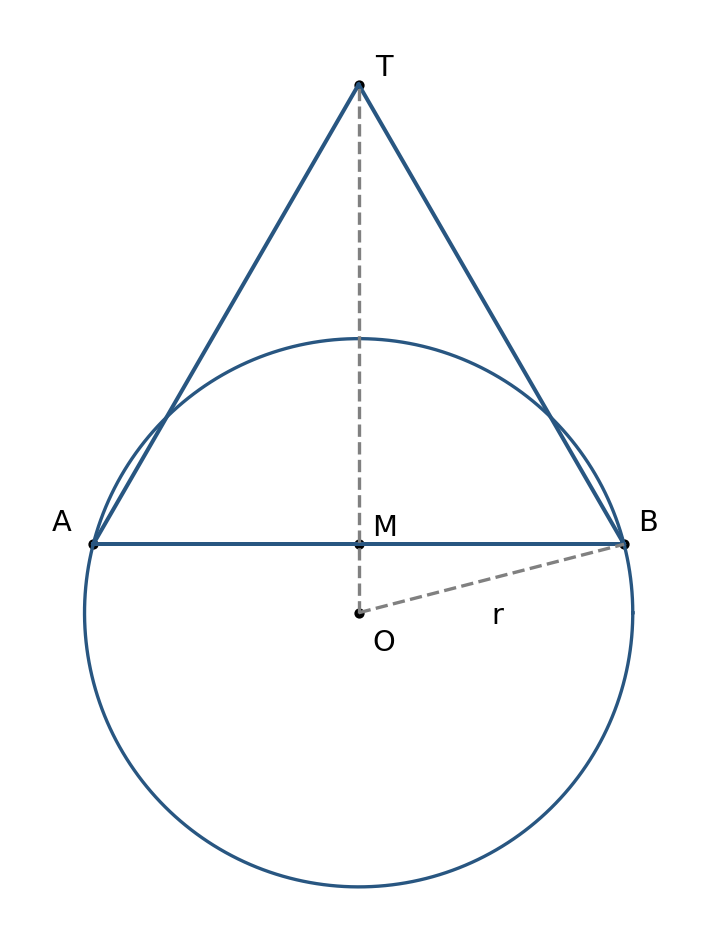
Let $\mathcal{K}$ be a circle with centre $O$ and radius $r$. What is the upper bound for the length of $|OT|$ given that $T$ is the point in the plane such that there exists an equilateral triangle $ABT$, where $A$ and $B$ lie on the circle $\mathcal{K}$?
An infinite sequence has first four terms $2,6,18,54$. Write its general term $a_n$, given that the ratio of any two consecutive terms is constant. Also calculate the sum of the first $1000$ terms of the sequence with general term $b_n=\log_3(a_n)$.
A continent has a finite number of castles and each castle belongs to exactly one of the two countries $A$ and $B$. Each castle has one general. We say two castles are *neighboring* if there is a path between those two castles. We also say that a castle $P$ and a set of castles $Q$ is *neighboring* if $P$ is neighboring some castle in $Q$. Prove that the following two conditions are equivalent.
1\. If some of the generals from the country $B$ move to some neighboring castles and attack, generals from the country $A$ can move to some neighboring castles so that at each castle from the country $A$, the number of generals from $A$ is greater than or equal to that of generals from $B$.
2\. If $X$ is a set of castles from the country $A$, the number of generals from $A$ who are in $X$ or in castles neighboring $X$ is greater than or equal to the number of generals from $B$ who are in castles neighboring $X$.