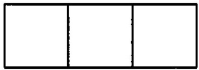
The lower row of a $2 \times 13$ rectangle is filled up with 13 markers labeled $1, 2, \ldots, 13$ in this order. An operation is moving a marker from its cell to an adjacent (by side) empty cell. The task is to rearrange the markers in the reverse order, in the lower row again. Do this with a minimal number of operations.
Points $D$ and $E$ divide side $AB$ of equilateral triangle $ABC$ into three equal parts; $D$ is between $A$ and $E$. Point $F$ on side $BC$ is such that $CF = AD$. Find the sum of the angles
$$
C\hat{D}F + C\hat{E}F.
$$
A $+1$ or $-1$ is written at each vertex of a regular $n$-gonal prism so that the product of numbers on each face is $-1$. For which $n \geq 3$ is this possible?
We say that a natural number is of type 1 (respectively type 2) if each of its digits at even (respectively odd) position is greater than or equal to each of its adjacent digits. Positions are counted from left to right; leading zeros are not allowed (the first digit is assumed nonzero). One-digit numbers are considered to be both of type 1 and of type 2. Decide if it is true that:
a) Each number $a \gt 1$ of type 1 can be represented as $a = b + c$ with $b$, $c$ numbers of type 2.
b) Each number $a \gt 1$ of type 2 can be represented as $a = b + c$ with $b$, $c$ numbers of type 1.
Felipe tells Roberto that he managed to place 1226 triminos $1\times 3$ on a certain grid square $Q$ so that they do not have common points, not even vertices. Without knowing the dimensions of $Q$, Roberto answers, "If what you say is true then one can place 1250 triminos $1\times 3$ on your square, under the same conditions." Is Roberto right?
Rectangle $ABCD$ has sides $AB = 3$, $BC = 2$. Point $P$ on side $AB$ is such that the bisector of $C\hat{D}P$ passes through the midpoint of $BC$. Find $BP$.
Call a natural number *acceptable* if it has at most 9 distinct prime divisors. There is given a pile of $100! = 1 \cdot 2 \cdot \dots \cdot 100$ stones. A legal move is to remove $k$ stones from the pile where $k$ is an *acceptable number*. Players $A$ and $B$ take turns in making legal moves; $A$ goes first. The one who removes the last stone wins. Decide which player has a winning strategy.
Let $N$ denote the number of ordered 9-tuples $(x_1, x_2, \dots, x_9)$ of positive integers such that
$$
\frac{1}{x_1} + \frac{1}{x_2} + \dots + \frac{1}{x_9} = 1.
$$
Decide if $N$ is even or odd. Justify your answer.
Find all $n \in \mathbb{N}$ that can be represented in the form $n = [a,b] + [b,c] + [c,a]$ with $a, b, c \in \mathbb{N}$. Here $[u,v]$ denotes the least common multiple of $u$ and $v$.
Given two positive integers $a$ and $b$, a legal move is to choose a proper divisor of one of them and add it to either $a$ or $b$. Players $A$ and $B$ make legal moves in turns; $A$ plays first. The one who obtains a number $\ge 2015$ wins. Determine who wins if the game starts with:
$$
a) a=3, b=5; \qquad b) a=6, b=7.
$$
(Here a proper divisor of $k \in \mathbb{N}$ means a $d \in \mathbb{N}$ such that $d$ divides $k$ and $d \neq k$.)
Consider the points $O = (0,0)$, $A = (-2,0)$ and $B = (0,2)$ in the coordinate plane. Let $E$ and $F$ be the midpoints of $OA$ and $OB$ respectively. Rotate triangle $OEF$ clockwise about $O$ to reach a triangle $OE'F'$ and, for each rotated position, let $P = (x, y)$ be the intersection of lines $AE'$ and $BF'$. Find the maximum of the $y$-coordinate of $P$.
A segment $S$ of length $50$ is covered by several segments of length $1$, all of them contained in $S$. If any of these unit segments is removed, $S$ is not completely covered any more. Find the maximum number of unit segments with this property. Assume that the segments include their endpoints.
Alex has thought of a number $N$ in $S = \{1, 2, ..., 1001\}$, and Bibi has to find it via the following procedure. She gives Alex a list of subsets of $S$, Alex reads it and tells Bibi how many subsets in her list contain $N$. If Bibi wishes she can repeat the same with a second list, and then with a third one, but no more than 3 lists are allowed.
What least total number of subsets would enable Bibi to find $N$ with certainty?
Let $ABC$ be a triangle, and let $D$ be a point on side $BC$. A line through $D$ intersects side $AB$ at $X$ and ray $AC$ at $Y$. The circumcircle of triangle $BXD$ intersects the circumcircle $\omega$ of triangle $ABC$ again at point $Z \neq B$. The lines $ZD$ and $ZY$ intersect $\omega$ again at $V$ and $W$, respectively. Prove that $AB = VW$.
Let $S=\{2,3,4, \ldots\}$ denote the set of integers that are greater than or equal to $2$. Does there exist a function $f: S \rightarrow S$ such that
$$
f(a) f(b) = f\left(a^{2} b^{2}\right) \text{ for all } a, b \in S \text{ with } a \neq b?
$$
A sequence of real numbers $a_{0}, a_{1}, \ldots$ is said to be $\operatorname{good}$ if the following three conditions hold.
(i) The value of $a_{0}$ is a positive integer.
(ii) For each non-negative integer $i$ we have $a_{i+1}=2 a_{i}+1$ or $a_{i+1}=\frac{a_{i}}{a_{i}+2}$.
(iii) There exists a positive integer $k$ such that $a_{k}=2014$.
Find the smallest positive integer $n$ such that there exists a good sequence $a_{0}, a_{1}, \ldots$ of real numbers with the property that $a_{n}=2014$.