A large urn contains $100$ balls, of which $36\%$ are red and the rest are blue. How many of the blue balls must be removed so that the percentage of red balls in the urn will be $72\%?$ (No red balls are to be removed.)
While exploring a cave, Carl comes across a collection of $5$-pound rocks worth $\$14$ each, $4$-pound rocks worth $\$11$ each, and $1$-pound rocks worth $\$2$ each. There are at least $20$ of each size. He can carry at most $18$ pounds. What is the maximum value, in dollars, of the rocks he can carry out of the cave?
How many ways can a student schedule $3$ mathematics courses—algebra, geometry, and number theory—in a $6$-period day if no two mathematics courses can be taken in consecutive periods? (What courses the student takes during the other $3$ periods is of no concern here.)
Alice, Bob, and Charlie were on a hike and were wondering how far away the nearest town was. When Alice said, “We are at least $6$ miles away,” Bob replied, “We are at most $5$ miles away.” Charlie then remarked, “Actually the nearest town is at most $4$ miles away.” It turned out that none of the three statements was true. Let $d$ be the distance in miles to the nearest town. Which of the following intervals is the set of all possible values of $d?$
For positive integers $m$ and $n$ such that $m + 10 \lt n + 1,$ both the mean and the median of the set $\{m, m + 4, m + 10,$ $n + 1,$ $n + 2,$ $2n\}$ are equal to $n.$ What is $m + n?$
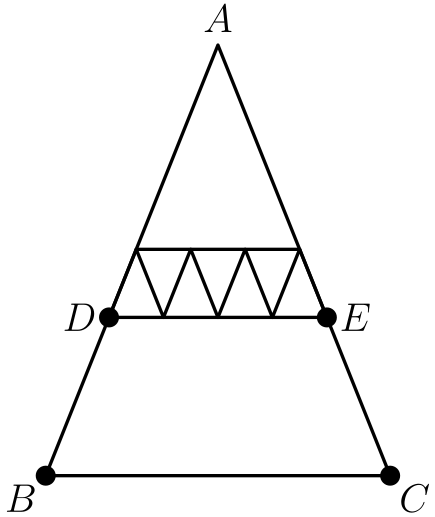
All of the triangles in the diagram below are similar to isosceles triangle $ABC,$ in which $AB = AC.$ Each of the $7$ smallest triangles has area $1,$ and $\triangle ABC$ has area $40.$ What is the area of trapezoid $DBCE?$
Which of the following describes the largest subset of values of $y$ within the closed interval $[0, \pi]$ for which $$
\sin(x + y) \le \sin(x) + \sin(y)
$$ for every $x$ between $0$ and $\pi,$ inclusive?
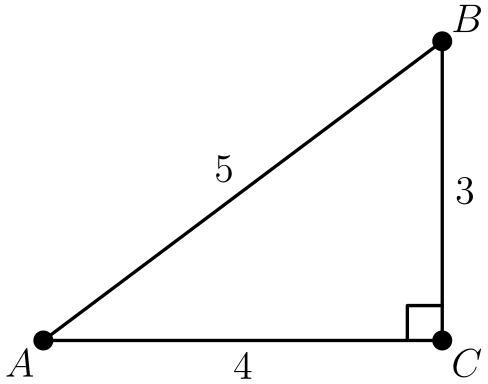
A paper triangle with sides of lengths $3,$ $4,$ and $5$ inches, as shown, is folded so that point $A$ falls on point $B.$ What is the length in inches of the crease?
Let $S$ be a set of $6$ integers taken from $\{1, 2, \ldots, 12\}$ with the property that if $a$ and $b$ are elements of $S$ with $a \lt b,$ then $b$ is not a multiple of $a.$ What is the least possible value of an element of $S?$
The solution to the equation $\log_{3x} 4 = \log_{2x} 8,$ where $x$ is a positive real number other than $\tfrac13$ or $\tfrac12,$ can be written as $\tfrac{p}{q},$ where $p$ and $q$ are relatively prime positive integers. What is $p + q?$
A scanning code consists of a $7 \times 7$ grid of squares, with some of its squares colored black and the rest colored white. There must be at least one square of each color in this grid of $49$ squares. A scanning code is called *symmetric* if its look does not change when the entire square is rotated by a multiple of $90^\circ$ counterclockwise around its center, nor when it is reflected across a line joining opposite corners or a line joining midpoints of opposite sides. What is the total number of possible symmetric scanning codes?
Which of the following describes the set of values of $a$ for which the curves $x^2 + y^2 = a^2$ and $y = x^2 - a$ in the real $xy$-plane intersect at exactly $3$ points?
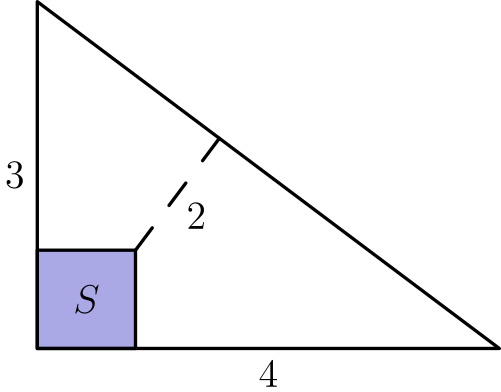
Farmer Pythagoras has a field in the shape of a right triangle. The right triangle’s legs have lengths of $3$ and $4$ units. In the corner where those sides meet at a right angle, he leaves a small unplanted square $S$ so that from the air it looks like the right angle symbol. The rest of the field is planted. The shortest distance from $S$ to the hypotenuse is $2$ units. What fraction of the field is planted?
Triangle $ABC$ with $AB = 50$ and $AC = 10$ has area $120.$ Let $D$ be the midpoint of $\overline{AB},$ and let $E$ be the midpoint of $\overline{AC}.$ The angle bisector of $\angle BAC$ intersects $\overline{DE}$ and $\overline{BC}$ at $F$ and $G,$ respectively. What is the area of quadrilateral $FDBG?$
Let $A$ be the set of positive integers that have no prime factors other than $2,$ $3,$ or $5.$ The infinite sum $$
\begin{aligned} &\frac{1}{1} + \frac{1}{2} + \frac{1}{3} + \frac{1}{4} \\ &\quad {}+ \frac{1}{5} + \frac{1}{6} + \frac{1}{8} + \frac{1}{9} \\ &\quad {}+ \frac{1}{10} + \frac{1}{12} + \frac{1}{15} + \frac{1}{16} \\ &\quad {}+ \frac{1}{18} + \frac{1}{20} + \cdots \end{aligned}
$$ of the reciprocals of all the elements of $A$ can be expressed as $\tfrac{m}{n},$ where $m$ and $n$ are relatively prime positive integers. What is $m + n?$
Triangle $ABC$ is an isosceles right triangle with $AB = AC = 3.$ Let $M$ be the midpoint of hypotenuse $\overline{BC}.$ Points $I$ and $E$ lie on sides $\overline{AC}$ and $\overline{AB},$ respectively, so that $AI \gt AE$ and $AIME$ is a cyclic quadrilateral. Given that triangle $EMI$ has area $2,$ the length $CI$ can be written as $\tfrac{a - \sqrt{b}}{c},$ where $a,$ $b,$ and $c$ are positive integers and $b$ is not divisible by the square of any prime. What is the value of $a + b + c?$