The numerals $(47)_a$ and $(74)_b$ represent the same decimal value, where $a,b$ are valid positive integer bases. What is the least possible value of $a+b$?
Tina uniformly chooses two distinct numbers from $\{1,2,3,4,5\}$. Independently, Sergio uniformly chooses a number from $\{1,2,\ldots,10\}$. What is the probability that Sergio's number exceeds the sum of Tina's numbers?
In a given plane, points $A$ and $B$ are $10$ units apart. How many points $C$ are there in the plane such that the perimeter of $\triangle ABC$ is $50$ units and the area of $\triangle ABC$ is $100$ square units?
A frog starts at $(1,2)$. On each jump it independently chooses up, down, left, or right with equal probability and moves one unit. It stops on reaching a side of the square with vertices $(0,0),(0,4),(4,4),(4,0)$. What is the probability of stopping on a vertical side?
Amelia's coin lands heads with probability $\dfrac13$, and Blaine's with probability $\dfrac25$. They alternate independent tosses, with the first head winning. Amelia goes first. Her winning probability is $\dfrac pq$ in lowest terms. What is $q-p$?
Line segment $AB$ is a diameter of a circle with $AB = 24.$ Point $C,$ not equal to $A$ or $B,$ lies on the circle. As point $C$ moves around the circle, the centroid (center of mass) of $\triangle ABC$ traces out a closed curve missing two points. To the nearest positive integer, what is the area of the region bounded by this curve?
A box contains five cards, three red and two white. Cards are drawn randomly one at a time without replacement, stopping as soon as only one color remains in the box. What is the probability that the last card drawn is white?
Let $n$ be the largest three-digit positive integer such that the sum of the first $n$ positive integers is not a divisor of their product. What is $n$?
A positive integer divisor of $12!$ is chosen uniformly at random. The probability that it is a perfect square is $\dfrac mn$ in lowest terms. What is $m+n$?
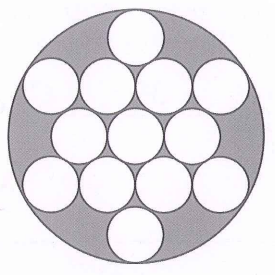
The figure below shows $13$ circles of radius $1$ within a larger circle. All the intersections occur at points of tangency. What is the area of the region, shaded in the figure, inside the larger circle but outside all the circles of radius $1?$