Let $N$ be the least positive integer that is both $22$ percent less than one integer and $16$ percent greater than another integer. Find the remainder when $N$ is divided by $1000.$
In a new school $40$ percent of the students are freshmen, $30$ percent are sophomores, $20$ percent are juniors, and $10$ percent are seniors. All freshmen are required to take Latin, and $80$ percent of the sophomores, $50$ percent of the juniors, and $20$ percent of the seniors elect to take Latin. The probability that a randomly chosen Latin student is a sophomore is $\frac{m}{n},$ where $m$ and $n$ are relatively prime positive integers. Find $m + n.$
In an isosceles trapezoid, the parallel bases have lengths $\log 3$ and $\log 192,$ and the altitude to these bases has length $\log 16.$ The perimeter of the trapezoid can be written in the form $\log 2^p 3^q,$ where $p$ and $q$ are positive integers. Find $p + q.$
Two unit squares are selected at random without replacement from an $n \times n$ grid of unit squares. Find the least positive integer $n$ such that the probability that the two selected squares are horizontally or vertically adjacent is less than $\frac{1}{2015}.$
Steve says to Jon, “I am thinking of a polynomial whose roots are all positive integers. The polynomial has the form $P(x) = 2x^3 - 2ax^2$ $+ (a^2 - 81)x - c$ for some positive integers $a$ and $c.$ Can you tell me the values of $a$ and $c?$”
After some calculations, Jon says, “There is more than one such polynomial.”
Steve says, “You’re right. Here is the value of $a.$” He writes down a positive integer and asks, “Can you tell me the value of $c?$”
Jon says, “There are still two possible values of $c.$”
Triangle $ABC$ has side lengths $AB = 12,$ $BC = 25,$ and $CA = 17.$ Rectangle $PQRS$ has vertex $P$ on $\overline{AB},$ vertex $Q$ on $\overline{AC},$ and vertices $R$ and $S$ on $\overline{BC}.$ In terms of the side length $PQ = w,$ the area of $PQRS$ can be expressed as the quadratic polynomial $$
\text{Area}(PQRS) = \alpha w - \beta \cdot w^2.
$$ Then the coefficient $\beta = \frac{m}{n},$ where $m$ and $n$ are relatively prime positive integers. Find $m + n.$
Let $a$ and $b$ be positive integers satisfying $\frac{ab + 1}{a + b} \lt \frac{3}{2}.$ The maximum possible value of $\frac{a^3 b^3 + 1}{a^3 + b^3}$ is $\frac{p}{q},$ where $p$ and $q$ are relatively prime positive integers. Find $p + q.$
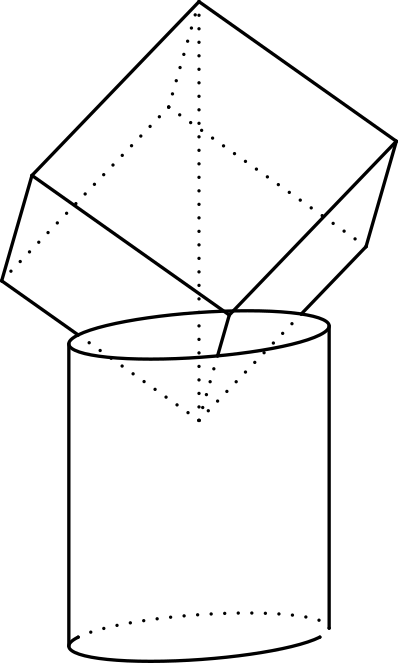
A cylindrical barrel with radius $4$ feet and height $10$ feet is full of water. A solid cube with side length $8$ feet is set into the barrel so that the diagonal of the cube is vertical. The volume of water thus displaced is $v$ cubic feet. Find $v^2.$
Call a permutation $a_1,$ $a_2,$ $\ldots,$ $a_n$ of the integers $1,$ $2,$ $\ldots,$ $n$ *quasi-increasing* if $a_k \le a_{k+1} + 2$ for each $1 \le k \le n - 1.$ For example, $53421$ and $14253$ are quasi-increasing permutations of the integers $1,$ $2,$ $3,$ $4,$ $5,$ but $45123$ is not. Find the number of quasi-increasing permutations of the integers $1,$ $2,$ $\ldots,$ $7.$
The circumcircle of acute $\triangle ABC$ has center $O.$ The line passing through point $O$ perpendicular to $\overline{OB}$ intersects lines $AB$ and $BC$ at $P$ and $Q,$ respectively. Also $AB = 5,$ $BC = 4,$ $BQ = 4.5,$ and $BP = \frac{m}{n},$ where $m$ and $n$ are relatively prime positive integers. Find $m + n.$
There are $2^{10} = 1024$ possible $10$-letter strings in which each letter is either an A or a B. Find the number of such strings that do not have more than $3$ adjacent letters that are identical.
Define the sequence $a_1,$ $a_2,$ $a_3,$ $\ldots$ by $a_n = \sum_{k=1}^{n} \sin(k),$ where $k$ represents radian measure. Find the index of the $100$th term for which $a_n \lt 0.$
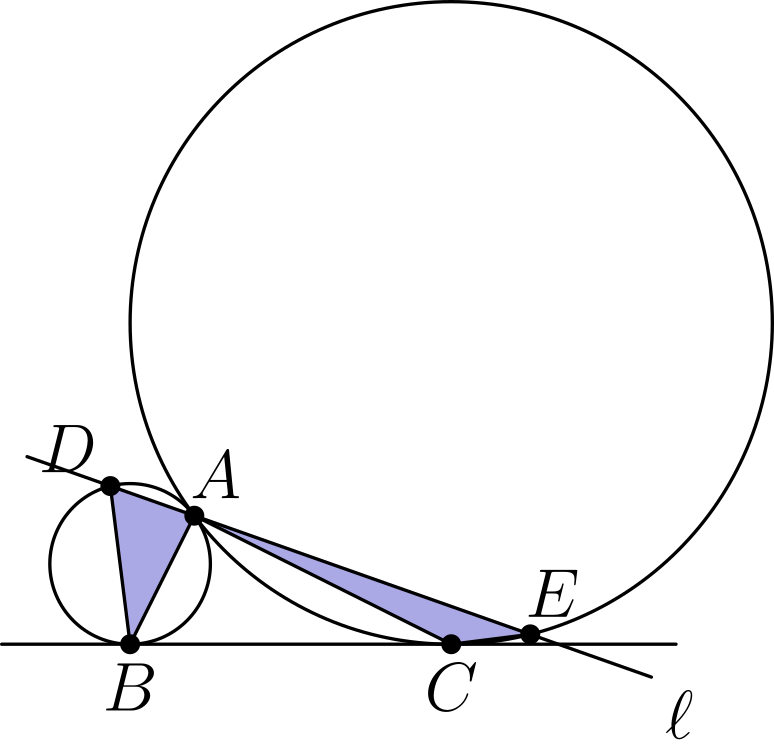
Circles $\mathcal{P}$ and $\mathcal{Q}$ have radii $1$ and $4,$ respectively, and are externally tangent at point $A.$ Point $B$ is on $\mathcal{P}$ and point $C$ is on $\mathcal{Q}$ so that line $BC$ is a common external tangent of the two circles. A line $\ell$ through $A$ intersects $\mathcal{P}$ again at $D$ and intersects $\mathcal{Q}$ again at $E.$ Points $B$ and $C$ lie on the same side of $\ell,$ and the areas of $\triangle DBA$ and $\triangle ACE$ are equal. This common area is $\frac{m}{n},$ where $m$ and $n$ are relatively prime positive integers. Find $m + n.$