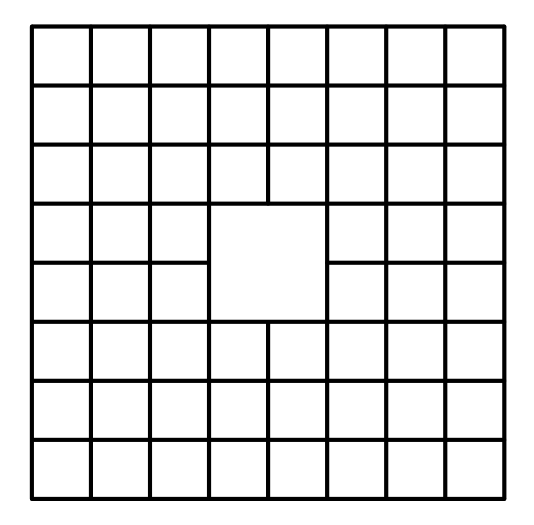
The four central squares of an $8\times8$ chessboard are removed as shown. What is the largest number of queens that can be placed on the remaining $60$ squares so that no two attack each other? A queen attacks the nearest piece in any common row, column, or diagonal. For this question, removed squares cannot hold queens but do not block attack lines.
Đức writes a $100$-digit integer $n$ containing no zeros. Let $m$ be the number formed by its first $50$ digits. If $n$ is divisible by $m$, how many zero digits occur in the quotient?
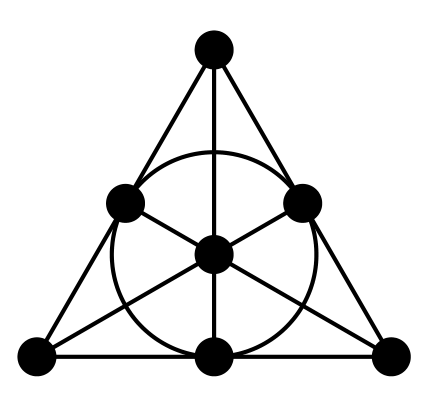
Phong assigns seven numbers, not necessarily distinct, from $\{1,2,\ldots,269\}$ to the black dots. The product of the three numbers on each shown straight line or circle must have the same remainder modulo $269$. If he uses $269$, what is the minimum number of times he must use it?
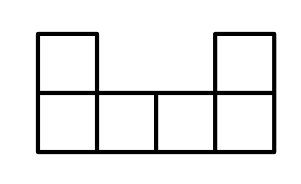
What is the maximum number of tiles of the shown shape that can fit on a $10\times10$ square-grid board without overlap? Tiles may be rotated and cover whole grid squares.
Luffy and five crewmen sit in a circle to divide $99$ gold coins. Luffy chooses his share and each crewman’s share. Each crewman votes yes exactly when his share is greater than both neighbors’ shares. A majority of the five crewmen must vote yes for Luffy to survive. What is the greatest share Luffy can take? Shares are nonnegative integers; a person may receive zero coins.
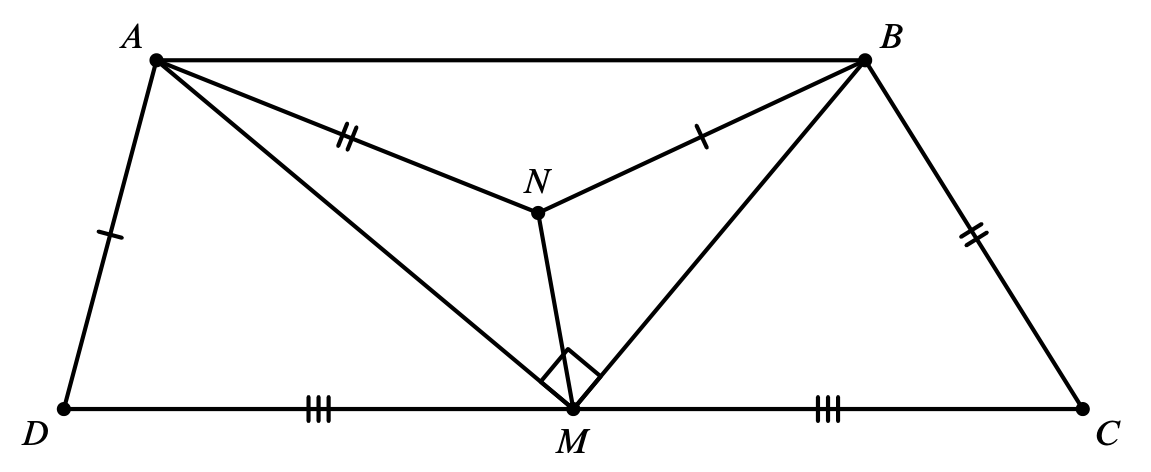
$ABCD$ is a trapezoid with parallel bases $AB,CD$, where $AB<CD$. Point $M$ is the midpoint of $CD$, and $N$ is inside the trapezoid with $AN=BC$ and $BN=AD$. If $\angle AMB=90^\circ$, prove that quadrilaterals $ANMD$ and $BNMC$ have equal areas.