In quadrilateral $ABCD,$ $\angle B$ is a right angle, diagonal $\overline{AC}$ is perpendicular to $\overline{CD},$ $AB = 18,$ $BC = 21,$ and $CD = 14.$ Find the perimeter of $ABCD.$
Let set $\mathcal{A}$ be a $90$-element subset of $\{1, 2, 3, \ldots, 100\},$ and let $S$ be the sum of the elements of $\mathcal{A}.$ Find the number of possible values of $S.$
Let $N$ be the number of consecutive $0$’s at the right end of the decimal representation of the product $1!\,2!\,3!\,4! \cdots 99!\,100!.$ Find the remainder when $N$ is divided by $1000.$
The number $$
\small \sqrt{104\sqrt{6} + 468\sqrt{10} + 144\sqrt{15} + 2006}
$$ can be written as $a\sqrt{2} + b\sqrt{3} + c\sqrt{5},$ where $a,$ $b,$ and $c$ are positive integers. Find $a \cdot b \cdot c.$
Let $\mathcal{S}$ be the set of real numbers that can be represented as repeating decimals of the form $0.\overline{abc}$ where $a,$ $b,$ $c$ are distinct digits. Find the sum of the elements of $\mathcal{S}.$
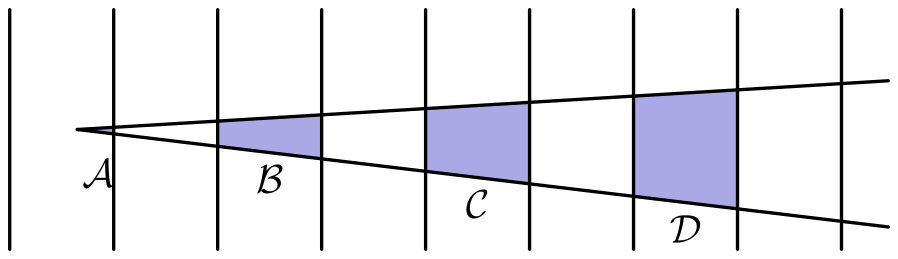
An angle is drawn on a set of equally spaced parallel lines as shown. The ratio of the area of shaded region $\mathcal{C}$ to the area of shaded region $\mathcal{B}$ is $\frac{11}{5}.$ Find the ratio of the area of shaded region $\mathcal{D}$ to the area of shaded region $\mathcal{A}.$
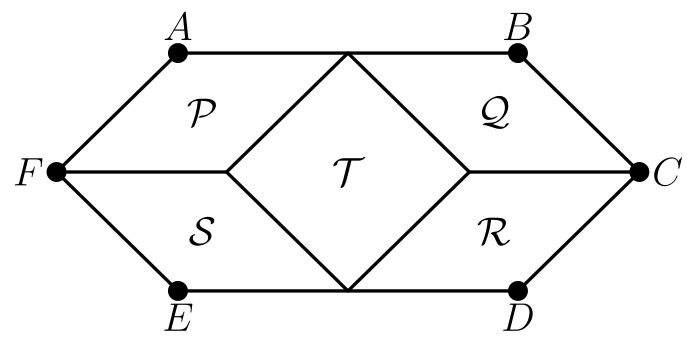
Hexagon $ABCDEF$ is divided into five rhombuses, $\mathcal{P},$ $\mathcal{Q},$ $\mathcal{R},$ $\mathcal{S},$ and $\mathcal{T},$ as shown. Rhombuses $\mathcal{P},$ $\mathcal{Q},$ $\mathcal{R},$ and $\mathcal{S}$ are congruent, and each has area $\sqrt{2006}.$ Let $K$ be the area of rhombus $\mathcal{T}.$ Given that $K$ is a positive integer, find the number of possible values for $K.$
The sequence $a_1,$ $a_2,$ $\ldots$ is geometric with $a_1 = a$ and common ratio $r,$ where $a$ and $r$ are positive integers. Given that $\log_8 a_1 + \log_8 a_2 + \cdots + \log_8 a_{12}$ $= 2006,$ find the number of possible ordered pairs $(a, r).$
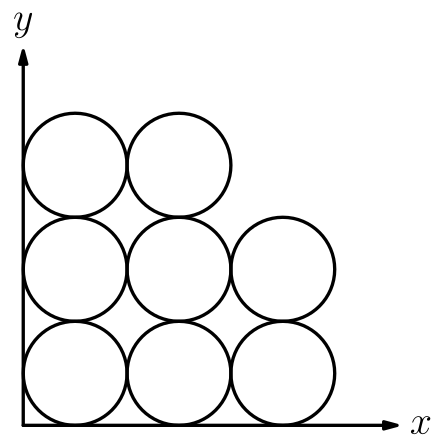
Eight circles of diameter $1$ are packed in the first quadrant of the coordinate plane as shown. Let region $\mathcal{R}$ be the union of the eight circular regions. Line $\ell,$ with slope $3,$ divides $\mathcal{R}$ into two regions of equal area. Line $\ell$’s equation can be expressed in the form $ax = by + c,$ where $a,$ $b,$ and $c$ are positive integers whose greatest common divisor is $1.$ Find $a^2 + b^2 + c^2.$
A collection of $8$ cubes consists of one cube with edge-length $k$ for each integer $k,$ $1 \le k \le 8.$ A tower is to be built using all $8$ cubes according to the rules:
• Any cube may be the bottom cube in the tower.
• The cube immediately on top of a cube with edge-length $k$ must have edge-length at most $k + 2.$
Let $T$ be the number of different towers that can be constructed. What is the remainder when $T$ is divided by $1000?$
Find the sum of the values of $x$ such that $\cos^3 3x + \cos^3 5x$ $= 8 \cos^3 4x \cos^3 x,$ where $x$ is measured in degrees and $100 \lt x \lt 200.$
For each even positive integer $x,$ let $g(x)$ denote the greatest power of $2$ that divides $x.$ For example, $g(20) = 4$ and $g(16) = 16.$ For each positive integer $n,$ let $S_n = \sum_{k=1}^{2^{n-1}} g(2k).$ Find the greatest integer $n$ less than $1000$ such that $S_n$ is a perfect square.
A tripod has three legs each of length $5$ feet. When the tripod is set up, the angle between any pair of legs is equal to the angle between any other pair, and the top of the tripod is $4$ feet from the ground. In setting up the tripod, the lower $1$ foot of one leg breaks off. Let $h$ be the height in feet of the top of the tripod from the ground when the broken tripod is set up. Then $h$ can be written in the form $\frac{m}{\sqrt{n}},$ where $m$ and $n$ are positive integers and $n$ is not divisible by the square of any prime. Find $\lfloor m + \sqrt{n} \rfloor.$ (The notation $\lfloor x \rfloor$ denotes the greatest integer that is less than or equal to $x.$)
Given that a sequence satisfies $x_0 = 0$ and $|x_k| = |x_{k-1} + 3|$ for all integers $k \ge 1,$ find the minimum possible value of $|x_1 + x_2 + \cdots + x_{2006}|.$