In parallelepiped $ABCDA_1B_1C_1D_1$, the angles $A_1AD,A_1AB,DAB$ are all 60°. Given $C_1A_1=\sqrt7$, $C_1B=\sqrt{13}$ and $C_1D=\sqrt{19}$ centimeters, find the distance from $A$ to plane $A_1BD$.
Let $ABCD$ be a square and let $X$ be any point on side $BC$ between $B$ and $C$. Let $Y$ be the point on line $CD$ such that $BX = YD$ and $D$ is between $C$ and $Y$. Prove that the midpoint of $XY$ lies on diagonal $BD$.
Find the smallest positive integer $N$ satisfying the following three properties.
- $N$ leaves a remainder of $5$ when divided by $7$.
- $N$ leaves a remainder of $6$ when divided by $8$.
- $N$ leaves a remainder of $7$ when divided by $9$.
You have an unlimited supply of square tiles with side length $1$ and equilateral triangle tiles with side length $1$. For which $n$ can you use these tiles to create a convex $n$-sided polygon? The tiles must fit together without gaps and may not overlap.
There are 13 marked points on the circumference of a circle with radius 13. Prove that we can choose three of the marked points which form a triangle with area less than 13.
Let $\Gamma_{1}$ and $\Gamma_{2}$ be circles internally tangent at point $A$, with $\Gamma_{1}$ inside $\Gamma_{2}$. Let $BC$ be a chord of $\Gamma_{2}$ which is tangent to $\Gamma_{1}$ at point $D$. Prove that line $AD$ is the angle bisector of $\angle BAC$.
A sequence of $A$s and $B$s is called antipalindromic if writing it backwards, then turning all the $A$s into $B$s and vice versa, produces the original sequence. For example $A B B A A B$ is antipalindromic. For any sequence of $A$s and $B$s we define the cost of the sequence to be the product of the positions of the $A$s. For example, the string $A B B A A B$ has cost $1\cdot 4\cdot 5 = 20$. Find the sum of the costs of all antipalindromic sequences of length 2020.
Let $\triangle ABC$ be an acute triangle with $AB \gt AC$. Let $P$ be the foot of the altitude from $C$ to $AB$ and let $Q$ be the foot of the altitude from $B$ to $AC$. Let $X$ be the intersection of $PQ$ and $BC$. Let the intersection of the circumcircles of triangle $\triangle AXC$ and triangle $\triangle PQC$ be distinct points: $C$ and $Y$. Prove that $PY$ bisects $AX$.
Josie and Ross are playing a $20 \times 20$ chessboard game. Initially the chessboard is empty. The two players alternately take turns, with Josie going first. On Josie's turn, she selects any two different empty cells, and places one white stone in each of them. On Ross' turn, he chooses any one white stone currently on the board, and replaces it with a black stone. If at any time there are 8 consecutive cells in a line (horizontally or vertically) all of which contain a white stone, Josie wins. Is it possible that Ross can stop Josie winning — regardless of how Josie plays?
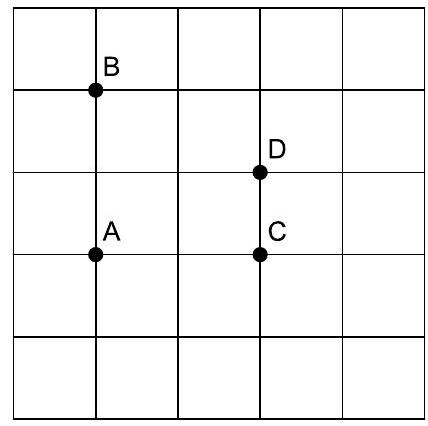
On the grid in the figure, two or more grid-intersection points are called equidistant with respect to a fixed point when their distances from that point are equal. For example, $B$ and $C$ are equidistant with respect to $A$, but $B$ and $D$ are not.
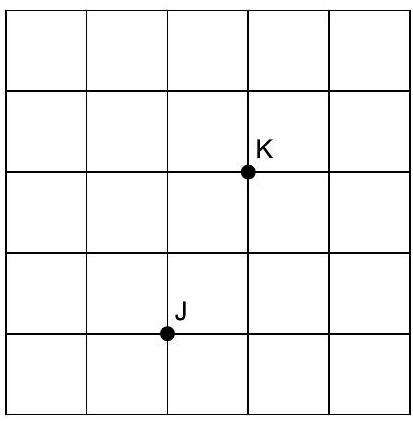
a) Mark on the following grid the points equidistant with $K$ with respect to $J$.
b) If the points need not be grid intersections, what figure is formed in the grid plane by the points equidistant with $K$ with respect to $J$?
c) If the points need not lie in the grid plane, what figure is formed by the points equidistant with $K$ with respect to $J$?
Professor M. A. Luco wrote the expression
$$
\frac{n^{2}-5 n+4}{n-4}
$$
on the board. He then told the students that $n$ may be any natural number except $4$.
a) What is the value of the expression for $n=1$?
b) Marcos substituted a natural number for $n$ and found that the value of the expression is $5$. Which number did he substitute?
c) Which natural numbers cannot be the numerical value of the expression?
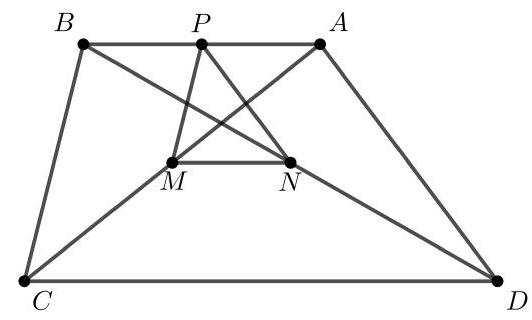
In trapezoid $ABCD$, sides $AB$ and $CD$ are parallel. Let $M$ be the midpoint of diagonal $AC$, $N$ the midpoint of diagonal $BD$, and $P$ the midpoint of side $AB$. We know that $AB=15\ \mathrm{cm}$, $CD=24\ \mathrm{cm}$, and the height is $h=14\ \mathrm{cm}$.