Each students is asked to remove three of the first twenty-one positive integers $(1,2,3,\ldots,21)$ and calculate the sum of the remaining eighteen numbers. The three numbers removed by each student contain two consecutive numbers, and no two students remove the same three numbers. At most how many students can correctly get $212$ as the answer?
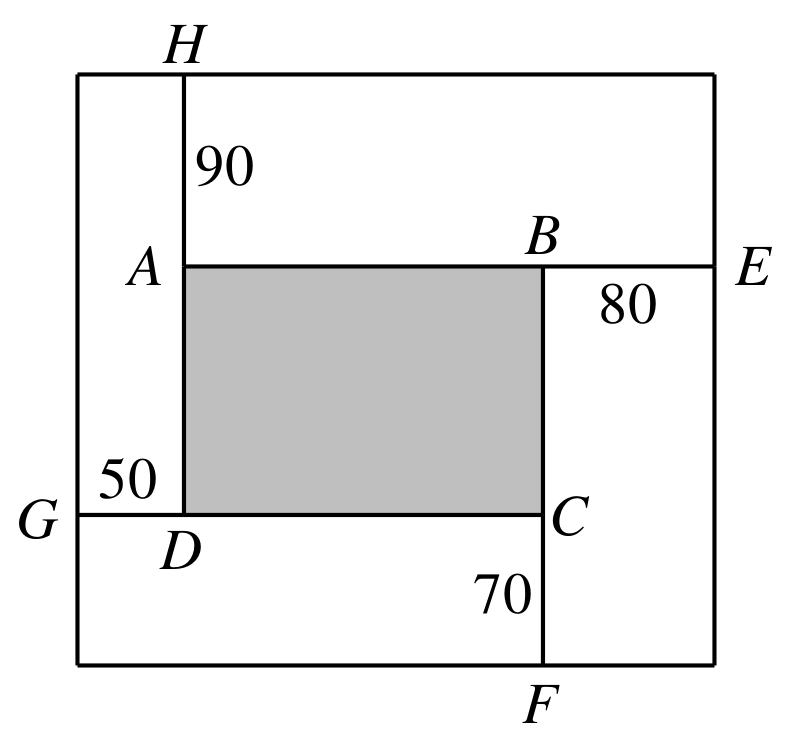
$ABCD$ is a rectangular house. A fence extends $AB$ to $E$ with $BE=80$ m. A fence extends $BC$ to $F$ with $CF=70$ m. A fence extends $CD$ to $G$ with $DG=50$ m. A fence extends $DA$ to $H$ with $AH=90$ m. Fences through $E$ and $G$ parallel to $AD$ and fences through $F$ and $H$ parallel to $AB$ are built, enclosing a rectangular plot with four rectangular gardens around the house. The sum of the perimeters of the four gardens is $2016$ m. What is the perimeter, in m, of the house?
A certain community is divided into organizations, each organization is divided into associations, each association is divided into societies and each society is divided into clubs. The number of clubs in each society, the number of societies in each association and the number of associations in each organization are the same integer which is greater than $1$. The community has a president, as does each organization, association, society and club. If there are $161$ presidential positions altogether, how many organizations are there in this community?
Each of the machines $A$ and $B$ can produce one bottle per minute. Machine $A$ has to rest for one minute after producing $3$ bottles and Machine $B$ has to rest $1.5$ minutes after producing $5$ bottles. What is the minimum number of minutes for these two machines to produce $2015$ bottles together?
The six digits $1,2,3,4,5$ and $6$ are used to construct a one-digit number, a two-digit number and a three-digit number. Each must be used only once and all six digits must be used. The sum of the one-digit number and the two-digit number is $47$ and the sum of the two-digit number and the three-digit number is $358$. Find the sum of all the three numbers.
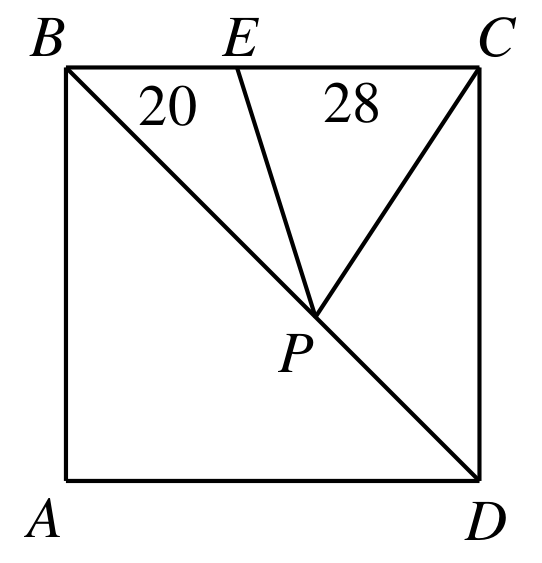
$E$ is a point on the side $BC$ of a square $ABCD$ such that $BE=20$ cm and $CE=28$ cm. $P$ is a point of the diagonal $BD$. What is the smallest possible value, in cm, of $PE+PC$?
In a group of distinct positive integers, the largest one is less than $36$, and is equal to three times the smallest one. The smallest number is equal to two-thirds of the group average. At most how many numbers are there in this group?
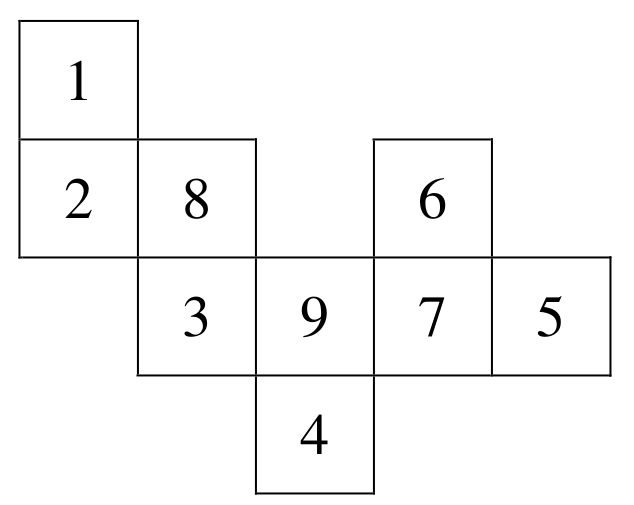
The diagram below shows the top view of a structure built with nine stacks of unit cubes. The number of cubes in each stack is indicated. Each stack rises from the bottom without gaps. The outside surface, including the nine $1$ by $1$ squares on the bottom, are painted. What is the total number of $1$ by $1$ faces that are painted?
The sum of the digits of each of four different three-digit numbers is the same, and the sum of these four numbers is $2015$. Find the sum of all possible values of the common digit sum of the four numbers.
There are three positive integers. The first is a two-digit number which consists of two identical digits. The second one is a two-digit number which consists of two different digits, and its units digit is the same as that of the first number. The third one is a one-digit number which consists of only one digit, which is the same as the tens digit of the second number. Exactly two of these three numbers are prime numbers. In how many different ways can the three positive integers be chosen?
A positive integer is divided by $5$. The quotient and the remainder are recorded. The same number is divided by $3$. Again the quotient and the remainder are recorded. If the same two numbers in different order are recorded, find the product of all possible values of the original number.
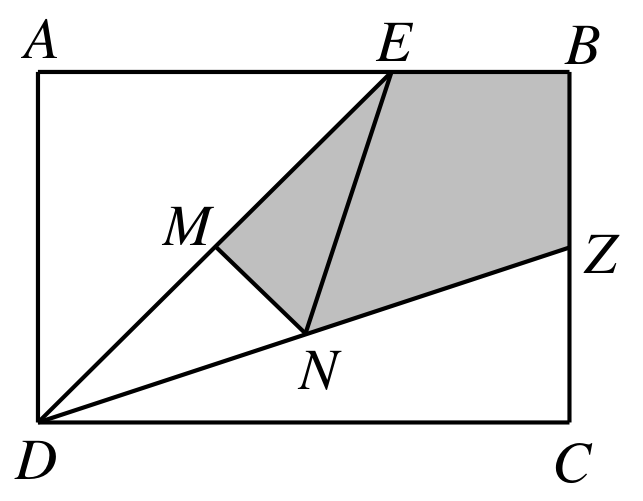
$E$ is a point of the side $AB$ of a rectangle $ABCD$ such that $AE=2EB$, and $Z$ is the midpoint of the side $BC$. $M$ and $N$ are the midpoints of $DE$ and $DZ$ respectively. If the area of the triangle $EMN$ is $5$ cm$^2$, calculate the area, in cm$^2$, of the pentagon $MEBZN$.
A number from $1,2,3,\ldots,19$ is said to be a follower of a second number from $1,2,3,\ldots,19$ if either the second number is $10$ to $18$ more than the first, or the first number is $1$ to $9$ more than the second. Thus $6$ is a follower of $16,17,18,19,1,2,3,4$ and $5$. In how many ways can we choose three numbers from $1,2,3,\ldots,19$ such that the first is a follower of the second, the second is a follower of the third, and the first is also a follower of the third?
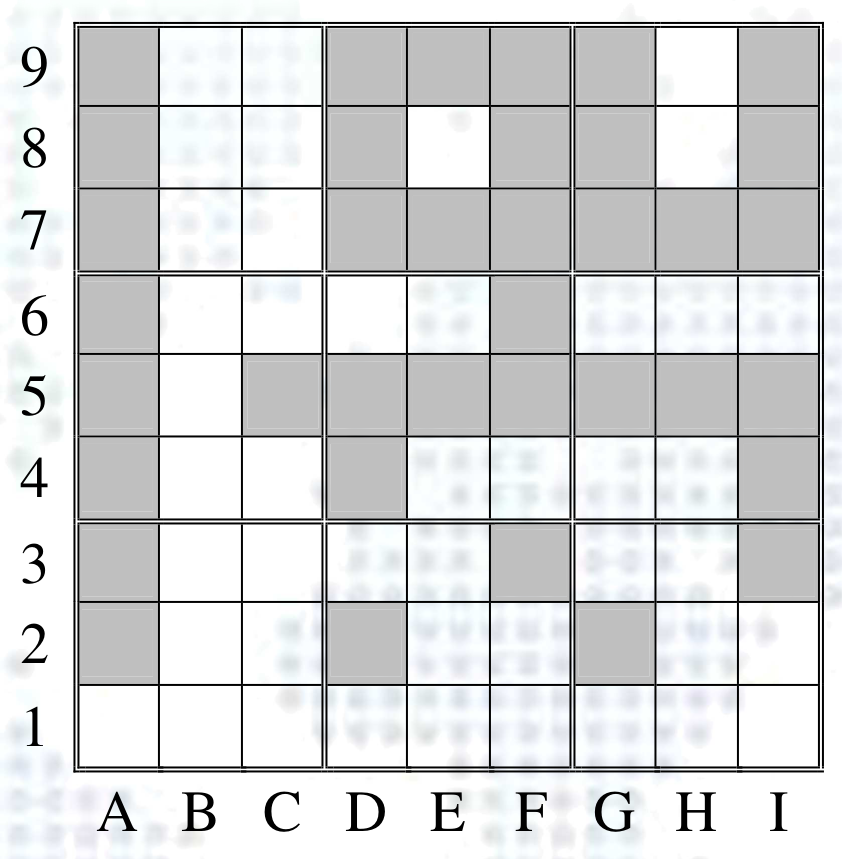
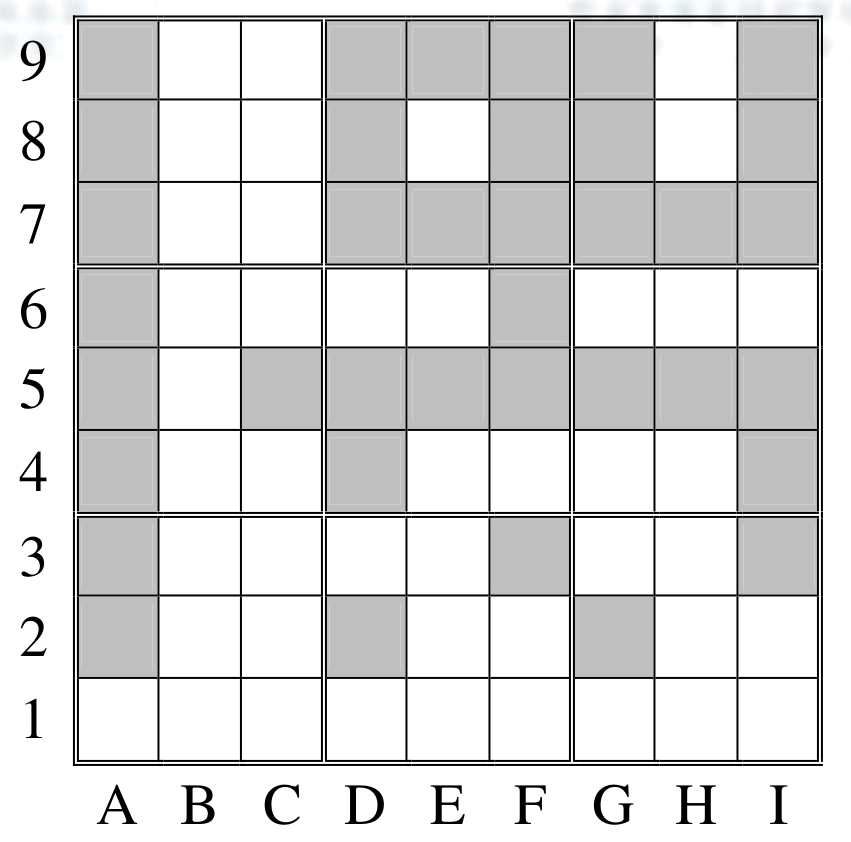
In the $9\times9$ table in the following diagram, some squares are shaded. Mark $9$ of the squares with “X” so that there is a marked square in each row, each column and each of the nine $3\times3$ subtables defined by the double lines. Shaded squares may not be marked.
A $14\times23$ piece of paper is divided by grid lines into $1\times1$ squares. We wish to cut out square pieces of paper of different sizes along the grid lines. What is the largest number of pieces we can get? Prove that no larger value can work, and give an example to show that your answer can be realized.
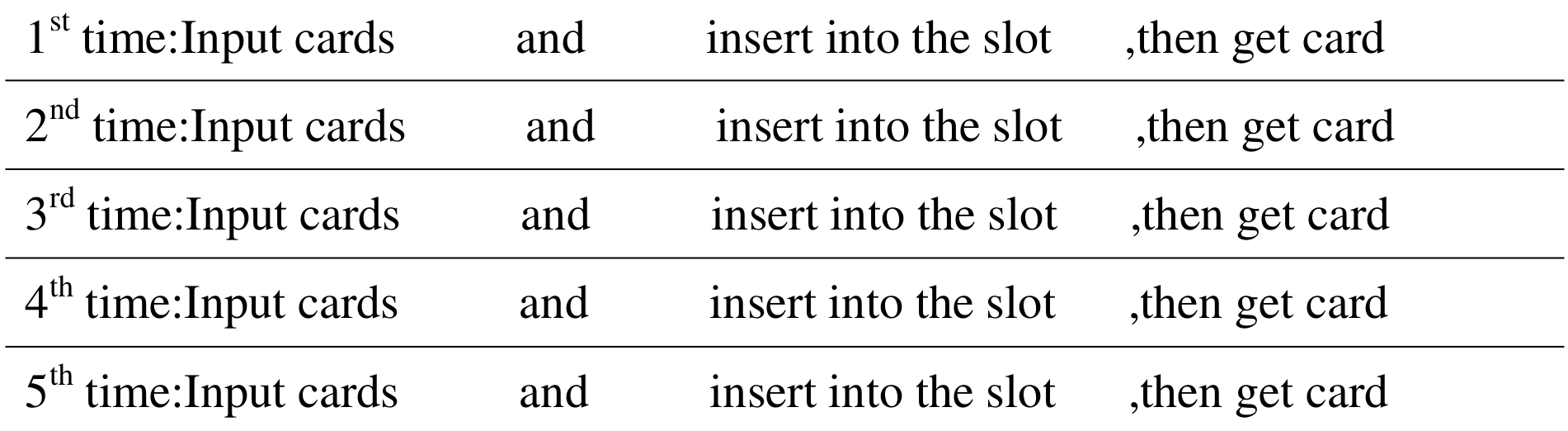
There is a machine with five slots. Each slots can receive two cards as input and in most cases will produce a new card as output. All cards have positive integers on them. The output from the $+,-,\times$ or $\div$ slots is the sum, the difference, the product or the quotient. If the difference or the quotient is not a positive integer, there is no output. The output from the $\sim$ slot is a number obtained by writing the second input immediately after the first input. For example, we get $102$ if we input $10$ and $2$, or $210$ if we input $2$ and $10$. All input cards are returned. Starting with two cards with the numbers $1$ and $2$, find a way of getting a card with the number $2015$, using the machine only five times. Every time we use a slot it counts as a separate operation.
For each of the five response rows, record the two input cards, the slot and the output card.
Twenty rabbits are hopping along the same path in the same direction, each at a different constant speed. The first rabbit leaves the starting point at noon. Each of the other rabbits leaves one minute after the preceding one. The second rabbit catches up with the first rabbit two minutes after it starts hopping. The third rabbit catches up with the second rabbit three minutes after it starts hopping. The pattern continues, so that the twentieth rabbit catches up with the nineteenth rabbit twenty minutes after it starts hopping. How many minutes past noon does the twentieth rabbit catch up with the first rabbit?
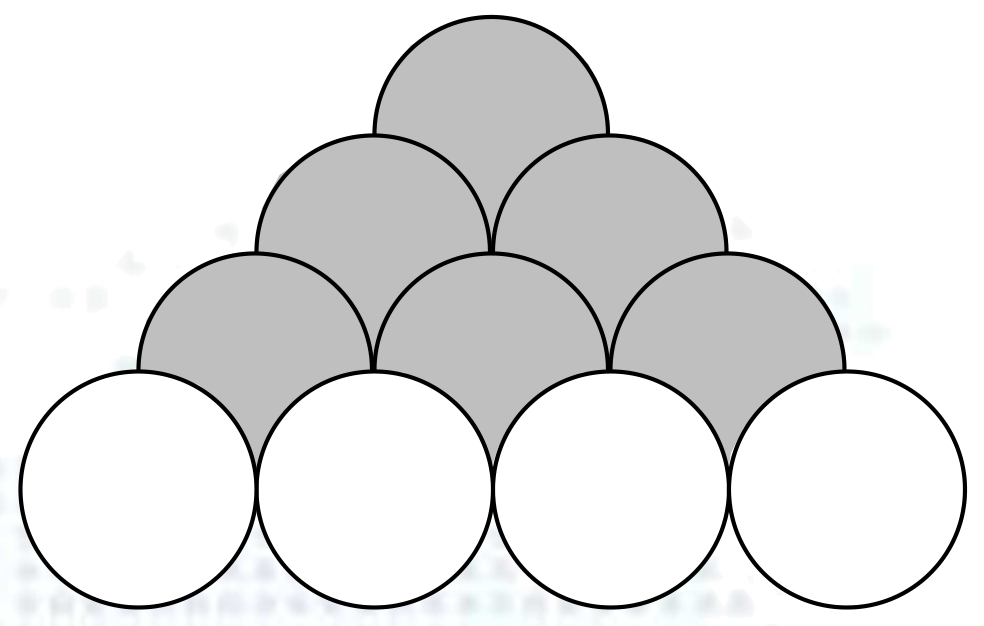
The diagram below shows ten circles each of radius $1$ cm long. The four circles in the front row are tangent to their neighbours and their centres lie on the same line. For each of the six circles behind, the top semicircle runs between the highest points of two circles in the row in front. Calculate the area, in cm$^2$, of the figure excluding the four circles in the front row. You may make take $\pi$ to be $3.14$.