The sum of four of the six fractions $\frac13,\frac16,\frac19,\frac1{12},\frac1{15},\frac1{18}$ is $\frac23$. Find the product of the other two fractions.
Find the quotient when a four-thousand-digit number consisting of two thousand ones followed by two thousand twos is divided by a two-thousand-digit number every digit of which is $6$.
Let $a,b,c,d,e$ be single-digit numbers. If the square of the fifteen-digit number $100000035811ab1$ is the twenty-nine-digit number $1000000cde2247482444265735361$, find $a+b+c-d-e$.
On the Celsius scale, water freezes at $0^\circ$ and boils at $100^\circ$. On the Sulesic scale, it freezes at $20^\circ$ and boils at $160^\circ$. Find the Sulesic temperature corresponding to $215^\circ$ Celsius.
All vertices of one square lie on a circle. Two adjacent vertices of another square lie on that circle and its other two vertices lie on one diameter. Find the ratio of the second square’s area to the first square’s area.
Ten positive integers are written in a row. Any three adjacent numbers have sum $20$. The first number is $2$ and the ninth is $8$. Find the fifth number.
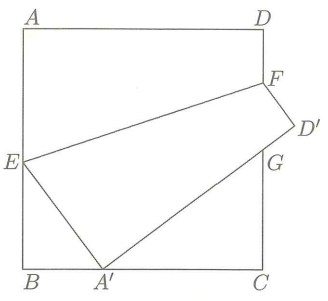
$E$ lies on side $AB$ and $F$ on side $CD$ of square $ABCD$. When the square is folded along $EF$, the new position $A^\prime$ of $A$ lies on $BC$. Let $D^\prime$ be the new position of $D$, and let $G$ be the intersection of $CF$ and $A^\prime D^\prime$. Prove $A^\prime E+FG=A^\prime G$.
Twenty distinct positive integers are written on the front and back of ten cards, one on each face. The sum of the two integers on each card is the same for all cards. The sum of the ten front integers equals that of the ten back integers. Nine front integers are $2,5,17,21,24,31,35,36,42$. Find the remaining front integer.
Two three-digit numbers $a,b$ and a four-digit number $c$ satisfy that the digit sums of $a+b,b+c,c+a$ are all $3$. Find the largest possible digit sum of $a+b+c$.
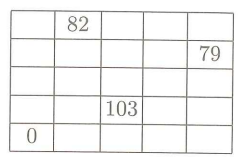
Four nonnegative integers have been entered in the following $5\times5$ table. Fill its remaining $21$ spaces with positive integers so that every row and every column has the same sum.
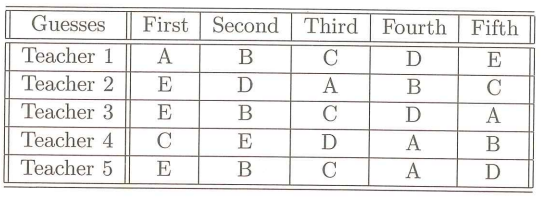
Five teachers predict the finish order of five classes $A,B,C,D,E$ in an examination, as in the table below. There are no ties. Two teachers each correctly predict exactly two classes’ ranks; the other three correctly predict none. Find the finish order.
| Teacher | First | Second | Third | Fourth | Fifth |
|---|---|---|---|---|---|
| 1 | A | B | C | D | E |
| 2 | E | D | A | B | C |
| 3 | E | B | C | D | A |
| 4 | C | E | D | A | B |
| 5 | E | B | C | A | D |