Given circles $\omega_1$ and $\omega_2$ intersecting at points $X$ and $Y$,
let $\ell_1$ be a line through the center of $\omega_1$
intersecting $\omega_2$ at points $P$ and $Q$
and let $\ell_2$ be a line through the center of $\omega_2$
intersecting $\omega_1$ at points $R$ and $S$.
Prove that if $P$, $Q$, $R$, and $S$ lie on a circle
then the center of this circle lies on line $XY$.
Proposed by Ian Le (credit in the supplied third-party notes).
Let $n$ be a positive integer.
Determine the size of the largest subset of $\{ -n, -n+1, \ldots, n-1, n\}$
which does not contain three elements $a$, $b$, $c$ (not necessarily distinct)
satisfying $a+b+c=0$.
Proposed by Kiran Kedlaya, Tewordos Amdeberhan (credit in the supplied third-party notes).
We define a chessboard polygon to be a simple polygon whose sides are
situated along lines of the form $x=a$ or $y=b$, where $a$ and $b$ are integers.
These lines divide the interior into unit squares, which are shaded alternately
gray and white so that adjacent squares have different colors.
To tile a chessboard polygon by dominoes is to
exactly cover the polygon by non-overlapping $ 1 \times 2$ rectangles.
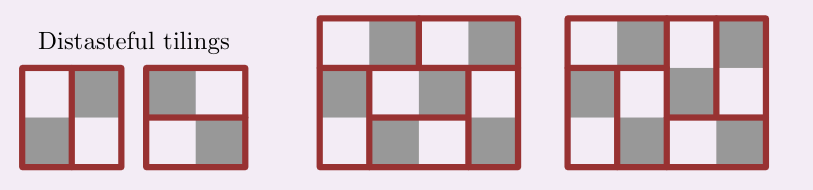
Finally, a tasteful tiling is one which avoids the
two configurations of dominoes and colors shown on the left below.
Two tilings of a $3 \times 4$ rectangle are shown;
the first one is tasteful, while the second is not,
due to the vertical dominoes in the upper right corner.
Prove that (a) if a chessboard polygon can be tiled by dominoes,
then it can be done so tastefully, and (b) such a tasteful tiling is unique.
Proposed by Sam Vandervelde (credit in the supplied third-party notes).
Trapezoid $ABCD$, with $\overline{AB} \parallel \overline{CD}$,
is inscribed in circle $\omega$ and point $G$ lies inside triangle $BCD$.
Rays $AG$ and $BG$ meet $\omega$ again at points $P$ and $Q$, respectively.
Let the line through $G$ parallel to $\overline{AB}$ intersect
$\overline{BD}$ and $\overline{BC}$ at points $R$ and $S$, respectively.
Prove that quadrilateral $PQRS$ is cyclic
if and only if $\overline{BG}$ bisects $\angle CBD$.
Proposed by Zuming Feng (credit in the supplied third-party notes).
Let $s_1, s_2, s_3, \ldots$ be an infinite,
nonconstant sequence of rational numbers,
meaning it is not the case that $s_1 = s_2 = s_3 = \ldots$.
Suppose that $t_1, t_2, t_3, \ldots$ is also an infinite,
nonconstant sequence of rational numbers
with the property that $(s_i - s_j)(t_i - t_j)$
is an integer for all $i$ and $j$.
Prove that there exists a rational number $r$
such that $(s_i - s_j)r$ and $(t_i - t_j)/r$
are integers for all $i$ and $j$.
Proposed by Gabriel Carroll (credit in the supplied third-party notes).