Adele has a fruit basket containing one apple, two bananas and three oranges, while Betty has a fruit basket containing two apples and three oranges. Assuming that Adele and Betty each randomly picked a fruit from her own basket, what is the probability that together they picked an apple and an orange?
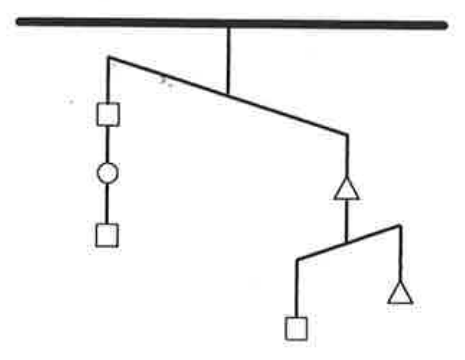
The following diagram shows a system of balances hanging from the ceiling with three types of weights. The balances tip down to the heavier side. If we use $\square\lt \triangle$ to represent $\square$ is lighter than $\triangle$, which of the following is true?
A shop sells two types of buns, with either cream or jam filling, which are indistinguishable until someone bites into the buns. Four mathematicians visited the shop and ordered (not necessarily in that sequence): three cream buns, two cream buns and one jam bun, one cream and two jam buns, and three jam buns. Each knew precisely what the others had ordered. Unfortunately, the shop owner mixed up the orders and gave each mathematician the wrong order!
The mathematicians started eating, all still unaware of the mixup, until the shop owner came over to inform them of the mistake. Mathematician A said: “I ate two buns and both had cream filling. So, if my order was wrong, I now know what type my third bun is.” Mathematician B then said: “I only ate one bun and it had cream filling. Based on what A said and since I remember A’s order, I now know what type my other two buns are.” Finally, Mathematician C said: “I have not started eating but I must have received three jam buns.” Which of the following statements about Mathematician D is correct?
D ordered two cream and one jam but received three jam buns.
D ordered one cream and two jam but received two cream and one jam buns.
D ordered three cream but received one cream and two jam buns.
D ordered three jam but received three cream buns.
If $n$ can take the value of any positive integer, how many distinct values can the expression $$\left\lfloor\frac n4\right\rfloor-\left\lfloor\frac n7\right\rfloor-\left\lfloor\frac n{14}\right\rfloor-\left\lfloor\frac n{28}\right\rfloor$$ take?
Let $n$ be a positive integer. If the lowest common multiple of $n$ and $12$ is $60$, and the highest common factor of $n$ and $36$ is $4$, what is the value of $n$?
The digits $1,2,3,4,5$ and $6$ are arranged to form two positive integers with each digit appearing exactly once. How many ways can this be done if the sum of the two integers is $570$?
Consider the following product of two mixed fractions $$m\frac67\times n\frac13=23,$$ where $m$ and $n$ are positive integers. What is the value of $m+n$?
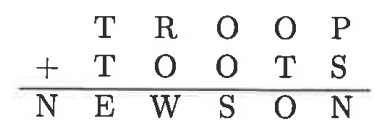
In the figure below, each distinct letter represents a unique distinct digit such that the arithmetic holds. If $W$ represents $5$, what number does TROOP represent?
$$\begin{array}{rrrrrr}&T&R&O&O&P\\+&T&O&O&T&S\\\hline N&E&W&S&O&N\end{array}$$
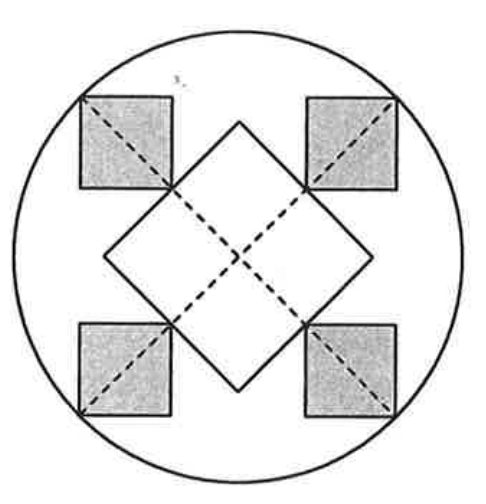
In the following diagram, a white square and four grey squares of equal size are drawn in a circle such that both dashed lines form diameters of the circle. If the diameter has length $60$, find the smallest possible value for the total area of the squares.
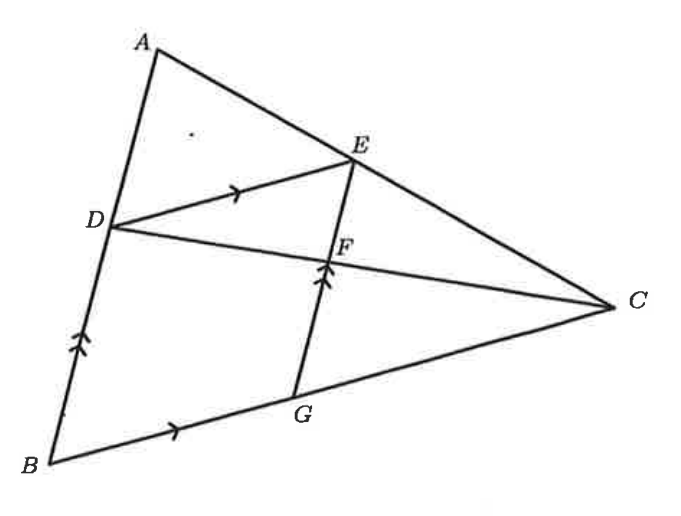
In the following diagram, $ABC$ is a triangle and $D$ lies on $AB$ such that the ratio $|AD|:|DB|=3:4$. Points $E$ and $G$ lie on $AC$ and $BC$ respectively such that $DBGE$ is a parallelogram and $F$ is the intersection of $DC$ and $GE$. If the ratio of the area of $\triangle EDF$ to the area of $\triangle ABC$ is $m:n$, where the highest common factor of $m$ and $n$ is $1$, what is the value of $m+n$?
Eggs in a certain supermarket are sold only in trays containing exactly 10, 12 or 30 eggs per tray. That is, it is impossible to buy exactly 14 eggs or any odd number of eggs. However, it is possible to buy exactly 78 eggs using four trays of 12 and one tray of 30. What is the largest even number of eggs that is impossible to be bought from this supermarket?
What is the smallest $k$ such that every subset of $\{1,2,\ldots,99\}$ with exactly $k$ integers contains at least two distinct integers $x$ and $y$, such that $|x-y|\le2$?
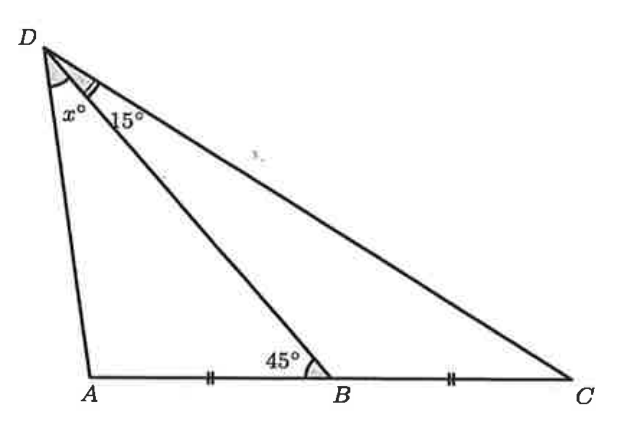
In the following diagram, $ACD$ is a triangle such that $|AB|=|BC|$, $\angle ABD=45^\circ$ and $\angle BDC=15^\circ$. If $\angle ADB=x^\circ$, what is the value of $x$?