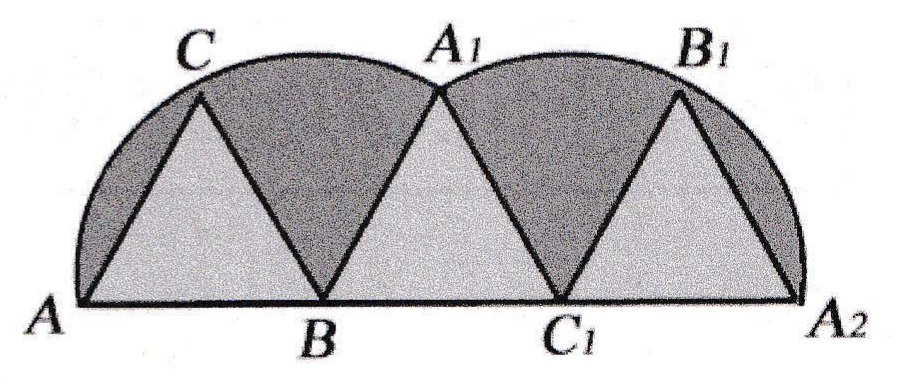
$ABC$ is an equilateral triangle of side $6$ cm. It first rotates about $B$, then $C_1$, without sliding. As a result, Vertex $A$ travels from $A$ to $A_1$, then comes to rest at $A_2$. Find the length, in cm, of the path travelled by vertex $A$, in terms of $\pi$.
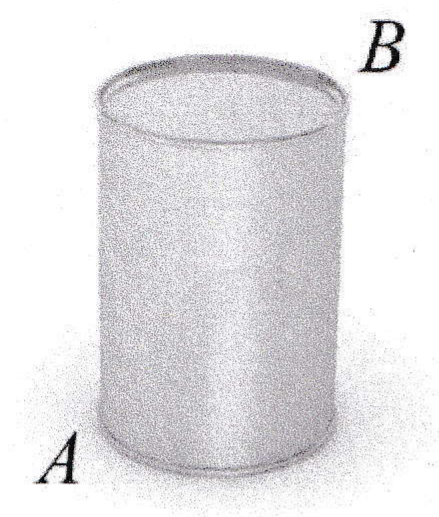
The figure shows a can of height $8$ cm. The circumference of its base is $44$ cm. Find the shortest distance from $A$ to $B$, without cutting through the can.
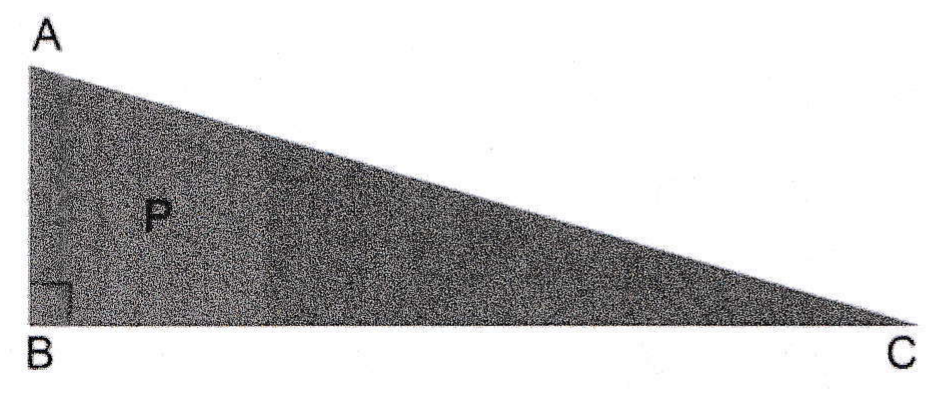
In triangle $ABC$, $\angle ABC=90^\circ$, $AB=7$ cm and $BC=24$ cm. $P$ is a point inside the triangle such that its shortest distance to each side of the triangle is the same. What is this distance?
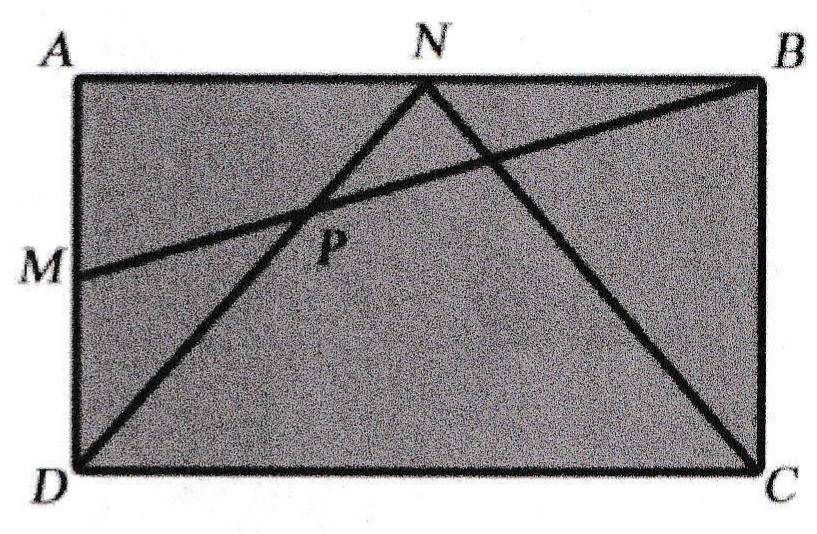
$M$ and $N$ are midpoints of $AD$ and $AB$, respectively, in rectangle $ABCD$. Lines $BM$ and $DN$ intersect at point $P$. Find $\angle MPD$, given that $\angle MBC=\angle BCN+31^\circ$.
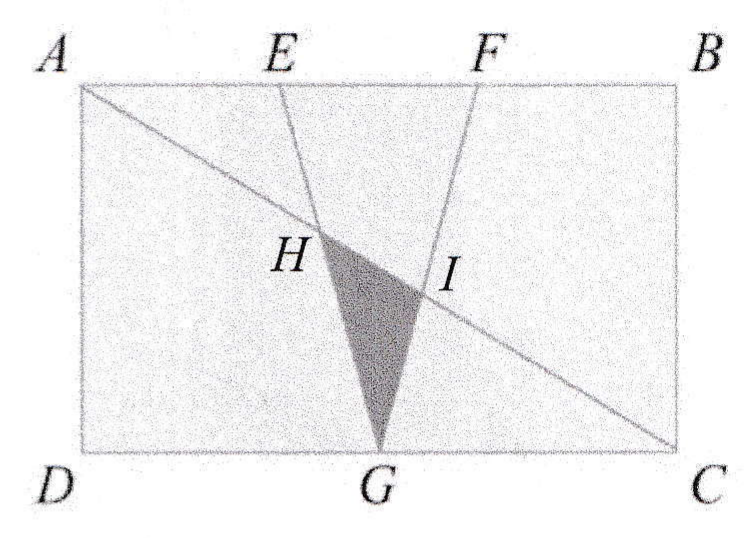
The area of rectangle $ABCD$ is $35\text{ cm}^2$. Points $E$ and $F$ divide side $AB$ into $3$ equal segments. $G$ is the midpoint of side $CD$. Find the area of green triangle $GHI$ in $\text{cm}^2$.
An integer is chosen from the set $\{1,2,3,\ldots,499,500\}$. The probability that this integer is divisible by $9$ or $11$ is $\dfrac mn$, in its lowest terms. Find the value of $m+n$.
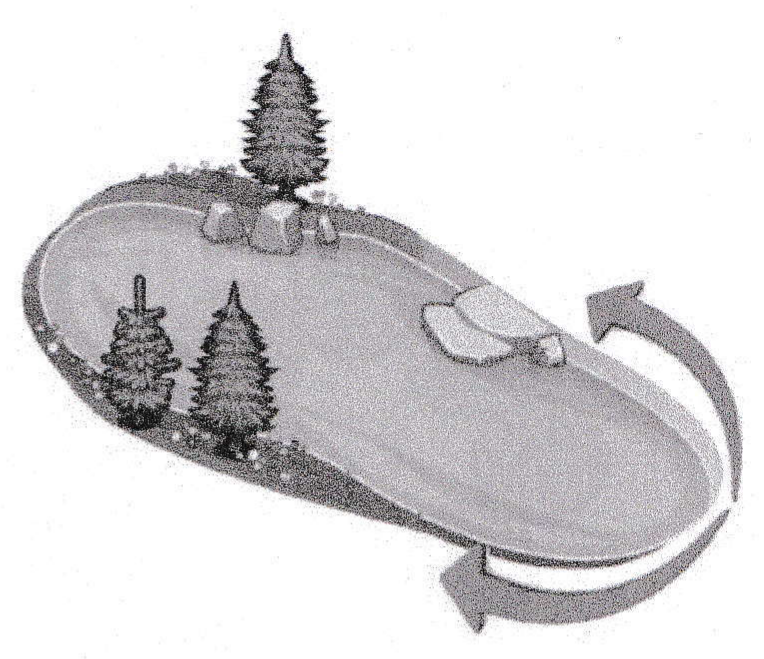
The circumference of a circular lake is $30\text{ km}$. Paul and Mary cycle around the lake in opposite directions, both starting from the same point.
Paul's speed is $250\text{ m/min}$, but he rests for $5$ minutes after every $55$ minutes of cycling. Mary's speed is $200\text{ m/min}$, but she rests for $10$ minutes after every $1\text{ h}$ of cycling. Find the time taken, in hours, for them to meet for the first time.