A set of $1990$ persons is divided into non-intersecting subsets in such a way that
(a) no one in a subset knows all the others in the subset;
(b) among any three persons in a subset, there are always at least two who do not know each other; and
(c) for any two persons in a subset who do not know each other, there is exactly one person in the same subset knowing both of them.
(i) Prove that within each subset, every person has the same number of acquaintances.
(ii) Determine the maximum possible number of subsets.
Note: it is understood that if a person $A$ knows person $B$, then person $B$ will know person $A$; an acquaintance is someone who is known. Every person is assumed to know one's self.
Let $a_{1}, a_{2}, \ldots, a_{n}$ be positive real numbers, and let $S_{k}$ be the sum of products of $a_{1}, a_{2}, \ldots, a_{n}$ taken $k$ at a time.
Show that
$$
S_{k} S_{n-k} \geq \binom{ n}{k}^{2} a_{1} a_{2} \ldots a_{n}, \quad \text{ for } \quad k=1,2, \ldots, n-1
$$
Consider all the triangles $A B C$ which have a fixed base $A B$ and whose altitude from $C$ is a constant $h$. For which of these triangles is the product of its altitudes a maximum?
Given that $f(x) = \frac{ax+b}{cx+d}$, $f(0) \neq 0$, $f(f(0)) \neq 0$. Let $F(x) = \underbrace{f(\dots(f(x)\dots))}_{n \text{ times}}$. If $F(0) = 0$, show that $F(x) = x$ for all $x$ where the expression is defined.
$ABCD$ is a convex quadrilateral. $E, F, G, H$ are the midpoints of sides $AB, BC, CD, DA$ respectively. Find the point $P$ such that area $PHAE = \text{area } PEBF = \text{area } PFCG = \text{area } PGDH$.
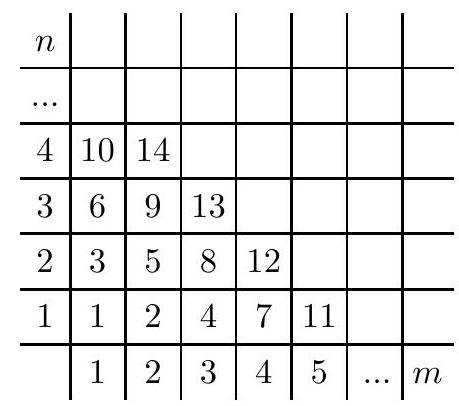
The squares of a squared paper are enumerated as follows:
Devise a polynomial $p(m, n)$ of two variables $m, n$ such that for any positive integers $m$ and $n$ the number written in the square with coordinates $(m, n)$ will be equal to $p(m, n)$.
Let $*$ denote an operation, assigning a real number $a * b$ to each pair of real numbers $(a, b)$ (e.g., $a * b = a + b^{2} - 17$). Devise an equation which is true (for all possible values of variables) provided the operation $*$ is commutative or associative and which can be false otherwise.
Let $ABCD$ be a quadrangle, $|AD| = |BC|$, $\angle A + \angle B = 120^{\circ}$ and let $P$ be a point exterior to the quadrangle such that $P$ and $A$ lie at opposite sides of the line $DC$ and the triangle $DPC$ is equilateral. Prove that the triangle $APB$ is also equilateral.
In two piles there are $72$ and $30$ sweets respectively. Two students take, one after another, some sweets from one of the piles. Each time the number of sweets taken from a pile must be an integer multiple of the number of sweets in the other pile. Is it the beginner of the game or his adversary who can always assure taking the last sweet from one of the piles?
Integers $1, 2, \ldots, n$ are written (in some order) on the circumference of a circle. What is the smallest possible sum of moduli of the differences of neighbouring numbers?
A segment $AB$ of unit length is marked on the straight line $t$. The segment is then moved on the plane so that it remains parallel to $t$ at all times, the traces of the points $A$ and $B$ do not intersect and finally the segment returns onto $t$. How far can the point $A$ now be from its initial position?
The midpoint of each side of a convex pentagon is connected by a segment with the intersection point of the medians of the triangle formed by the remaining three vertices of the pentagon. Prove that all five such segments intersect at one point.