Xiaoming writes down all the perfect square numbers continuously, starting from 1, in increasing order from left to right, one after the other as shown:
$$1491625364964\ldots$$
Which digit is located in the 121st place starting from the left?
A four-digit number is said to be nice if it satisfies the following conditions:
- all the digits are distinct,
- the number is divisible by 6,
- the digits are in descending order from left to right,
- the number is greater than 9000 but less than 10000.
Tom and Jerry play a game. They alternately take some marble(s) out of a box containing 2024 marbles, starting with Tom. In each turn, each player must take $2^m$ marble(s) from the box, where $m$ is a non-negative integer, i.e., $m=0,1,2,3,\ldots$. For example, a player may take 1 marble, 4 marbles or 32 marbles, but cannot take 10 marbles, because 10 is not a power of 2. The player who takes the last marble(s) from the box wins the game. Determine who has a winning strategy and explain the winning strategy.
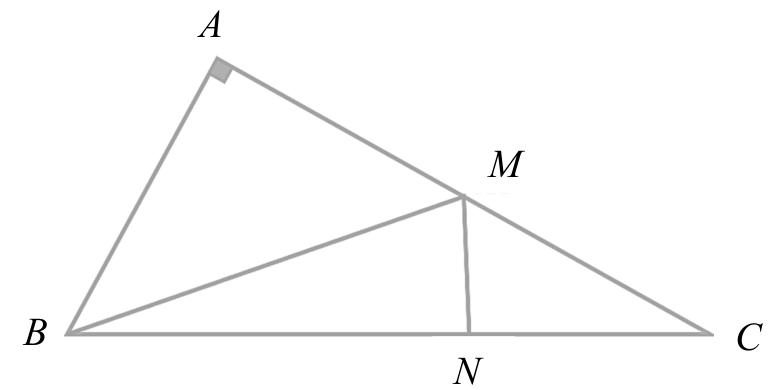
In the diagram, $ABC$ is a right-angled triangle at $A$, such that $AB=8$ cm, $AC=12$ cm and $M$ is the midpoint of $AC$. Let $N$ be a point on $BC$ such that $BN=2NC$. What is the length, in cm, of $MN$?
Nala has six cards. All the numbers on the cards are consecutive two-digit factors of the product $2023\times2024\times2025$. He selects the minimum number of cards where the sum of all digits is 21. He arranges all the selected cards in a line to form a bigger number. What is the second largest number that Nala can form?
Tony has two water tanks, each has a capacity of 1234 liters. At the beginning, Tank Red is full of water, while Tank Blue is empty. Tony accepts the challenge from his friend that for each turn, he can do one of the following options:
- Option A: Pour 1 liter of water from Tank Red to Tank Blue,
- Option B: Drain out the water from Tank Red out with the same volume as the volume of water in Tank Blue at that time.
What is the minimum number of turns that Tony takes such that the amount of water in Tank Red will be the same as that in Tank Blue?
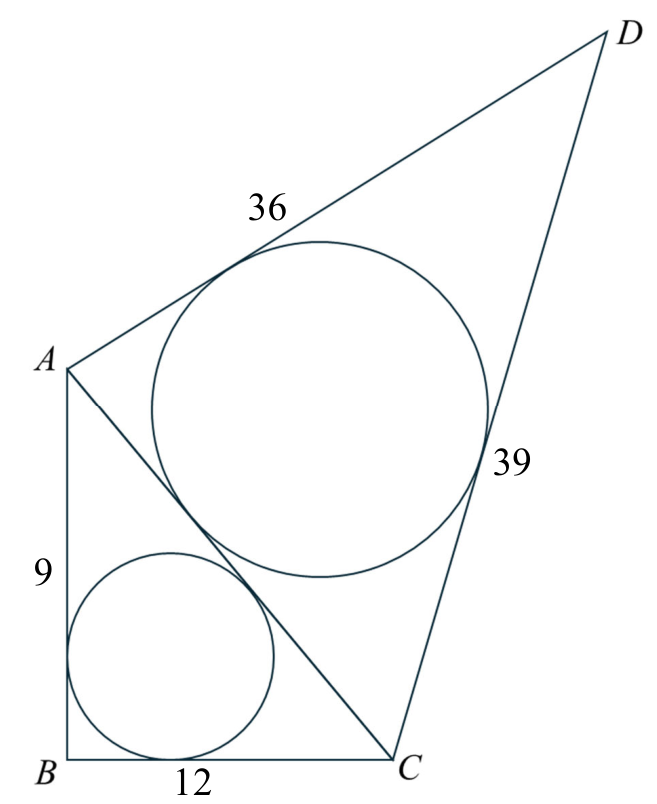
In the diagram, $ABCD$ is a quadrilateral where $\angle ABC=90^\circ$, $AB=9$, $BC=12$, $CD=39$ and $DA=36$. Circle $M$ is tangent to each side of $\triangle ABC$, and circle $N$ is tangent to each side of $\triangle ACD$. What is the ratio of the radius of circle $N$ to the radius of circle $M$?
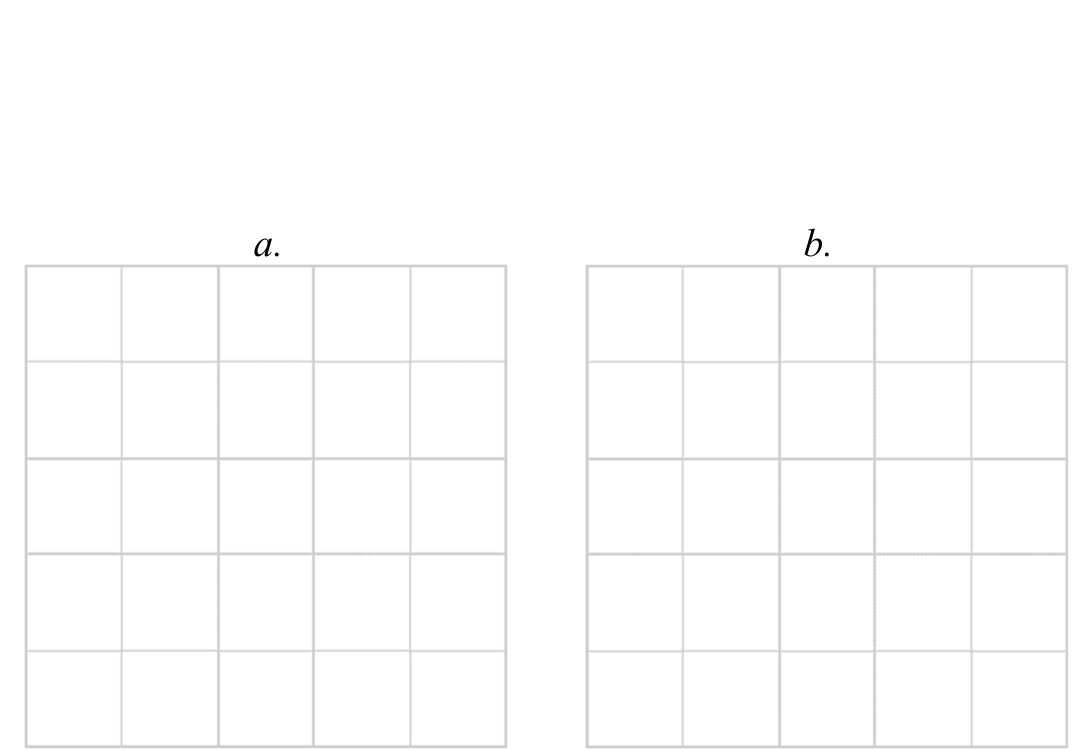
A $5\times5$ table is called a UCAS table if it satisfies the following conditions:
- Each cell is coloured with grey or white,
- Any two adjacent cells (sharing an edge) must have different colours,
- The 25 cells are filled with 25 consecutive integers, which must include 2024,
- The numbers in any two adjacent cells (sharing an edge) must have different parity (cannot be both odd or both even).
Now, your tasks are to:
a. Construct a UCAS table which gives the greatest possible sum of all integers in the shaded cells. What is the sum?
b. Construct a UCAS table which gives the smallest possible sum of all integers in the shaded cells. What is the sum?
The IMSO ROBOT stands at box 1 in a path with 15 boxes that are arranged in a line as shown in the diagram below. In each turn, the IMSO ROBOT can only move 1, 2 or 3 step(s) to the right. So, in the first turn, the IMSO ROBOT can either move one step to land into box 2, two steps to land into box 3 or three steps to land into box 4. If the IMSO ROBOT cannot land outside of the boxes, what is the total number of ways to move the IMSO ROBOT to land into box 15?
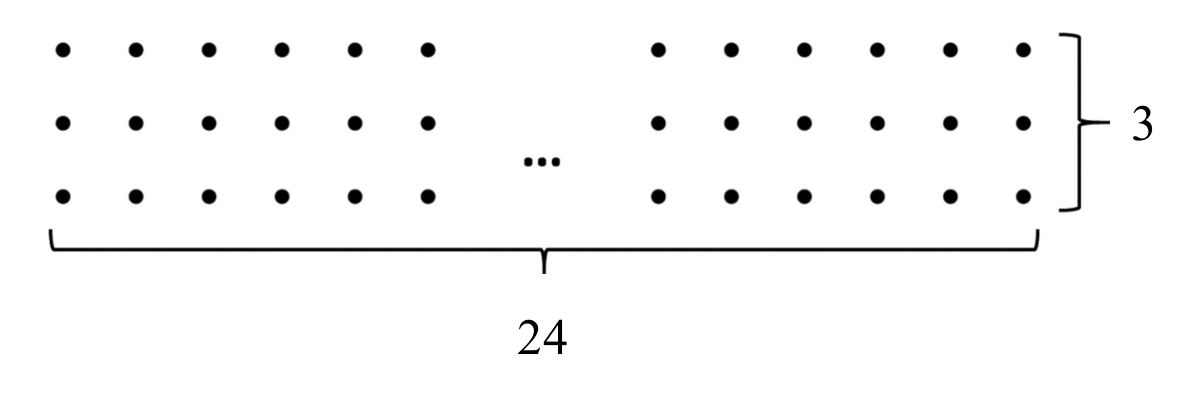
In the diagram, 72 dots lie in 3 rows and 24 columns. The distance between consecutive rows and the consecutive columns are equal. In how many ways can we draw a straight line passing through at least 3 dots?
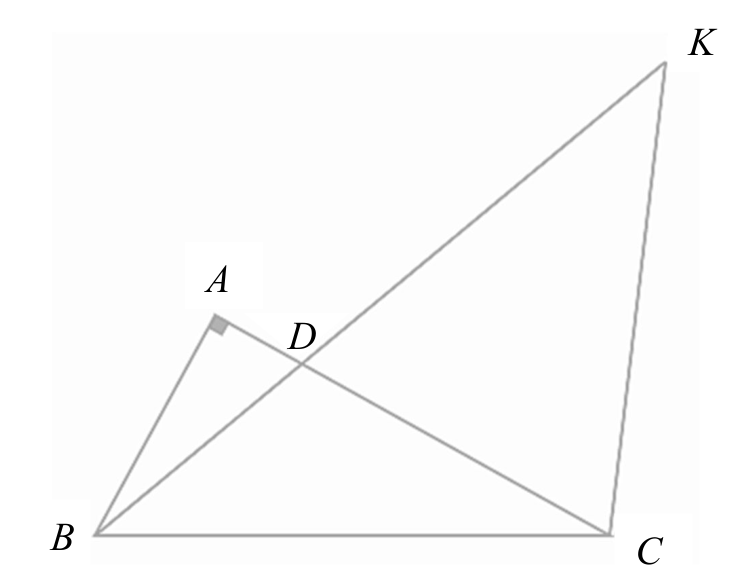
In the diagram, $ABC$ is a right-angled triangle at $A$ and $\angle ABC=60^\circ$. On side $AC$, point $D$ is taken such that $\angle ABD=20^\circ$. On ray $BD$, point $K$ is taken such that $DK=BC$. What is the measure, in degrees, of $\angle KCB$?
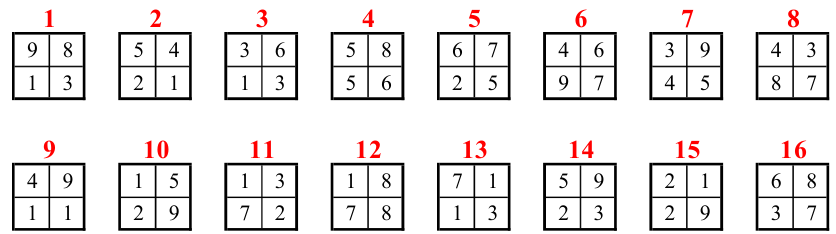
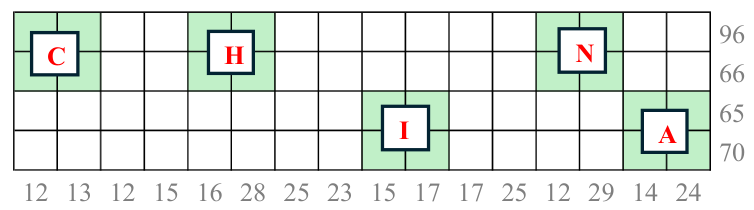
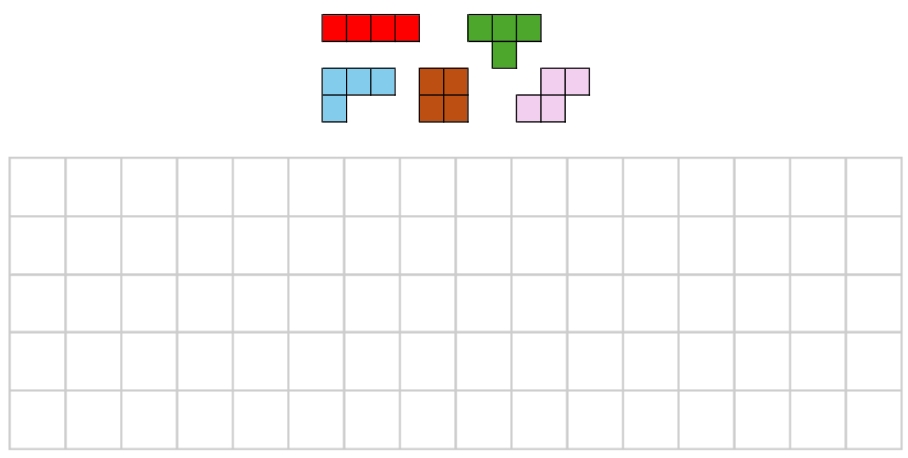
Fill the $4\times16$ grid using the sixteen $2\times2$ tiles below, each exactly once. Every column sum must equal the number below it; each row sum is given at its right. What are the tile numbers represented by [C], [H], [I], [N], [A]?
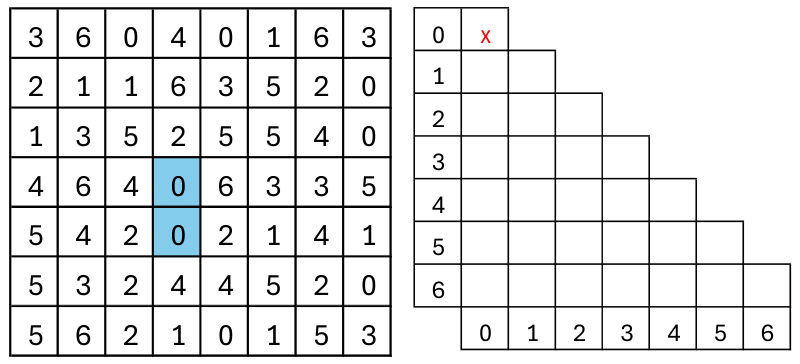
A standard domino set has 28 pieces: 6-6, 6-5, 6-4, 6-3, 6-2, 6-1, 6-0, 5-5, 5-4, 5-3, 5-2, 5-1, 5-0, 4-4, 4-3, 4-2, 4-1, 4-0, 3-3, 3-2, 3-1, 3-0, 2-2, 2-1, 2-0, 1-1, 1-0, 0-0.
a. In the left diagram, a standard set is laid out in an $8\times8$ grid. Mark the domino positions in pencil. The checklist at right may help: cross out each found domino. The 0-0 domino has already been marked.
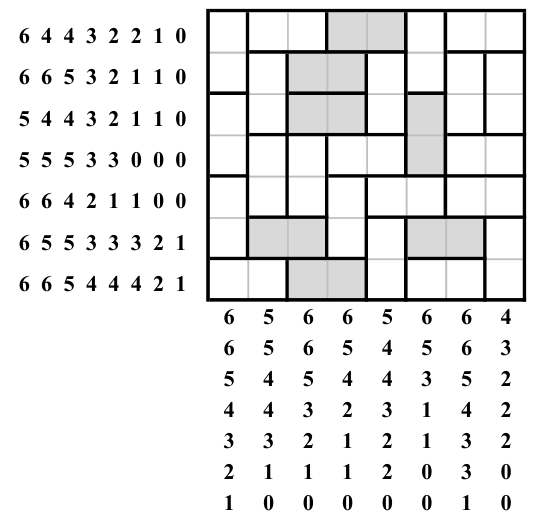
b. Bold lines show domino positions. Numbers beside each row and below each column must occur in that row or column, not necessarily in the given order. In a horizontal domino, the smaller number is on the right; in a vertical domino it is at the top. Each colored domino has equal numbers. Complete the $8\times8$ grid.
Editorial source note: both figures actually show 7 rows and 8 columns. The original wording and numbers are retained; see the solution for further contradictions.
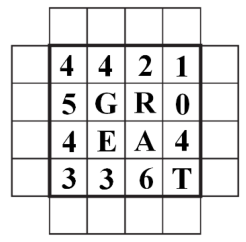
Place an arrow in each of the 16 outer squares, vertically, horizontally, or diagonally at 45 degrees, pointing into the bold-bordered grid. A number inside the bold border is the number of arrows pointing to that square. Draw all arrows correctly and find the five-digit number $\overline{GREAT}$, where G,R,E,A,T are the five missing numbers.
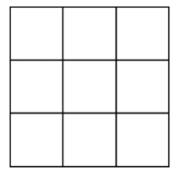
Andy wants to shade some cells so that no two shaded cells share an edge. How many ways are there to shade (a) fewer than 3 cells, (b) 3 or 4 cells, (c) more than 4 cells?
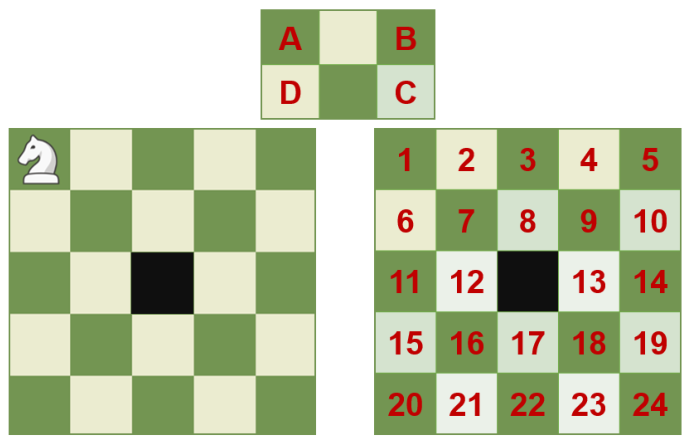
A $5\times5$ square board has its center square missing, marked black. A white knight moves in an L-shape: in the illustrated $3\times2$ rectangle it can move A to C, C to A, B to D, or D to B. Starting at the top-left square (Square 1), list every possible route by writing in order the numbers of the squares visited. A route passes through every available square exactly once.