Five points $A$, $B$, $C$, $D$ and $E$ are on a plane such that $AB=90$ cm, $BC=45$ cm, $CD=252$ cm, $DE=81$ cm and $EA=36$ cm. What is the length, in cm, of $CE$?
There are 23 students in a room. Their ages are either 10, 11, 12 or 13 years old, and there is at least one student of each age. It is known that their total age is 253, and there are 1.5 times as many 12-year-old students as 13-year-old students. How many 10-year-old students are there?
Mr. Nam has 10 cuboid prisms: one of size $2\text{ cm}\times2\text{ cm}\times2\text{ cm}$, three of size $1\text{ cm}\times1\text{ cm}\times2\text{ cm}$, and six of size $1\text{ cm}\times1\text{ cm}\times1\text{ cm}$. He wants to make a larger cuboid prism by using some of them. What is the biggest possible surface area, in cm², of the new cuboid prism?
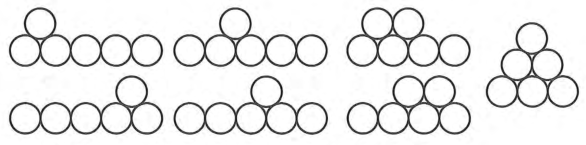
Consider the arrangements of $n$ identical circles, without overlapping, such that there are at least two rows of circles. Each circle should touch the next one in the same row and each circle except those on the bottom row should touch two circles on the row below it. For example, there are 7 possible arrangements for $n=6$ as shown in the diagram below.
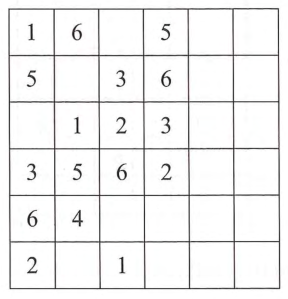
Each small square in a $6\times6$ table is filled with one of the numbers 1, 2, 3, 4, 5 and 6, so that any row or column has six different numbers. The numbers in some squares are filled as below. How many different completed tables are there?
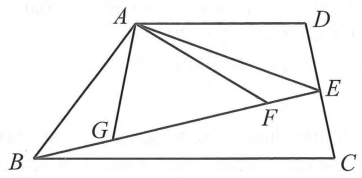
In the diagram below, $ABCD$ is a trapezium and $E$ is the midpoint of $DC$. The areas of the triangles $ABG$, $ABF$ and $AGE$ are 15 cm², 45 cm² and 60 cm², respectively. What is the area, in cm², of the trapezium $ABCD$?
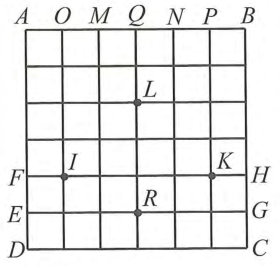
Mr. Nobi used a square grid paper $ABCD$, as shown in the diagram, to fold an envelope.
Then, he folded it as follows:
1) Fold $D$ to $F$;
2) Fold $E$ to $I$ and $G$ to $K$;
3) Fold $A$ to $M$ and $B$ to $N$;
4) Fold $O$ to $L$ and $P$ to $L$;
5) Fold $Q$ to $R$.
Given that $AB=12$ cm, what is the area, in cm², of the envelope he obtained?
Draw the envelope he obtained.
What is the maximum number of digits that can be removed from the 1000-digit number 20192019…2019 so that the sum of the remaining digits is 2019? What is the biggest resulting number?
A football tournament has 8 participating teams, each team playing against each other once. A win is worth 3 points, a draw 1 point, and a loss 0 points. After each team has played exactly 5 matches, all 8 teams have different numbers of points. Given that there are 6 draws among the matches played, and that the current third team has 10 points. What is the greatest possible number of points of the current sixth team?
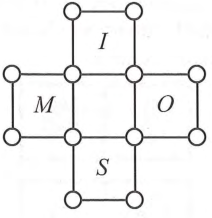
There are four squares labelled as $I$, $M$, $S$ and $O$, as shown in the diagram. Each vertex of these squares is painted in one of the three colours: blue, red, yellow. A colouring is called “even” if in each of the four squares, the 4 vertices are painted in exactly two colours so that 2 vertices are of the same colour and the remaining 2 vertices are of the other colour. How many different even colourings are there?
Laila, Mary and Nelly took turns picking beads from a box according to the following increasing pattern: Laila picked 1 bead, Mary picked 2 beads, Nelly picked 3 beads, then Laila picked 4 beads, Mary picked 5 beads, Nelly picked 6 beads, and again, Laila picked 7 beads, and so on. When the number of remaining beads was smaller than the number of beads required for the next turn, all those beads would go to the girl who was in the turn before. In the end, Laila got a total of 2019 beads. How many beads were there in the box at the beginning?
Two six-digit numbers 123459 and 193452 are multiples of 7. Use each of the digits 1, 2, 3, 4, 5 and 9 exactly once to form ten more different six-digit numbers that are also multiples of 7.
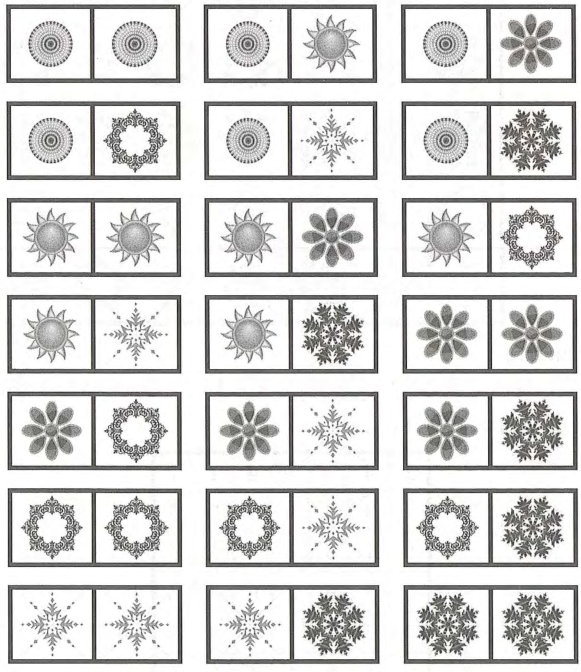
Connect two unit squares side by side to form $2\times1$ tiles, and draw pictures in each square as shown below. We get a set of 21 different tiles with pictures.
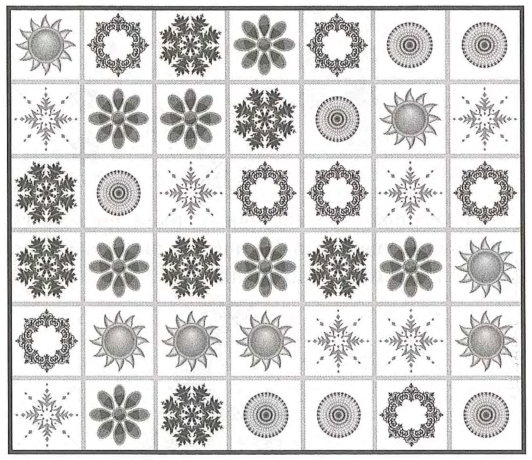
These 21 tiles are placed in a $6\times7$ grid, as shown in the diagram below. Each tile is used exactly once, it can be rotated and placed in the grid either horizontally or vertically. The borders of the tiles are then erased and one can only see the grid with the pictures. Find the locations of the 21 tiles shown above in the grid below, by drawing the border of each tile.
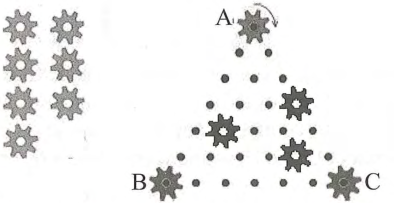
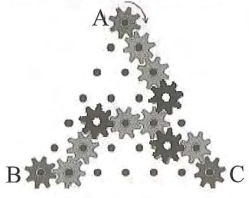
Given the diagram below. Find as many ways as possible to put 7 more gears into the triangular board so that we can move the gears B and C simultaneously by moving the gear A. (Gears can be mounted only on the given points and a gear can move another gear only if the two gears are mounted around adjacent dots.)
For example, we can put 7 more gray gears as in the following picture to be able to move the gears B and C simultaneously by moving the gear A.
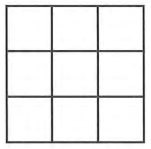
In how many ways can two identical checkers be placed on the $3\times3$ grid shown in the diagram below, so that each checker is placed in only one cell, and each cell has at most one checker? Draw all the possible ways on the answer sheet. (Note: If one can obtain one arrangement from another by rotation, then these two arrangements will be only considered as one.)
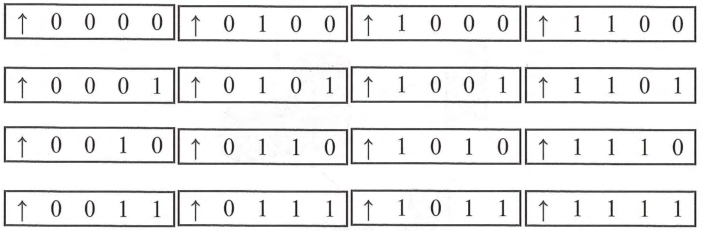
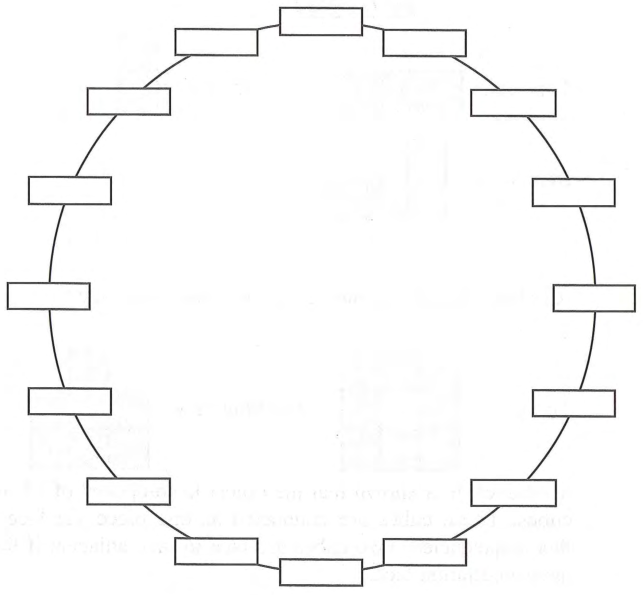
Four digits, each is 0 or 1, are written on each of the following 16 cards. Place them in a circle, so that any two adjacent cards differ in exactly one place. For example, 0101 and 0111 differ in exactly one place, 0101 and 0110 differ in two places. It is not allowed to flip or rotate cards.
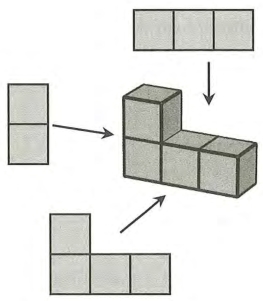
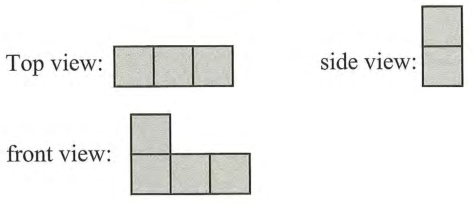
When drawing, engineers use projections to represent 3D objects. For example, the L-shape is represented by three views, which are projections from the front, from the side and from the top.
Top view; side view; front view:
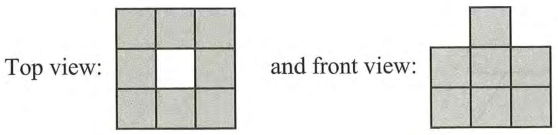
An object has the following top view and front view:
Moreover, it is known that the object is composed of 13 unit cubes. These cubes are connected as one piece via face to face adjacencies. Two cubes are face to face adjacent if they have a common face.
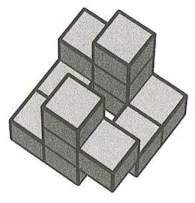
For example, the following shape satisfies all previous conditions.
Draw all possible side views of this object on your answer sheet.