In 2017, Alex’s age is equal to the sum of all the digits of his year of birth and his mother’s age is also equal to the sum of all the digits of her year of birth. How old was Alex’s mother when she gave birth to Alex?
All positive integers from 1 to 10,000 are arranged according to the following rules:
- The first row contains all the integers whose sum of their digits is 1.
- The second row contains all the integers whose sum of their digits is 2.
- The third row contains all the integers whose sum of their digits is 3.
- ....
- Integers in each row are arranged in increasing order.
- Each of these rows are then rearranged in a line such that the first number in the second row comes after the last number of the first row; the first number in the third row comes after the last number of the second row;... and so on.
Which term is the number 9799 in the final arrangement?
A trapezium has three equal sides, and the base is 2 cm less than the sum of these three sides. If the distance between the parallel sides is 5 cm, find the area, in $\mathrm{cm}^2$, of the trapezium.
A box contained some red and blue balls. At least 90% of the balls were red. Peter first took the balls out of the box one at a time. Out of the first 50 balls that he took out, only one was blue. Subsequently, he took out 8 balls each time where one was blue and 7 were red. He continued in this manner until fewer than 8 balls were left in the box. Find the maximum number of balls the box could have contained at the beginning.
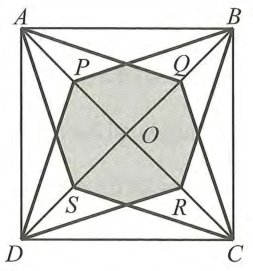
Square $ABCD$ has sides of length 12 cm. The centre of the square is $O$, and $P$, $Q$, $R$ and $S$ are the midpoints of $OA$, $OB$, $OC$ and $OD$ respectively. Find the area, in $\mathrm{cm}^2$, of the shaded region.
Cindy used red and green pens to write all 3-digit positive integers in increasing order. All the even numbers were written in red and all the odd numbers were written in green. How many among all the digits ‘6’ were written in red?
Each face of a cube is divided into four equal small squares. Each small square is painted with one of the three different available colours. Small squares with common sides or edges are painted with different colours. What is the maximum number of small squares that can be painted with the same colour?
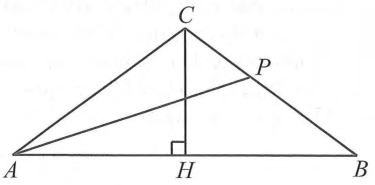
Triangle $ABC$ is an isosceles triangle with $AC=BC$. Point $H$ is on $AB$ such that $CH$ is perpendicular to $AB$ and the angle bisector of $\angle CAB$ meets $BC$ at point $P$. If $AP=2CH$, find the measure, in degrees, of $\angle ACB$.
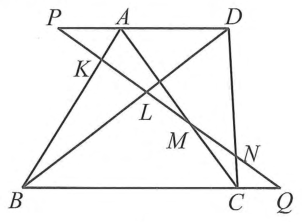
In the diagram below, $ABCD$ is a trapezium where $AD$ is parallel to $BC$. Points $P$, $A$ and $D$ lie on a straight line. Points $B$, $C$ and $Q$ also lie on a straight line. Line $PQ$ intersects $AB$, $BD$, $AC$ and $CD$ at $K$, $L$, $M$ and $N$ respectively, such that $PK=KL=LM=MN=NQ$. If $AD=20$ cm, what is the length, in cm, of $BC$?
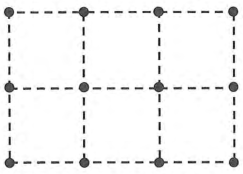
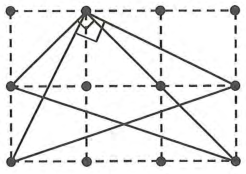
The diagram on the left shows a $3\times2$ table with 12 grid points. Three grid points are chosen to form a right triangle. The diagram on the right shows two such right triangles. How many right triangles can be formed in the diagram on the left?
A square is drawn on a plane. Mary chooses a point P on this plane but keeps its position secret. You may draw any straight line on the plane and Mary will tell you whether P lies on one side or on the other side of the line, or on the line itself. The answer is given to you immediately after each line has been drawn. Regardless of the position of the point Mary chooses, what is the minimum number of lines you must draw to find out whether P lies inside or outside the square or on the sides of the square? Explain your answer.
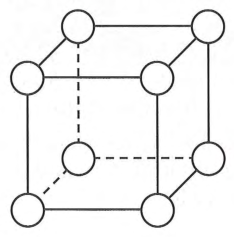
Colour four vertices of a cube white and four vertices black so that for any plane passing through three vertices of the same colour, the plane must have a fourth vertex of the other colour.
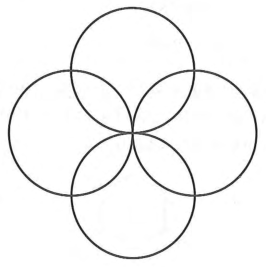
The diagram below shows four intersecting circles enclosing 8 regions. The numbers 1, 2, 3, 4, 5, 6, 7 and 8 are placed in each of the regions with each number being used exactly once. Each region should contain a number such that the sum of the three numbers within each of the four circles is the same. Solutions obtained by reflecting or rotating the diagram is considered the same. Find all possible solutions.
A deck consists of $n$ different cards. A move consists of taking out a stack of consecutive cards from the deck, and then putting the same stack back somewhere else within the deck without flipping any of the cards or changing the order of cards within the stack. You are required to reverse the original order of cards in the deck by such moves. What is the minimum number of moves required if
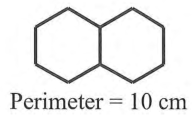
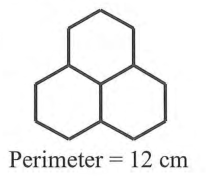
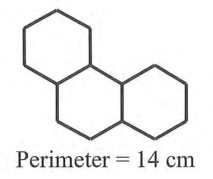
Hexagonal tessellations are formed by joining identical regular hexagons with sides of length 1 cm together by their sides. The diagrams below are some examples.
If tessellations obtained by reflecting or rotating the diagram are considered the same, draw all the different possible hexagonal tessellations with a perimeter of 18 cm in the answer sheet provided.
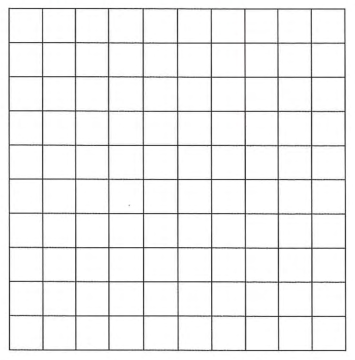
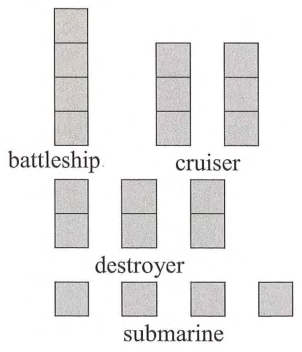
The Battleship game is played on a $10\times10$ board, with one $1\times4$ battleship, two $1\times3$ cruisers, three $1\times2$ destroyers and four $1\times1$ submarines. The ships are placed on the board so that no two ships share common sides or common vertices. However, the ships may touch the edges of the board. On the board provided in the answer sheet, shade a possible position of two $1\times3$ cruisers, three $1\times2$ destroyers and four $1\times1$ submarines on the board such that a $1\times4$ battleship cannot be fitted onto the board.