Let $\mathbb Z^+$ be the set of positive integers. Determine all functions $f:\mathbb Z^+\to\mathbb Z^+$ such that $a^2+f(a)f(b)$ is divisible by $f(a)+b$ for all positive integers $a,b$.
Let $m$ be a fixed positive integer. Define an infinite sequence by a positive integer $a_1$ and, for every $n\ge1$,
$$a_{n+1}=\begin{cases}a_n^2+2^m,&a_n\lt 2^m,\\a_n/2,&a_n\ge2^m.\end{cases}$$
For each $m$, determine all $a_1$ for which every term is an integer.
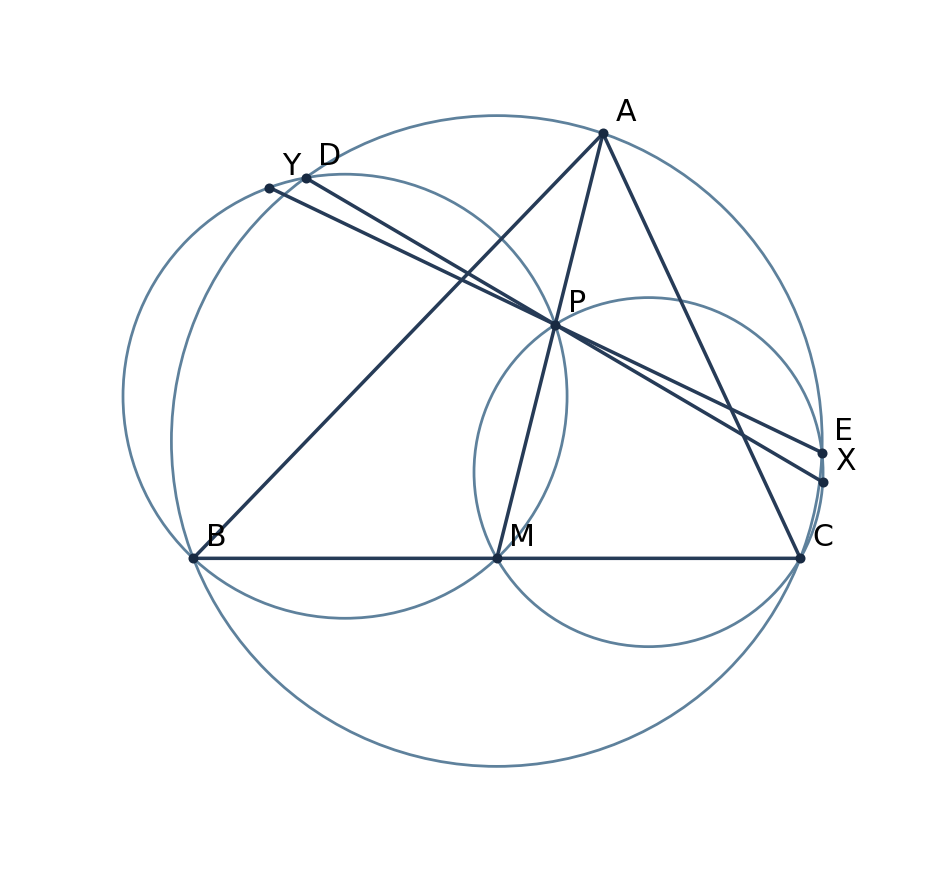
Let $ABC$ be a scalene triangle with circumcircle $\Gamma$, and let $M$ be the midpoint of $BC$. A variable point $P$ is selected in the segment $AM$. The circumcircles of $BPM$ and $CPM$ meet $\Gamma$ again at $D$ and $E$, respectively. The lines $DP$ and $EP$ meet, a second time, the circumcircles of $CPM$ and $BPM$ at $X$ and $Y$, respectively. Prove that, as $P$ varies, the circumcircle of $AXY$ passes through a fixed point $T\ne A$.
Editorial clarification: take $P$ in the interior of $AM$ and restrict to positions where the distinct second intersections and the circumcircle $AXY$ are defined. The endpoint wording in the original source is preserved above.
Consider a $2018\times2019$ board with integers in its unit squares. Squares are neighbours if they share an edge. In each turn choose some squares, calculate the average of all neighbours of each chosen square, and then simultaneously replace each chosen entry by its calculated average. Is it always possible to make all entries equal after finitely many turns?