Call a 5-tuple of integers arrangeable if its entries can be labeled $a,b,c,d,e$ in some order so that $a-b+c-d+e=29$. Determine all 2017-tuples of integers $n_1,\ldots,n_{2017}$ such that, when placed clockwise around a circle, every five consecutive positions form an arrangeable 5-tuple.
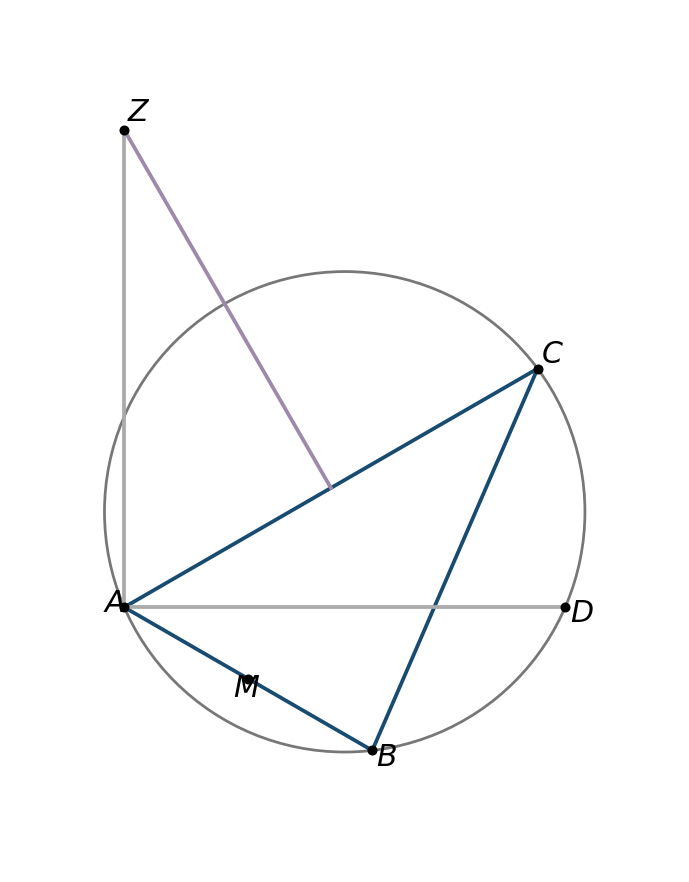
Let $ABC$ be a triangle with $AB\lt AC$. Let $D$ be the second intersection of the internal bisector of $\angle BAC$ with the circumcircle of $ABC$. Let $Z$ be the intersection of the perpendicular bisector of $AC$ with the external bisector of $\angle BAC$. Prove that the midpoint of $AB$ lies on the circumcircle of $ADZ$.
Let $A(n)$ be the number of sequences $a_1\ge\cdots\ge a_k$ of positive integers with sum $n$ such that every $a_i+1$ is a power of 2. Let $B(n)$ be the number of sequences $b_1\ge\cdots\ge b_m$ of positive integers with sum $n$ such that $b_j\ge2b_{j+1}$ for $1\le j\lt m$. Prove $A(n)=B(n)$ for every positive integer $n$.
Proposed by the Senior Problems Committee of the Australian Mathematical Olympiad Committee.
Call a rational number $r$ powerful if $r=p^k/q$ for relatively prime positive integers $p,q$ and an integer $k\gt 1$. Let positive rational numbers $a,b,c$ satisfy $abc=1$. Suppose positive integers $x,y,z$ exist such that $a^x+b^y+c^z$ is an integer. Prove that $a,b,c$ are all powerful.
Let $n$ be a positive integer. Call two integer $n$-tuples $(a_1,\ldots,a_n)$ and $(b_1,\ldots,b_n)$ an exquisite pair if
$$|a_1b_1+\cdots+a_nb_n|\le1.$$
Determine the maximum number of distinct integer $n$-tuples such that every two distinct members form an exquisite pair.
Proposed by Pakawut Jiradilok and Warut Suksompong, Thailand.