The increasing sequence $2,$ $3,$ $5,$ $6,$ $7,$ $10,$ $11,$ $\ldots$ consists of all positive integers that are neither the square nor the cube of a positive integer. Find the $500$th term of this sequence.
Let $P_1$ be a regular $r$-gon and $P_2$ be a regular $s$-gon $(r\geq s\geq3)$ such that each interior angle of $P_1$ is $\frac{59}{58}$ as large as each interior angle of $P_2.$ What is the largest possible value of $s?$
Let $n$ be the smallest positive integer that is a multiple of $75$ and has exactly $75$ positive integral divisors, including $1$ and itself. Find $\frac{n}{75}.$
A biologist wants to calculate the number of fish in a lake. On May $1$ she catches a random sample of $60$ fish, tags them, and releases them. On September $1$ she catches a random sample of $70$ fish and finds that $3$ of them are tagged. To calculate the number of fish in the lake on May $1,$ she assumes that $25\%$ of these fish are no longer in the lake on September $1$ (because of death and emigrations), that $40\%$ of the fish were not in the lake May $1$ (because of births and immigrations), and that the number of untagged fish and tagged fish in the September $1$ sample are representative of the total population. What does the biologist calculate for the number of fish in the lake on May $1?$
A triangle has vertices $P=(-8,5),$ $Q=(-15,-19),$ and $R=(1,-7).$ The equation of the bisector of $\angle P$ can be written in the form $ax+2y+c=0.$ Find $a+c.$
In a shooting match, eight clay targets are arranged in two hanging columns of three targets each and one column of two targets. A marksman is to break all the targets according to the following rules:
$(1)$ The marksman first chooses a column from which a target is to be broken.
$(2)$ The marksman must then break the lowest remaining target in the chosen column.
If the rules are followed, in how many different orders can the eight targets be broken?
A fair coin is to be tossed $10$ times. Let $\frac{i}{j},$ in lowest terms, be the probability that heads never occur on consecutive tosses. Find $i+j.$
The sets $A=\{z:z^{18}=1\}$ and $B=\{w:w^{48}=1\}$ are both sets of complex roots of unity. The set $C=\{zw:z\in A,\ w\in B\}$ is also a set of complex roots of unity. How many distinct elements are in $C?$
Someone observed that $6!=8\cdot9\cdot10.$ Find the largest positive integer $n$ for which $n!$ can be expressed as the product of $n-3$ consecutive positive integers.
A regular $12$-gon is inscribed in a circle of radius $12.$ The sum of the lengths of all sides and diagonals of the $12$-gon can be written in the form $$
a+b\sqrt2+c\sqrt3+d\sqrt6,
$$ where $a,$ $b,$ $c,$ and $d$ are positive integers. Find $a+b+c+d.$
Let $T$ be the set of powers $9^k,$ where $k$ is an integer with $0\leq k\leq4000.$ Given that $9^{4000}$ has $3817$ digits and that its first (leftmost) digit is $9,$ how many elements of $T$ have $9$ as their leftmost digit?
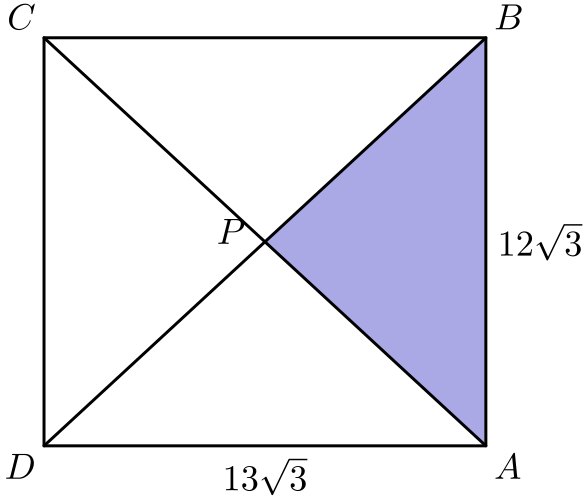
The rectangle $ABCD$ below has dimensions $AB=12\sqrt3$ and $BC=13\sqrt3.$ Diagonals $AC$ and $BD$ intersect at $P.$ If triangle $ABP$ is cut out and removed, edges $AP$ and $BP$ are joined, and the figure is then creased along segments $CP$ and $DP,$ we obtain a triangular pyramid, all four of whose faces are isosceles triangles. Find the volume of this pyramid.
Find $ax^5+by^5$ if the real numbers $a,$ $b,$ $x,$ and $y$ satisfy the equations $$
\begin{aligned}ax+by&=3,\\ax^2+by^2&=7,\\ax^3+by^3&=16,\\ax^4+by^4&=42.\end{aligned}
$$