Let $p \geq 5$ be a prime and let $r$ be the number of ways of placing $p$ checkers on a $p \times p$ checkerboard so that not all checkers are in the same row (but they may all be in the same column). Show that $r$ is divisible by $p^{5}$. Here, we assume that all the checkers are identical.
Let $n$ be a positive integer. Find the largest nonnegative real number $f(n)$ (depending on $n$) with the following property: whenever $a_{1}, a_{2}, \ldots, a_{n}$ are real numbers such that $a_{1}+a_{2}+\cdots+a_{n}$ is an integer, there exists some $i$ such that $\left|a_{i}-\frac{1}{2}\right| \geq f(n)$.
Let $A$, $B$ be two distinct points on a given circle $O$ and let $P$ be the midpoint of the line segment $AB$. Let $O_{1}$ be the circle tangent to the line $AB$ at $P$ and tangent to the circle $O$. Let $\ell$ be the tangent line, different from the line $AB$, to $O_{1}$ passing through $A$. Let $C$ be the intersection point, different from $A$, of $\ell$ and $O$. Let $Q$ be the midpoint of the line segment $BC$ and $O_{2}$ be the circle tangent to the line $BC$ at $Q$ and tangent to the line segment $AC$. Prove that the circle $O_{2}$ is tangent to the circle $O$.
In a circus, there are $n$ clowns who dress and paint themselves up using a selection of 12 distinct colours. Each clown is required to use at least five different colours. One day, the ringmaster of the circus orders that no two clowns have exactly the same set of colours and no more than 20 clowns may use any one particular colour. Find the largest number $n$ of clowns so as to make the ringmaster's order possible.
Prove that every positive integer can be written as a finite sum of distinct integral powers of the golden mean $\tau=\frac{1+\sqrt{5}}{2}$. Here, an integral power of $\tau$ is of the form $\tau^{i}$, where $i$ is an integer (not necessarily positive).
Prove that if positive numbers $a, b, x, y$ satisfy the inequality $ab \ge xa + yb$, then they satisfy the inequality $\sqrt{a+b} \ge \sqrt{x} + \sqrt{y}$.
On a circle were marked $15$ white dots and $1$ black dot. Let us consider all possible polygons (convex) with their vertices at these points. Let's separate them into two types: - Type 1: those that have only white vertices. - Type 2: those who have the black dot as one of the vertices. Are there more type 1 or type 2 polygons? How many more are there?
The pirate law establishes that, in order to divide the coins of a treasure, the captain must choose a group of pirates (excluding himself). Then the captain must distribute the same amount of coins to each of the pirates in this group, in such a way that it is not possible to give each of them any of the remaining coins (respecting the fact that each pirate receives the same amount). The remaining coins are then given to the captain. On Captain Barbaroxa's ship there are 100 pirates (not including the captain). Barbaroxa must share a treasure that contains less than 1000 coins. If he chooses 99 pirates, he will have 51 coins, but if he chooses 77 pirates, he will have 29 coins.
a) How many coins does the treasure contain?
b) How many pirates should choose Barbaroxa to get as many coins as possible?
The following figure shows a square $ABCD$, and two points $P$ and $Q$ on the sides $\overline{BC}$ and $\overline{DA}$, respectively. We now fold the square along the segment $\overline{PQ}$, taking the vertex $B$ to the midpoint of the segment $\overline{CD}$. It is known that the side of the square measures 24.
a) Calculate the length of the segment $\overline{PC}$.
b) Calculate the length of segment $\overline{AQ}$.
c) Calculate the length of segment $\overline{PQ}$.
At the bus stop - a group of boys and girls wait at a stop by the bus. On the first bus that passes, only 15 girls board, and 2 boys remain for each girl at the bus stop. On the second bus that passes, only 45 boys board, and 5 girls remain for each boy at the bus stop. Determine the number of boys and girls who were at the stop before the first bus stop.
The tin triangle - a boy tried to line 480 cans in the shape of a triangle with a can in the $1^{a}$ line, 2 cans on the $2^{a}$ and so on. In the end, 15 cans were left. How many lines does this triangle have?
A group of boys and girls went out to eat pizza on two consecutive days. In the restaurant where they went, the pizzas are cut into twelve equal pieces. Maria observed that on the first day each boy ate 7 pieces, and each girl 3 pieces. On the second day, each boy ate 6 pieces and each girl 2 pieces. Interestingly, on both days they ordered four pizzas that were completely consumed and then ordered another one, from which some pieces were left (that is, at least one piece was eaten and at least one piece was left over). How many boys and girls went to the pizzeria?
FOOTBALL GAMES - The twelve students of an Olympic class went out to play football every day after the math class, forming two teams of 6 players each and playing each other. Each day they formed two different teams from the teams formed in previous days. At the end of the year, they found that every 5 students had played together on the same team exactly once. How many different teams were formed throughout the year?
Let $ABC$ be a triangle such that $AB = 55$, $AC = 35$ and $BC = 72$. Consider a straight line $\ell$ that cuts the side $BC$ at $D$ and the side $AC$ at $E$ and divides the triangle into two figures with equal perimeters and equal areas. Determine the measure of segment $CD$.
In a tournament, any two players play each other. Each player gets one point per win, $1/2$ for a tie and $0$ point by defeat. Be $S$ the set of $10$ lower scores. We know that each player got half of their score by playing against players $S$.
a) what is the sum of the scores of the players of $S$?
b) Determine how many participants the tournament has. Note: Each player plays only once with each opponent.
Julia is training for the math Olympics. One day she decides to divide $2014$ by each of the positive integer divisors of $2015$. For each division, she writes the quotient in her notebook and the rest on a board.
a. Let's help Julia. Write the eight positive integer divisors of $2015$.
b. For each of the divisors, make the division and write a list with the quotients and another with the remains obtained.
c. At the end, Julia noticed a great "coincidence": the numbers written in the notebook were the same that were on the board, just written in a different order. Would it be a coincidence? Show that for any number $n$ that Julia chooses, if she calculates the quotient and the rest of the $n-1$ division for each of the $n$ divisors the numbers in the notebook and on the board They will be exactly the same, being only possibly written in a different order.
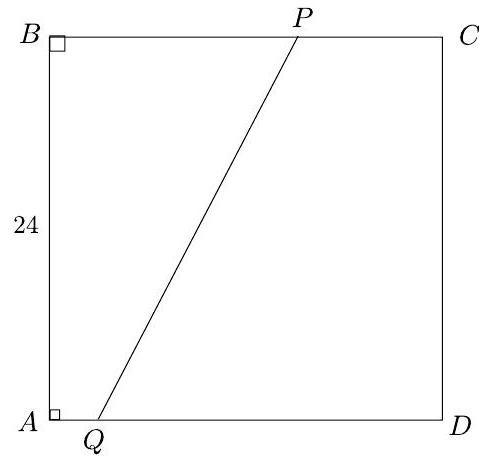 We now fold the square along the segment $\overline{PQ}$, taking the vertex $B$ to the midpoint of the segment $\overline{CD}$.
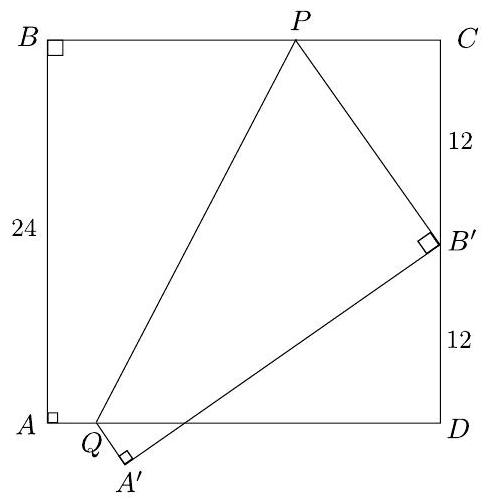 It is known that the side of the square measures 24.