The cost of organizing the National Mathematical Olympiad increases each year by $0.5\%$ over the preceding year. In which year will it be exactly twice the 2012 cost?
Note: the 2012 cost is nonzero.
(A) 2023 (B) 2150 (C) 2151 (D) 2212 (E) never.
Let $M N P Q$ be a square of side length $1$, and $A, B, C, D$ points on the sides $M N$, $N P$, $P Q$, and $Q M$ respectively such that $A C \cdot B D = \frac{5}{4}$. Can the set $\{A B, B C, C D, D A\}$ be partitioned into two subsets $S_{1}$ and $S_{2}$ of two elements each, so that each one of the sums of the elements of $S_{1}$ and $S_{2}$ are positive integers?
For a real number $r$ denote by $[r]$ the greatest integer less than or equal to $r$. How many positive integers $n$ are there for which
$$
\lfloor \frac{1000000}{n} \rfloor - \lfloor \frac{1000000}{n+1} \rfloor = 1
$$
is satisfied?
Two people, $A$ and $B$, go up a staircase with a certain number of steps. $A$ goes up 2 steps in one stride, while $B$ goes up 5 steps in one stride, except if $A$ finds only 1 step before the last stride, then he will go up just 1 step to finish, and if $B$ finds 4 or less steps remaining before the last stride, then $B$ will go up whatever steps remaining to climb to finish. $B$ took 6 strides less than $A$ to finish climbing this staircase. Determine all possible numbers of steps for this staircase can have.
Alice, Berto, and Carlo want to bury a treasure at a point equidistant from all three of them. They stand at the vertices of a right triangle with a $30^\circ$ angle and perimeter $6$ metres. How far will the treasure be from each person?
(A) $1$ m; (B) $\frac32$ m; (C) $2$ m; (D) $3-\sqrt3$ m; (E) $3$ m.
We know that $p(x)$ is a monic polynomial of degree $5$. We also know that the solutions of $p(x)=0$ are exactly $x=0,1,2,4$. Determine the greatest possible coefficient of the linear term.
Note: a polynomial is monic if the coefficient of its highest-degree term (here, the fifth-degree term) is $1$.
(A) $-32$; (B) $16$; (C) $32$; (D) $64$; (E) It can be arbitrarily large.
In an acute triangle $ABC$ with $AB\lt AC$, the angle bisector from $A$ meets $BC$ at $P$. The line through $P$ parallel to $AB$ meets $AC$ at $Q$. On this line let $R$ lie on the ray from $Q$ not containing $P$, with $QR=QA$. Let $S$ be the perpendicular projection of $R$ onto $BC$, and let $T$ be the intersection of $AC$ with the line through $P$ perpendicular to $AP$.
a. Prove that $Q$ is the circumcenter of $APR$.
b. Prove that triangles $STC$ and $APC$ are similar.
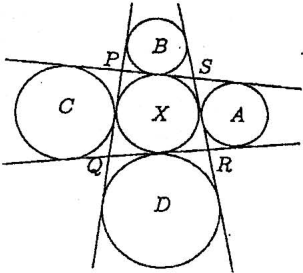
A circle $X$ is inscribed in a quadrilateral $PQRS$. Construct 4 circles $A, B, C, D$, each of which is tangent to 3 of the 4 straight lines determined by the sides of the quadrilateral, as shown in the figure below. Suppose that the radii of the circles $A, B, C, X$ are $2$, $1$, $4$, $3$, respectively. Determine the radius of the circle $D$.
Players $A$ and $B$ wrote down two positive integers each on a black board. The product of the two numbers $A$ wrote is twice the sum of the two numbers $B$ wrote, and the product of the two numbers $B$ wrote is twice the sum of the two numbers $A$ wrote, and furthermore, the sum of the two numbers $A$ wrote is greater than or equal to the sum of the two numbers $B$ wrote. Determine all possible values for the sum of the two numbers $B$ wrote. Note that four numbers written down need not be distinct.
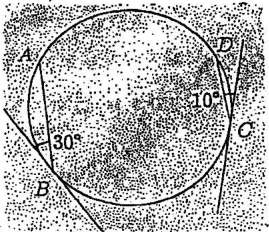
Suppose the points $A$, $B$, $C$, $D$ are located on the circumference of a circle in this order as indicated in the figure below.
Suppose the angle formed by the line tangent to the circle at $B$ and the line $AB$ is $30^\circ$, and that formed by the line tangent to the circle at $C$ and the line $CD$ is $10^\circ$. Suppose further that the lines $AB$ and $DC$ are parallel and they are located on the opposite sides from each other with respect to the center of the circle. Determine the magnitude of the angle $\angle BDC$.
In a circle of diameter $1$ consider $65$ points no three of which are collinear. Prove that there exist $3$ among these points which form a triangle with area less than or equal to $\frac{1}{72}$.
How many pairs of positive integers $(m,n)$ have $m/n$ in lowest terms and strictly less than 1, with $mn=1\cdot2\cdot3\cdots24\cdot25$, the product of the first 25 positive integers?
(A) $2^7$ (B) $2^8-1$ (C) $2^8$ (D) $2^9-1$ (E) $2^9$.
A subset $B$ of natural numbers is called *loyal* if there exist positive integers $i \le j$ such that $B = \{i, i+1, \dots, j\}$. $Q$ is the collection of *loyal* subsets of natural numbers. For every subset $A = \{a_1 \lt a_2 \lt \dots \lt a_k\}$ of $\{1, 2, \dots, n\}$ we define:
$$
g(A) = \max_{B \subset A, B \in Q} |B| \quad \text{and} \quad f(A) = \max_{1 \le i \le k-1} a_{i+1} - a_i.
$$
Prove there exists $m \in \mathbb{N}$ such that for every positive integer $n$ greater than $m$ we have $F(n) \gt G(n)$. ($|A|$ denotes the number of elements of a set $A$ and if $|A| \le 1$ we set $f(A) = 0$).
Find the largest positive integer $n$ for which the inequality
$$
\frac{a+b+c}{a b c+1}+\sqrt[n]{a b c} \leq \frac{5}{2}
$$
holds for all $a, b, c \in[0,1]$. Here $\sqrt[1]{a b c}=a b c$.
Let $ABC$ be an acute triangle and $H$ the foot of the altitude from $A$. Colour every point $P$ inside the triangle red if its nearest vertex is $A$, green if its nearest vertex is $B$, and blue if its nearest vertex is $C$. Given $AH=35,BH=21,CH=15$, what is the area of the red region?
Let $p(x),q(x)$ be distinct polynomials of degree at most 3 with integer coefficients, such that
$$p(1)=q(1),\quad p(2)=q(2),\quad p(3)=q(3),$$
$$p(-1)=-q(-1),\quad p(-2)=-q(-2),$$
$$p(-3)=-q(-3).$$
What is the least possible value of $[p(0)]^2+[q(0)]^2$?
$n$ is a positive integer. Let $A, B$ be two sets of $n$ points in the plane such that no three points of them are collinear. Denote by $T(A)$ the number of non-self-intersecting broken lines containing $n-1$ segments such that its vertices are in $A$. Define $T(B)$ similarly. If the elements of $B$ are the vertices of a convex $n$-gon but the elements of $A$ are not, prove that $T(B) \lt T(A)$.