**General instructions.** Answer the following 10 questions, and show your detailed solution in the space provided after each question. Each question is worth 4 points. Time limit: 60 minutes.
John challenged Tom on to a general knowledge contest. For every answer Tom got right, John gave him 7 dollars and for every answer Tom got wrong, he had to give John 3 dollars. John asked 50 questions and at the end of the competition, when everything was added up, neither owned the other any money! How many questions did Tom answer correctly?
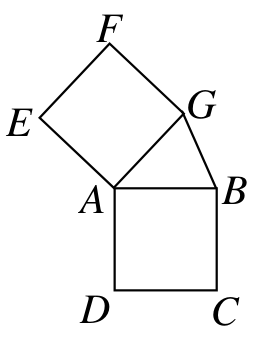
The diagram shows two squares, ABCD and AEFG, which are equal in size. Giving full reasons for each of your statements, show that $\angle DAE=2\times\angle ABG$.
The diameter of a coin is 1 cm. If four such identical coins are placed on a table that each rim of them touches the other two, find the maximum possible area that is enclosed inside. ($\pi=3.14$)
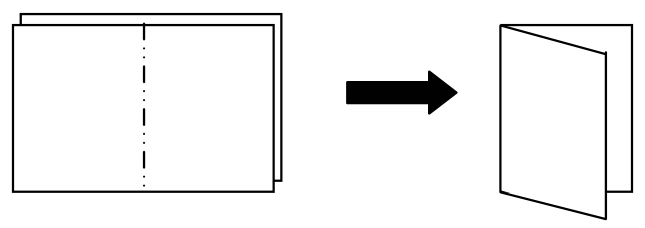
An A5 booklet is constructed by stapling 20 sheets of A4 paper together down the middle and then folding.
Starting with the front page, the pages are numbered consecutively from 1 to 80. A certain page is numbered 30. If the book is then unstapled, which other three numbers will appear on this same sheet of paper?
Amy drives her car at constant speed. At 1 pm, 2 pm and 3 pm, she notices her distance from home. When she starts her journey at 1 pm, her distance from home is a two digit number of kilometres, after an hour it is given by the same two digits in reverse order and after a second hour the distance is given by the original two digits separated by a zero. Calculate Amy’s speed.
Eric has an odd way of counting his gold coins. Firstly, he splits them up into two piles with numbers of coins in the ratio of 1:2. He then splits the smaller pile into two piles in the ratio 1:3. Then he splits the new smaller pile into two piles in the ratio 1:4 and then 1:5, 1:6. Eventually, having carried on some hours, he splits the smaller pile in the ratio 1:7 and finds that the new small pile only contains one coin. How many gold coins does Eric have in total?
A radio presenter invites listeners to “crack the code” to win a prize. The code is a four-digit number, which may start with a 0. All the digits are different and are arranged in ascending order, so 2457 is a possible code, but 1973 and 2448 are not. A caller guesses 0389 and is told that she has no number correct; a second then guesses 1456, and is told that she has three numbers correct and two of these are in the correct place. After this, the presenter giving a clue that this code is an even number. Is it now possible to “crack the code”, i.e. given these two guesses and the presenter’s responses, to give exactly one correct code fitting all the conditions. If not, why not?
Is it possible to write down more than 50 different 2-digit numbers in such a way that there aren’t two numbers with the sum equal to 100? If it is possible, construct an example. If not, explain why.