Among the $900$ residents of Aimeville, there are $195$ who own a diamond ring, $367$ who own a set of golf clubs, and $562$ who own a garden spade. In addition, each of the $900$ residents owns a bag of candy hearts. There are $437$ residents who own exactly two of these things, and $234$ residents who own exactly three of these things. Find the number of residents of Aimeville who own all four of these things.
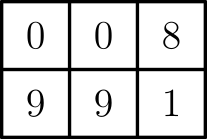
Find the number of ways to place a digit in each cell of a $2 \times 3$ grid so that the sum of the two numbers formed by reading left to right is $999,$ and the sum of the three numbers formed by reading top to bottom is $99.$ The grid below is an example of such an arrangement because $8 + 991 = 999$ and $9 + 9 + 81 = 99.$
Let $x,$ $y,$ and $z$ be positive real numbers that satisfy the following system of equations: $$
\log_2\left(\frac{x}{yz}\right) = \frac{1}{2}
$$ $$
\log_2\left(\frac{y}{xz}\right) = \frac{1}{3}
$$ $$
\log_2\left(\frac{z}{xy}\right) = \frac{1}{4}
$$
Then the value of $\left|\log_2(x^4 y^3 z^2)\right|$ is $\frac{m}{n}$ where $m$ and $n$ are relatively prime positive integers. Find $m + n.$
Let $ABCDEF$ be a convex equilateral hexagon in which all pairs of opposite sides are parallel. The triangle whose sides are extensions of segments $\overline{AB},$ $\overline{CD},$ and $\overline{EF}$ has side lengths $200,$ $240,$ and $300.$ Find the side length of the hexagon.
Alice chooses a set $A$ of positive integers. Then Bob lists all finite nonempty sets $B$ of positive integers with the property that the maximum element of $B$ belongs to $A.$ Bob’s list has $2024$ sets. Find the sum of the elements of $A.$
Let $N$ be the greatest four-digit integer with the property that whenever one of its digits is changed to $1,$ the resulting number is divisible by $7.$ Let $Q$ and $R$ be the quotient and remainder, respectively, when $N$ is divided by $1000.$ Find $Q + R.$
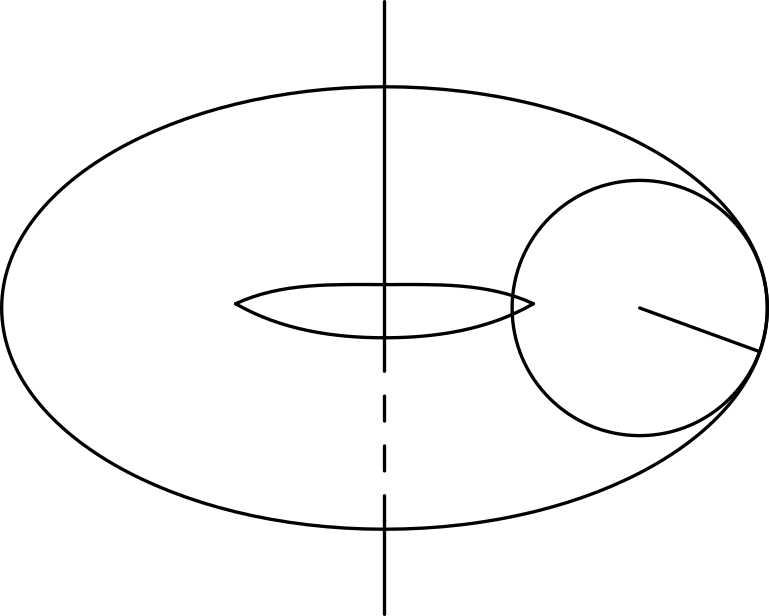
Torus $T$ is the surface produced by revolving a circle with radius $3$ around an axis in the plane of the circle that is a distance $6$ from the center of the circle (so like a donut).
Let $S$ be a sphere with a radius $11.$ When $T$ rests on the inside of $S,$ it is internally tangent to $S$ along a circle with radius $r_i,$ and when $T$ rests on the outside of $S,$ it is externally tangent to $S$ along a circle with radius $r_o.$ The difference $r_i - r_o$ can be written as $\frac{m}{n},$ where $m$ and $n$ are relatively prime positive integers. Find $m + n.$
There is a collection of $25$ indistinguishable white chips and $25$ indistinguishable black chips. Find the number of ways to place some of these chips in a $5 \times 5$ grid such that:
• each cell contains at most one chip
• all chips in the same row and all chips in the same column have the same color, and
• any additional chip placed on the grid would violate one or more of the previous two conditions.
Find the number of triples of nonnegative integers $(a, b, c)$ satisfying $a + b + c = 300$ and $$
\begin{aligned} &a^2 b + a^2 c \\ &\quad {}+ b^2 a + b^2 c \\ &\quad {}+ c^2 a + c^2 b = 6{,}000{,}000. \end{aligned}
$$
Let $O = (0, 0),$ $A = \left(\tfrac{1}{2}, 0\right),$ and $B = \left(0, \tfrac{\sqrt{3}}{2}\right)$ be points in the coordinate plane. Let $\mathcal{F}$ be the family of segments $\overline{PQ}$ of unit length lying in the first quadrant with $P$ on the $x$-axis and $Q$ on the $y$-axis. There is a unique point $C$ on $\overline{AB},$ distinct from $A$ and $B,$ that does not belong to any segment from $\mathcal{F}$ other than $\overline{AB}.$ Then $OC^2 = \tfrac{p}{q},$ where $p$ and $q$ are relatively prime positive integers. Find $p + q.$
Let $\omega \neq 1$ be a $13$th root of unity. Find the remainder when $$
\prod_{k=0}^{12} \left(2 - 2\omega^k + \omega^{2k}\right)
$$ is divided by $1000.$
Let $b \ge 2$ be an integer. Call a positive integer $n$ *$b$-eautiful* if it has exactly two digits when expressed in base $b$ and these two digits sum to $\sqrt{n}.$ For example, $81$ is $13$-eautiful because $81 = \underline{6}\,\underline{3}_{13}$ and $6 + 3 = \sqrt{81}.$ Find the least integer $b \ge 2$ for which there are more than ten $b$-eautiful integers.
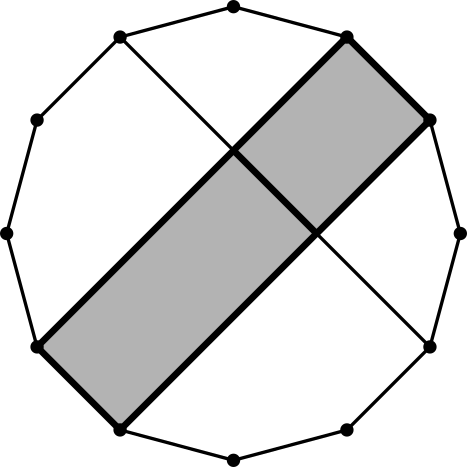
Find the number of rectangles that can be formed inside a fixed regular dodecagon ($12$-gon) where each side of the rectangle lies on either a side or a diagonal of the dodecagon. The diagram below shows three of those rectangles.