Points $A,$ $B,$ and $C$ lie in that order along a straight path where the distance from $A$ to $C$ is $1800$ meters. Ina runs twice as fast as Eve, and Paul runs twice as fast as Ina. The three runners start running at the same time with Ina starting at $A$ and running toward $C,$ Paul starting at $B$ and running toward $C,$ and Eve starting at $C$ and running toward $A.$ When Paul meets Eve, he turns around and runs toward $A.$ Paul and Ina both arrive at $B$ at the same time. Find the number of meters from $A$ to $B.$
Let $a_0 = 2,$ $a_1 = 5,$ and $a_2 = 8,$ and for $n \gt 2$ define $a_n$ recursively to be the remainder when $4(a_{n-1} + a_{n-2} + a_{n-3})$ is divided by $11.$ Find $a_{2018} \cdot a_{2020} \cdot a_{2022}.$
Find the sum of all positive integers $b \lt 1000$ such that the base-$b$ integer $36_{b}$ is a perfect square and the base-$b$ integer $27_{b}$ is a perfect cube.
In equiangular octagon $CAROLINE,$ $CA = RO = LI = NE = \sqrt{2}$ and $AR = OL = IN = EC = 1.$ The self-intersecting octagon $CORNELIA$ encloses six non-overlapping triangular regions. Let $K$ be the area enclosed by $CORNELIA,$ that is, the total area of the six triangular regions. Then $K = \frac{a}{b},$ where $a$ and $b$ are relatively prime positive integers. Find $a + b.$
Suppose that $x,$ $y,$ and $z$ are complex numbers such that $xy = -80 - 320i,$ $yz = 60,$ and $zx = -96 + 24i,$ where $i = \sqrt{-1}.$ Then there are real numbers $a$ and $b$ such that $x + y + z = a + bi.$ Find $a^2 + b^2.$
A real number $a$ is chosen randomly and uniformly from the interval $[-20, 18].$ The probability that the roots of the polynomial $$
\begin{aligned} &x^4 + 2ax^3 + (2a - 2)x^2 \\ &\quad {}+ (-4a + 3)x - 2 \end{aligned}
$$ are all real can be written in the form $\frac{m}{n},$ where $m$ and $n$ are relatively prime positive integers. Find $m + n.$
Triangle $ABC$ has side lengths $AB = 9,$ $BC = 5\sqrt{3},$ and $AC = 12.$ Points $A = P_0,$ $P_1,$ $P_2,$ $\ldots,$ $P_{2450} = B$ are on segment $\overline{AB}$ with $P_k$ between $P_{k-1}$ and $P_{k+1}$ for $k = 1,$ $2,$ $\ldots,$ $2449,$ and points $A = Q_0,$ $Q_1,$ $Q_2,$ $\ldots,$ $Q_{2450} = C$ are on segment $\overline{AC}$ with $Q_k$ between $Q_{k-1}$ and $Q_{k+1}$ for $k = 1,$ $2,$ $\ldots,$ $2449.$ Furthermore, each segment $\overline{P_kQ_k},$ $k = 1,$ $2,$ $\ldots,$ $2449,$ is parallel to $\overline{BC}.$ The segments cut the triangle into $2450$ regions, consisting of $2449$ trapezoids and $1$ triangle. Each of the $2450$ regions has the same area. Find the number of segments $\overline{P_kQ_k},$ $k = 1,$ $2,$ $\ldots,$ $2450,$ that have rational length.
A frog is positioned at the origin in the coordinate plane. From the point $(x, y),$ the frog can jump to any of the points $(x + 1, y),$ $(x + 2, y),$ $(x, y + 1),$ or $(x, y + 2).$ Find the number of distinct sequences of jumps in which the frog begins at $(0, 0)$ and ends at $(4, 4).$
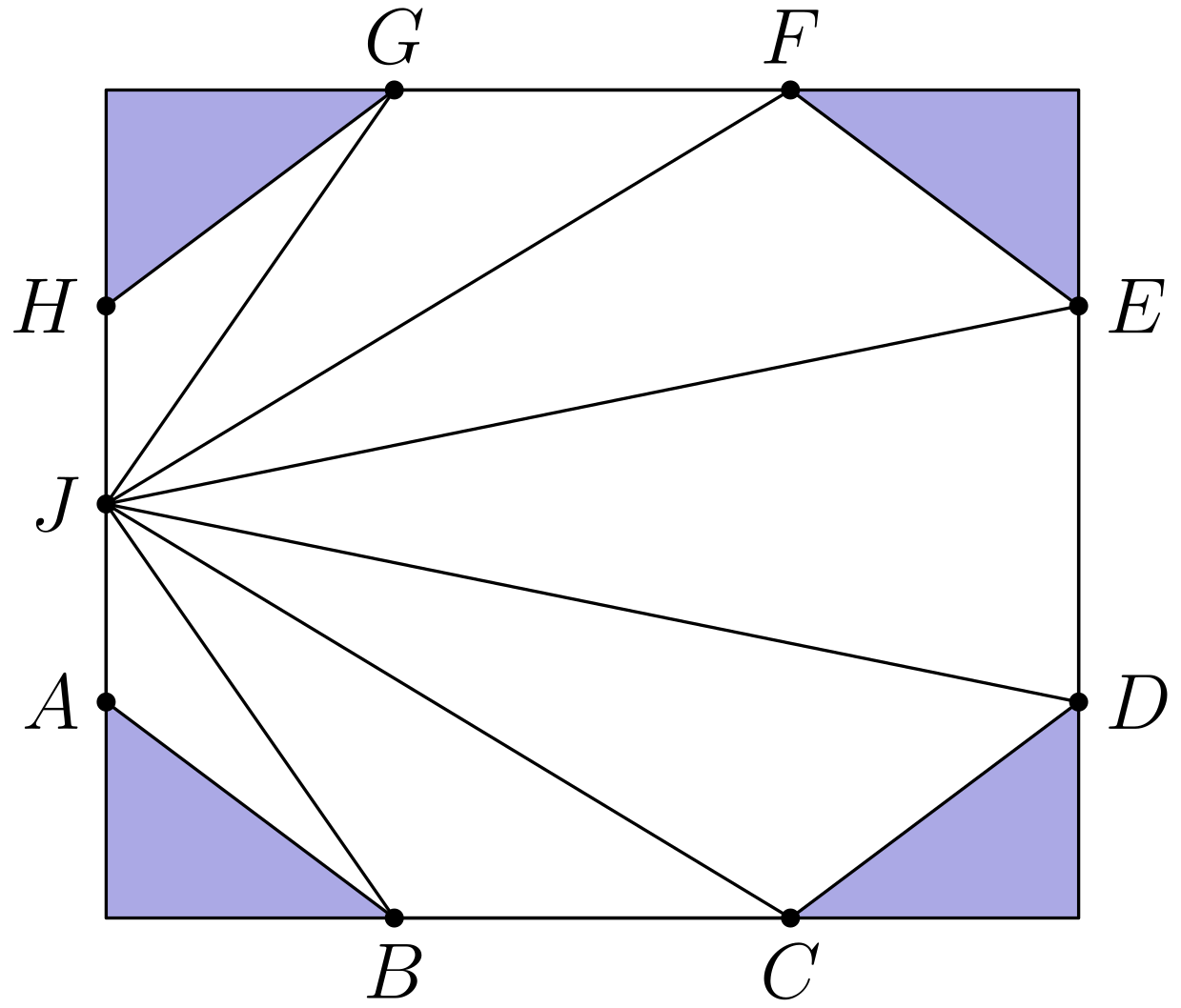
Octagon $ABCDEFGH$ with side lengths $AB = CD = EF = GH = 10$ and $BC = DE = FG = HA = 11$ is formed by removing four $6$-$8$-$10$ triangles from the corners of a $23 \times 27$ rectangle with side $\overline{AH}$ on a short side of the rectangle, as shown. Let $J$ be the midpoint of $\overline{AH},$ and partition the octagon into $7$ triangles by drawing segments $\overline{JB},$ $\overline{JC},$ $\overline{JD},$ $\overline{JE},$ $\overline{JF},$ and $\overline{JG}.$ Find the area of the convex polygon whose vertices are the centroids of these $7$ triangles.
Find the number of functions $f(x)$ from $\{1, 2, 3, 4, 5\}$ to $\{1, 2, 3, 4, 5\}$ that satisfy $f(f(x)) = f(f(f(x)))$ for all $x$ in $\{1, 2, 3, 4, 5\}.$
Find the number of permutations of $1,$ $2,$ $3,$ $4,$ $5,$ $6$ such that for each $k$ with $1 \le k \le 5,$ at least one of the first $k$ terms of the permutation is greater than $k.$
Let $ABCD$ be a convex quadrilateral with $AB = CD = 10,$ $BC = 14,$ and $AD = 2\sqrt{65}.$ Assume that the diagonals of $ABCD$ intersect at point $P,$ and that the sum of the areas of triangles $APB$ and $CPD$ equals the sum of the areas of triangles $BPC$ and $APD.$ Find the area of quadrilateral $ABCD.$
Misha rolls a standard, fair six-sided die until she rolls $1$-$2$-$3$ in that order on three consecutive rolls. The probability that she will roll the die an odd number of times is $\frac{m}{n},$ where $m$ and $n$ are relatively prime positive integers. Find $m + n.$
The incircle $\omega$ of triangle $ABC$ is tangent to $\overline{BC}$ at $X.$ Let $Y \neq X$ be the other intersection of $\overline{AX}$ with $\omega.$ Points $P$ and $Q$ lie on $\overline{AB}$ and $\overline{AC},$ respectively, so that $\overline{PQ}$ is tangent to $\omega$ at $Y.$ Assume that $AP = 3,$ $PB = 4,$ $AC = 8,$ and $AQ = \frac{m}{n},$ where $m$ and $n$ are relatively prime positive integers. Find $m + n.$
Find the number of functions $f$ from $\{0, 1, 2, 3, 4, 5, 6\}$ to the integers such that $f(0) = 0,$ $f(6) = 12,$ and $$
\begin{aligned} |x - y| &\le |f(x) - f(y)| \\ &\le 3|x - y| \end{aligned}
$$ for all $x$ and $y$ in $\{0, 1, 2, 3, 4, 5, 6\}.$