Fifteen distinct points are designated on $\triangle ABC:$ the $3$ vertices $A,$ $B,$ and $C;$ $3$ other points on side $\overline{AB};$ $4$ other points on side $\overline{BC};$ and $5$ other points on side $\overline{CA}.$ Find the number of triangles with positive area whose vertices are among these $15$ points.
When each of $702,$ $787,$ and $855$ is divided by the positive integer $m,$ the remainder is always the positive integer $r.$ When each of $412,$ $722,$ and $815$ is divided by the positive integer $n,$ the remainder is always the positive integer $s \neq r.$ Find $m + n + r + s.$
For a positive integer $n,$ let $d_n$ be the units digit of $1 + 2 + 3 + \cdots + n.$ Find the remainder when $$
\sum_{n=1}^{2017} d_n
$$ is divided by $1000.$
A pyramid has a triangular base with side lengths $20,$ $20,$ and $24.$ The three edges of the pyramid from the three corners of the base to the fourth vertex of the pyramid all have length $25.$ The volume of the pyramid is $m\sqrt{n},$ where $m$ and $n$ are positive integers, and $n$ is not divisible by the square of any prime. Find $m + n.$
A rational number written in base eight is $\underline{a}\,\underline{b}.\underline{c}\,\underline{d},$ where all digits are nonzero. The same number in base twelve is $\underline{b}\,\underline{b}.\underline{b}\,\underline{a}.$ Find the base-ten number $\underline{a}\,\underline{b}\,\underline{c}.$
A circle is circumscribed around an isosceles triangle whose two congruent angles have degree measure $x.$ Two points are chosen independently and uniformly at random on the circle, and a chord is drawn between them. The probability that the chord intersects the triangle is $\frac{14}{25}.$ Find the difference between the largest and smallest possible values of $x.$
For nonnegative integers $a$ and $b$ with $a + b \le 6,$ let $T(a, b) = \binom{6}{a}\binom{6}{b}\binom{6}{a+b}.$ Let $S$ denote the sum of all $T(a, b),$ where $a$ and $b$ are nonnegative integers with $a + b \le 6.$ Find the remainder when $S$ is divided by $1000.$
Two real numbers $a$ and $b$ are chosen independently and uniformly at random from the interval $(0, 75).$ Let $O$ and $P$ be two points in the plane with $OP = 200.$ Let $Q$ and $R$ be points on the same side of line $OP$ such that the degree measures of $\angle POQ$ and $\angle POR$ are $a$ and $b,$ respectively, and $\angle OQP$ and $\angle ORP$ are both right angles. The probability that $QR \le 100$ is equal to $\frac{m}{n},$ where $m$ and $n$ are relatively prime positive integers. Find $m + n.$
Let $z_1 = 18 + 83\mathrm{i},$ $z_2 = 18 + 39\mathrm{i},$ and $z_3 = 78 + 99\mathrm{i},$ where $\mathrm{i} = \sqrt{-1}.$ Let $z$ be the unique complex number with the properties that $\frac{z_3 - z_1}{z_2 - z_1} \cdot \frac{z - z_2}{z - z_3}$ is a real number and the imaginary part of $z$ is the greatest possible. Find the real part of $z.$
Consider arrangements of the $9$ numbers $1,$ $2,$ $3,$ $\ldots,$ $9$ in a $3 \times 3$ array. For each such arrangement, let $a_1,$ $a_2,$ and $a_3$ be the medians of the numbers in rows $1,$ $2,$ and $3,$ respectively, and then let $m$ be the median of $\{a_1, a_2, a_3\}.$ Let $Q$ be the number of arrangements for which $m = 5.$ Find the remainder when $Q$ is divided by $1000.$
Call a set $S$ *product-free* if there do not exist $a,$ $b,$ $c \in S$ (not necessarily distinct) such that $ab = c.$ For example, the empty set and the set $\{16, 20\}$ are product-free, whereas the sets $\{4, 16\}$ and $\{2, 8, 16\}$ are not product-free. Find the number of product-free subsets of the set $\{1, 2, 3, 4, 5, 6, 7, 8, 9, 10\}.$
For every $m \ge 2,$ let $Q(m)$ be the least positive integer with the following property: For every $n \ge Q(m),$ there is always a perfect cube $k^3$ in the range $n \lt k^3 \le m \cdot n.$ Find the remainder when $$
\sum_{m=2}^{2017} Q(m)
$$ is divided by $1000.$
Let $a \gt 1$ and $x \gt 1$ satisfy $\small \log_a\!\left(\log_a\!\left(\log_a 2\right) + \log_a 24 - 128\right)$ $= 128$ and $\log_a\!\left(\log_a x\right) = 256.$ Find the remainder when $x$ is divided by $1000.$
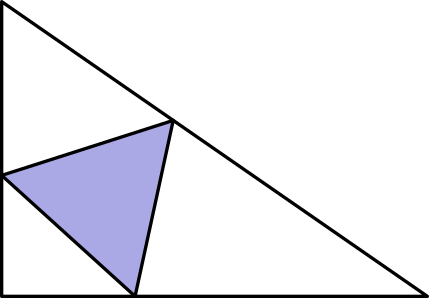
The area of the smallest equilateral triangle with one vertex on each of the sides of the right triangle with side lengths $2\sqrt{3},$ $5,$ and $\sqrt{37},$ as shown, is $\frac{m\sqrt{p}}{n},$ where $m,$ $n,$ and $p$ are positive integers, $m$ and $n$ are relatively prime, and $p$ is not divisible by the square of any prime. Find $m + n + p.$