All the positive integers $1,2,3,4,\ldots$ are grouped in the following way: $G_1=\{1,2\}$, $G_2=\{3,4,5,6\}$, $G_3=\{7,8,9,10,11,12,13,14\}$, that is, the set $G_n$ contains the next $2^n$ positive integers listed in ascending order after the set $G_{n-1}$, $n\gt 1$. If $S$ is the sum of all the positive integers from $G_1$ to $G_8$, find $\lfloor S/100\rfloor$.
A sequence of one hundred positive integers $x_1,x_2,x_3,\ldots,x_{100}$ are such that $$(x_1)^2+(2x_2)^2+(3x_3)^2+\cdots+(100x_{100})^2=338350.$$ Find the largest possible value of $x_1+x_2+\cdots+x_{100}$.
Let $a$ and $b$ be two real numbers satisfying $a\lt b$, and such that for each real number $m$ satisfying $a\lt m\lt b$, the circle $x^2+(y-m)^2=25$ meets the parabola $4y=x^2$ at four distinct points in the Cartesian plane. Let $S$ be the maximum possible value of $b-a$. Find $\lfloor4S\rfloor$.
A tetrahedron in $\mathbb R^3$ has one vertex at the origin $O$ and the other vertices at the points $A(6,0,0)$, $B(4,2,4)$ and $C(3,2,6)$. If $x$ is the height of the tetrahedron from $O$ to the plane $ABC$, find $\lfloor5x^2\rfloor$.
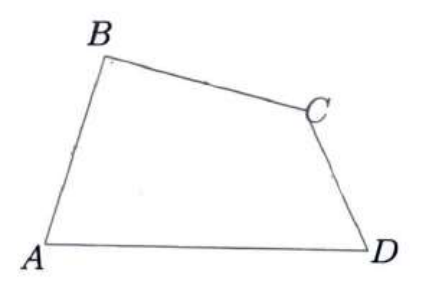
In the quadrilateral $ABCD$ below, it is given that $AB=BC=CD$ and $\angle ABC=80^\circ$, $\angle BCD=160^\circ$. Suppose $\angle ADC=x^\circ$. Find the value of $x$.
Find the largest possible value of $|a|+|b|$, where $a$ and $b$ are coprime integers (i.e., integers with no common factors larger than $1$) such that $a/b$ is a solution of $$\sqrt{4x+5-4\sqrt{x+1}}+\sqrt{x+2-2\sqrt{x+1}}=1.$$
Let $S$ be the set of real solutions $(x,y,z)$ of $$\frac{4x^2}{1+4x^2}=y,\qquad\frac{4y^2}{1+4y^2}=z,\qquad\frac{4z^2}{1+4z^2}=x.$$ For each $(x,y,z)\in S$, define $m(x,y,z)=2000(|x|+|y|+|z|)$. Determine the maximum value of $m(x,y,z)$ over all $(x,y,z)\in S$.
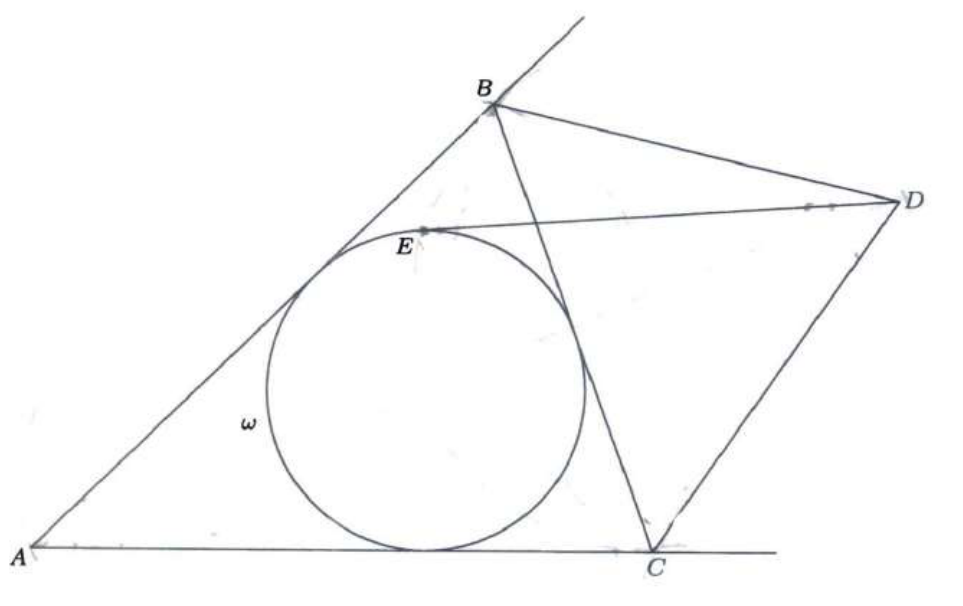
In the triangle $ABC$ shown in the diagram below, the external angle bisectors of $\angle B$ and $\angle C$ meet at $D$. The tangent from $D$ to the incircle $\omega$ of triangle $ABC$ touches $\omega$ at $E$, where $E$ and $B$ are on the same side of line $AD$. Suppose $\angle BEC=112^\circ$. Find the size of $\angle A$ in degrees.
Find the largest integer $n$ such that $n^2+5n-9486=10s(n)$, where $s(n)$ is the product of all digits of $n$ in its decimal representation. (For example, $s(481)=4\times8\times1=32$.)
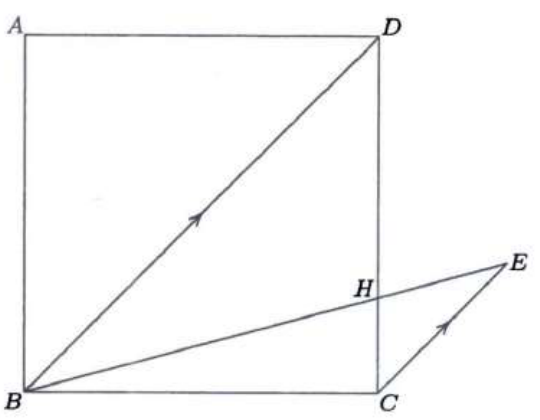
In the diagram below, $E$ is a point outside a square $ABCD$ such that $CE$ is parallel to $BD$, $BE=BD$, and $BE$ intersects $CD$ at $H$. Given $BE=\sqrt{6}+\sqrt{2}$, find the length of $DH$.
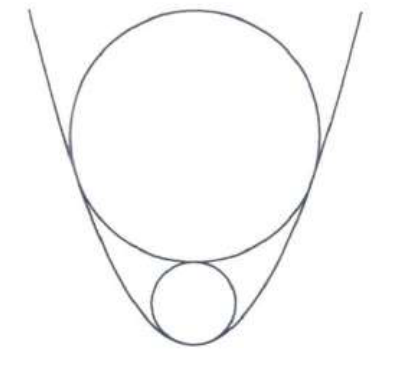
The diagram below shows the region $R=\{(x,y)\in\mathbb R^2\mid y\ge\tfrac12x^2\}$ on the $xy$-plane bounded by the parabola $y=\tfrac12x^2$. Let $C_1$ be the largest circle lying inside $R$ with its lowest point at the origin. Let $C_2$ be the largest circle lying inside $R$ and resting on top of $C_1$. Find the sum of the radii of $C_1$ and $C_2$.