Ten points are marked on a circle. How many distinct convex polygons of three or more sides can be drawn using some (or all) of the ten points as vertices?
If $a<b<c<d<e$ are consecutive positive integers such that $b+c+d$ is a perfect square and $a+b+c+d+e$ is a perfect cube, what is the smallest possible value of $c?$
When a certain biased coin is flipped five times, the probability of getting heads exactly once is not equal to $0$ and is the same as that of getting heads exactly twice. Let $\frac{i}{j},$ in lowest terms, be the probability that the coin comes up heads in exactly $3$ out of $5$ flips. Find $i+j.$
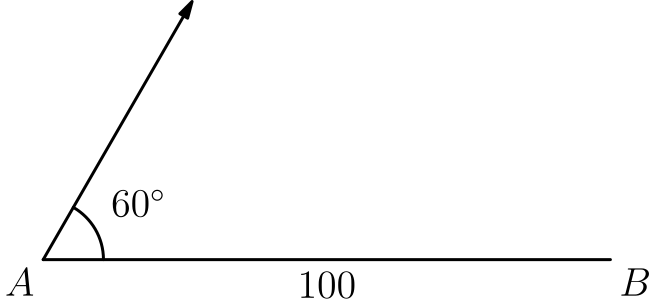
Two skaters, Allie and Billie, are at points $A$ and $B,$ respectively, on a flat, frozen lake. The distance between $A$ and $B$ is $100$ meters. Allie leaves $A$ and skates at a speed of $8$ meters per second on a straight line that makes a $60^\circ$ angle with $AB.$ At the same time Allie leaves $A,$ Billie leaves $B$ at a speed of $7$ meters per second and follows the straight path that produces the earliest possible meeting of the two skaters, given their speeds. How many meters does Allie skate before meeting Billie?
If the integer $k$ is added to each of the numbers $36,$ $300,$ and $596,$ one obtains the squares of three consecutive terms of an arithmetic series. Find $k.$
One of Euler’s conjectures was disproved in the $1960$s by three American mathematicians when they showed there was a positive integer $n$ such that $$
133^5+110^5+84^5+27^5=n^5.
$$ Find the value of $n.$
Let $a,$ $b,$ $c$ be the three sides of a triangle, and let $\alpha,$ $\beta,$ $\gamma$ be the angles opposite them. If $a^2+b^2=1989c^2,$ find $$
\frac{\cot\gamma}{\cot\alpha+\cot\beta}.
$$
A sample of $121$ integers is given, each between $1$ and $1000$ inclusive, with repetitions allowed. The sample has a unique mode (most frequent value). Let $D$ be the difference between the mode and the arithmetic mean of the sample. What is the largest possible value of $\lfloor D\rfloor?$ (For real $x,$ $\lfloor x\rfloor$ is the greatest integer less than or equal to $x.$)
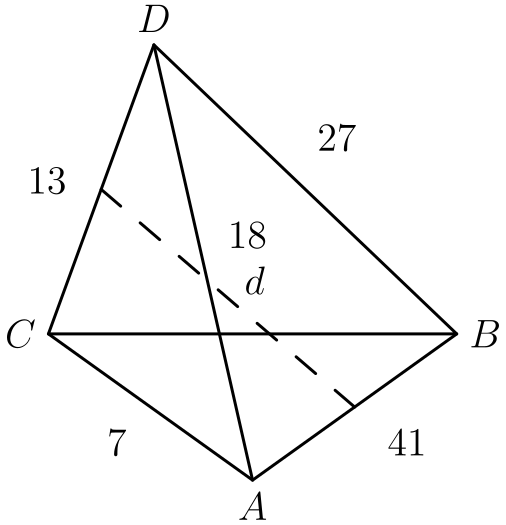
Let $ABCD$ be a tetrahedron with $AB=41,$ $AC=7,$ $AD=18,$ $BC=36,$ $BD=27,$ and $CD=13,$ as shown in the figure. Let $d$ be the distance between the midpoints of edges $AB$ and $CD.$ Find $d^2.$
Let $S$ be a subset of $\{1,2,3,\ldots,1989\}$ such that no two members of $S$ differ by $4$ or $7.$ What is the largest number of elements $S$ can have?
Given a positive integer $n$, every nonzero complex number of the form $r+si$, where $r$ and $s$ are integers, has a unique expansion in base $-n+i$ using the integers $0,1,\ldots,n^2$ as digits. That is,
for a unique nonnegative integer $m$ and digits $a_0,a_1,\ldots,a_m$ chosen from $\{0,1,2,\ldots,n^2\}$, with $a_m\ne0$. The number zero is represented by the single digit $0$. We write
$$r+si=(a_ma_{m-1}\ldots a_1a_0)_{-n+i}$$
to denote this base expansion. There are only finitely many integers $k+0i$ that have four-digit expansions
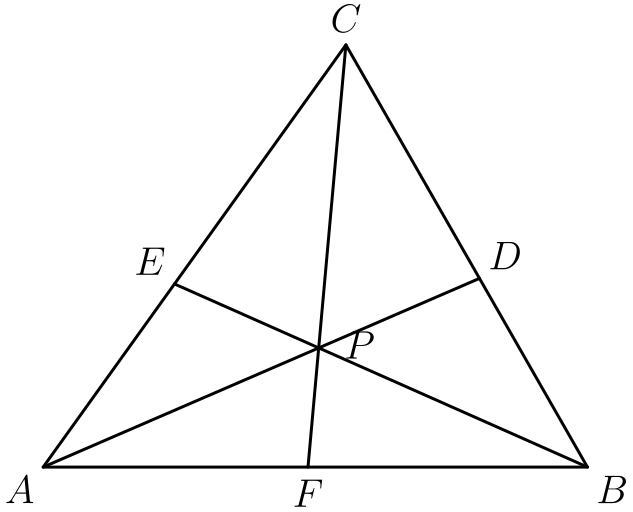
Point $P$ is inside triangle $ABC.$ Line segments $APD,$ $BPE,$ and $CPF$ are drawn with $D$ on $BC,$ $E$ on $AC,$ and $F$ on $AB$ (see the figure). Given that $AP=6,$ $BP=9,$ $PD=6,$ $PE=3,$ and $CF=20,$ find the area of triangle $ABC.$