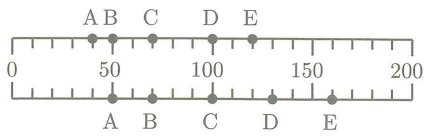
The five large dots on the top horizontal line show the populations of City Montessori Schools $A,B,C,D,E$ in Lucknow in $1992$. The bottom line shows their populations in $2002$. Which school had the greatest percentage increase?
Given $x$, three operations suffice for $x^8$: $x^2=x\cdot x$, $x^4=x^2\cdot x^2$, $x^8=x^4\cdot x^4$. Five suffice for $x^{15}$: the same first three, then $x^{16}=x^8\cdot x^8$, $x^{15}=x^{16}\div x$. What is the minimum number of multiplications and divisions needed to find $x^{1000}$?
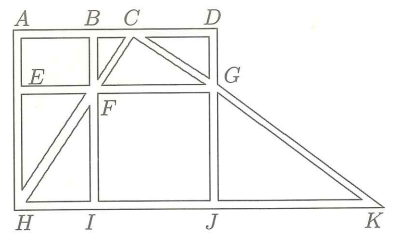
The diagram shows a city street map. Three police officers must stand at street corners so that every point of every street is visible to at least one officer. Give the letter codes of these corners.
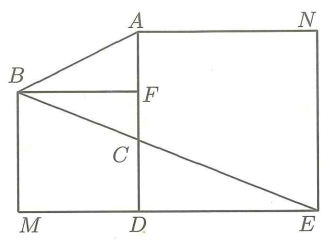
$ADEN$ is a square. $BMDF$ is a square with $F$ on $AD$ and $M$ on the extension of $ED$. Let $C=AD\cap BE$. If triangle $CDE$ has area $6$ cm$^2$, find the area of triangle $ABC$ in cm$^2$.
Ten people stand in a line. The first moves to the back and the next sits down, leaving the original third person at the front. Repeat: move the front person to the back, then the next person sits down, until only one remains standing. What was that person’s original position?
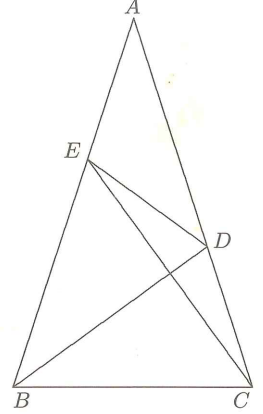
In triangle $ABC$, $\angle CAB=36^\circ$, $\angle BCA=72^\circ$. Let $D$ lie on $AC$ such that $BD$ bisects $\angle ABC$. Let $E$ lie on $AB$ with $CE\perp BD$. How many isosceles triangles are in the diagram?
Two distinct two-digit numbers have the same units digit but different tens digits. The quotient on dividing either by $9$ equals the remainder on dividing the other by $9$, and vice versa. What is their common units digit?
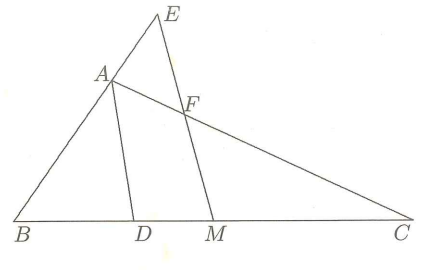
In triangle $ABC$, $D$ lies on $BC$ and $AD$ bisects $\angle CAB$. Let $M$ be the midpoint of $BC$. Point $E$ lies on the extension of $BA$ with $ME\parallel AD$, and $ME$ meets $AC$ at $F$. Prove $BE=CF=\frac{AB+AC}{2}$.
Let $f(x)=\frac{bx+1}{2x+a}$, where $a,b$ are constants with $ab\ne2$. (a) If $f(x)f(1/x)=k$ for all admissible $x$, find $k$. (b) Prove that $f(f(x))$ is not a constant function.
Four brothers divide $137$ gold coins, no two receiving the same number. Each receives an integral multiple of the number received by his next younger brother. Find all possible shares.