Skip to content / Đến nội dung
ThichHocToan.com

Question bank IMSO Science 2004

Exam papers

141 questions

Question 1

ALTITUDE OF STARS


Objectives:

To determine the altitude of stars from the horizon


Materials:


1\. Pipe


2\. Protactor


3\. Masking tape


4\. String


5\. Heavy bolt


6\. Artificial stars


Procedure:


1\. Construct an equipment using the available materials for determining the altitude of stars

from the horizon.


2\. Estimate the altitude of 3 stars

a. Look through the pipe (keeping one eye closed) at star 1. Read the degrees on the

protactor.

b. Look through the pipe (keeping one eye closed) at star 2. Read the degrees on the

protactor.

c. Look through the pipe (keeping one eye closed) at star 3. Read the degrees on the

protactor.


Results and conclusion:

Write down your results and conclusion
Question 2

MAKE YOUR OWN KEY TO IDENTIFY FRUITS


Plants and animals are useful to humankind. We need plants for food and medicine, to supply the

atmosphere with oxygen, to help water conservation, etc. It is important to identify the plants to

know its’ usefulness. One way to identify plants or animals is using keys. One of example is the

following keys that can be used to identify nuts and beans. You may try to use the keys.


Objectives:

In this experiment you will identify some fruits based on a key you made using known beans and

nuts.


Materials:


1\. Small bags


2\. Various kinds of beans

a. Red beans

b. soy beans,

c. coffee beans

d. cashew nuts

e. peanuts


3\. Baby carrot (15 kg)


4\. Passion fruit (15 kg)


5\. Zalacca (10 kg)


6\. Mangosteen (10 kg)


7\. Baby radish (15 kg)


8\. Radish (5 kg)


Procedure:

Creating your own keys

Observe five different beans and nuts available on your desk, use the following keys and put the

beans on little plastic bags available inside a red color code bag.


Use the following keys to identify the object


1\. Is the beans smells coffee? If yes ………………..Coffee bean

If not …………………………………………….. go to no 2


2\. Is the beans has black spot ? ……………………. Soy bean

If not …………………………………………….. go to no 3


3\. Is the beans has red color? …………………….. Red bean

If not …………………………………………….. go to no 4


4\. Is the beans longer than 4 cm ……………… Cashew nut

If not ……………………………………………. Peanut


Questions:


1\. Keys are made based on a range of biological character such as shape, color etc. Create

keys as many as you can to identify the following objects available on the bucket.


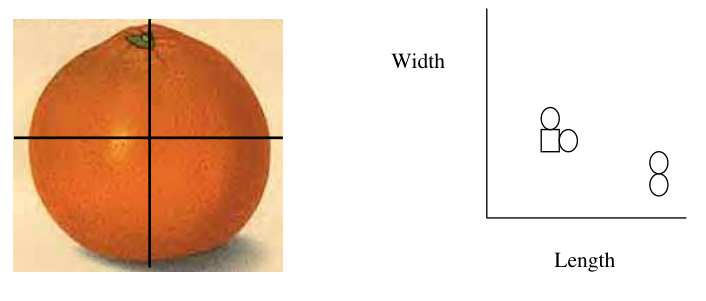
2\. With your ruler measure the dimension of those objects and plot your measurement in the

following graph. Use the axis of each object to measure the length and width see the example


3\. Keys are made based on a range of biological character such as shape, color etc. Create

keys as many as you can to identify the following objects available on the bucket. Remember

each item (number) maximum contain only two statements.


4\. With your ruler measure the dimension of those objects and plot your measurement in the

following graph. Use the axis of each object to measure the length and width see the example

Question illustration

Question 3

ELECTRICAL RESISTANCES OF METAL WIRES


Every material is characterized by its electrical resistance. If a metal wire is connected to a

battery, electrical current will flow through the wire. By reading the voltage difference between

the ends of the wire and the current flowing through the wire, the resistance of the wire can be

calculated.


Objectives:

In this experiment you will determine the resistances of materials.


Materials:

Electrical circuit board

Four batteries 1.5 V


Procedure:


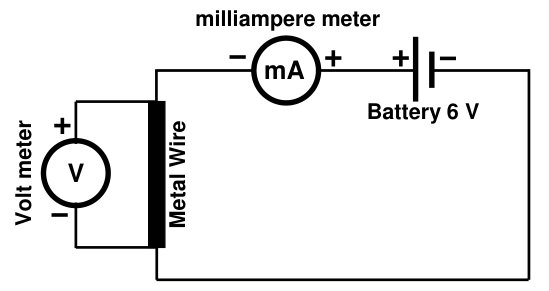
1\. Arrange the following electrical circuit using an electrical board and electrical

jumpers/connectors provided:

milliampere meter

mA

Battery 6 V
meter Wire V
Volt Metal


2\. The dependence of resistance on the length of a metal wire is investigated. Use a metal
wire with the cross-section area A1 of 0.1 mm2 and the length (L) of 5 cm. Read the

electrical current (I) flowing through the wire and the voltage (V) across the wire, which

are displayed by a milliampere meter and a volt meter, respectively.


3\. Repeat the measurement for the length (L) of 10 cm, 15 cm, and 20 cm.


4\. Calculate resistance (R) of the wire using the relation R=V/I.


5\. Make a table for the measurement and calculated resistance.


6\. Make a graph describing resistance (R) as a function of wire’s length (L) from the table.


7\. Now, resistance as a function of wire’s cross-section area is investigated. Use a metal
wire with the length of 20 cm and the area A1 of 0.1 mm2. Read the electrical current (I)

flowing through the wire and the voltage (V) across the wire.


8\. Repeat the measurement for the area A2, A3, and A4.


9\. Calculate resistance (R) of the wire using the relation R=V/I.


10\. Make a table for the measurement and calculated resistance.


11\. Make a graph describing the dependence of resistance (R) on 1/A from the table.


Question:

What are your conclusions from the two graphs.

Question illustration

Question 1

RESPIRATION


Objectives:

In this experiment you will determine the respiration rates of sprout


Materials:

1\. long sprout

2\. scalled plastic straw

3\. plasticin

4\. reaction tubes

5\. Tissue/filter paper

6\. short sprout

7\. timer

8\. KOH

9\. dye solution

Procedures:


1\. Prepared 2 tubes and give label to the tubes (A and B)


2\. Put 14 long sprout in tube A and 18 short spout in tube B


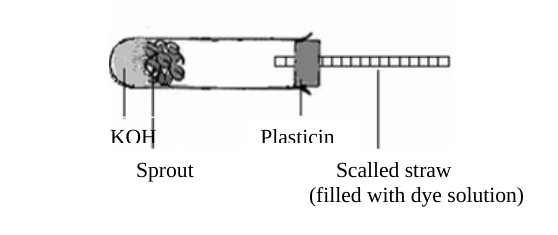
3\. Covered the tube with plasticin and straw (Arranged the equipment as seen in the

picture above).


KOH Plasticin
Sprout Scalled straw
(filled with dye solution)


4\. Observe how far dye solution move in every two minutes for 5 times.


5\. Put your result on the table


6\. Assume that 1 scale is 1 ml of oxygen consumed, calculate the respiration rates of

long sprout and short sprout in each minutes.

Table 1. Respiration rates in two different sprouts

| Time (per 2 mins) | Volume O₂ (ml): Sprout A | Volume O₂ (ml): Sprout B |
| --- | --- | --- |
| I | | |
| II | | |
| III | | |
| IV | | |
| V | | |
| Respiration rates | … ml/min | … ml/min |

Answer the following Questions:


1\. Which sprout has a higher respiration rates?


2\. Explain why the respiration of sprout A and sprout B is different?


3\. Change the table of your data into the graph. Respiration rates on the horizontal axis and

time in the vertical axis.


4\. Write down the conclusion of the experiment

Question illustration

Question 2

FRICTION FORCE


Friction force between two contacting surfaces plays important role in our daily life. The surfaces

of vehicle tires and the surface of roads must not be smooth to generate appreciable friction

forces between them. This friction force avoids a slippery motion of the vehicles, which may

cause the occurrence of unexpected accidents. On the other hand, lubricant oils are used to

reduce the friction forces between the moving parts in machines to avoid the occurrence of any

damage on the machine as well as to enhance the efficiency of energy usage. The friction force

between two surfaces depends on the contacting forces between these surfaces (how strong one

surface pulls another surface) and the nature of the contacting surfaces. Mathematically, the

friction force between two contacting surfaces just before a relative motion between two surfaces

occurs can be expressed as


Fs = C N


where

Fs : the friction force

N : the contacting force between two surface

C : a factor which describes the nature of the contacting surfaces. This factor is known as

the coefficient of friction.


Objectives:

In this experiment, you will measure the friction force between two contacting bodies using two

methods: i.e., (a) using a spring balance and without spring balance (b). You must compare the

results obtained by these two methods.


Materials:


1\. Wood plate


2\. Three blocks (200 g, 300 g, and 400 g) having different surface roughness:

(a) covered with a coarse sand paper,

(b) covered with a fine sand paper,

(c) covered with a mica


3\. Spring balance


4\. Ruler


Questions:

Determine the coefficient of frictions between each block and plane surface using a spring

balance. You must report the method (procedure) of measurement.


A.1. Surface covered with coarse sand paper

| Block mass (kg) | Contacting force or weight (N) | Friction force just before surface slippery (N) | Coefficient of friction |
| --- | --- | --- | --- |
| 0.2 | | | |
| 0.3 | | | |
| 0.4 | | | |

A.2. Surface covered with fine sand paper

| Block mass (kg) | Contacting force or weight (N) | Friction force just before surface slippery (N) | Coefficient of friction |
| --- | --- | --- | --- |
| | | | |
| | | | |
| | | | |

A.2. Surface covered with mica

| Block mass (kg) | Contacting force or weight (N) | Friction force just before surface slippery (N) | Coefficient of friction |
| --- | --- | --- | --- |
| | | | |
| | | | |
| | | | |

The source repeats label A.2. Blank entries remain blank.

Question 3

THE MAGIC OF ELECTRICITY


Energy can change its form from one to another. For instance, light energy of the Sun is changed

to chemical energy by plants through photosyntesis process.


Objectives:

In this experiment you will observe the change of electricity into heat energy.


Materials:

- plastics cup (50 ml) with cover

- water

- cables and connectors

- coil

- batteries with holder

- thermometer

- timer


Procedures:


1\. Fill the plastics cup with 50 ml of water


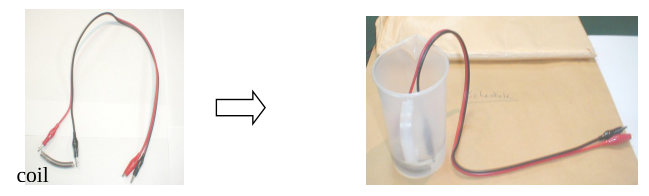
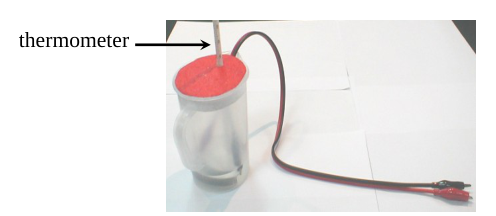
2\. Connect the coil with connector then put it into the plastics cup. Make sure that whole coil is

immersed in water. (See figure below)

coil


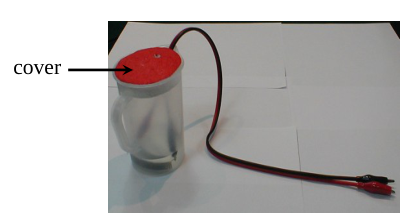
3\. Put the cover of cup on the top of the cup and make sure that it can seal the cup properly (See

figure below)


cover


4\. Put the thermometer into the hole provided in the cover of cup (see figure below)


thermometer


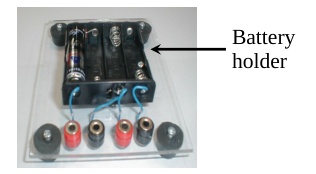
5\. Put one battery (1.5V) on the battery holder properly.

Battery
holder


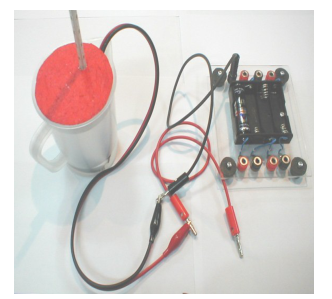
6\. Arrange the experimental apparatus according to the picture below.


7\. Measure the initial temperature of water in the plastics cup by using the thermometer provided.

Write down the measured temperature on the Table provided below.


8\. Connect the coil to the battery for 5 minutes. Disconnect coil and battery and then measure the

temperature of water by using the thermometer provided. Use the timer to measure the time.

Write down this measured temperature on the Table.


9\. Add one (1) battery serially to the circuit so that the voltage become 3.0 V and then repeat the

steps 7 and 8.


10\. Add one (1) more battery serially to the circuit so that the voltage become 4.5 V and then

repeat the steps 7 and 8 again.


11\. Calculate the difference between the temperature of water after 5 minutes heating and the

initial temperature for each voltage.


| No | Voltage (Volt) | Initial temperature of water (°C) | Temperature after 5 minutes Heating (°C) | Temperature Difference (°C) |
| --- | --- | --- | --- | --- |
| 1 | 1.5 | | | |
| 2 | 3.0 | | | |
| 3 | 4.5 | | | |

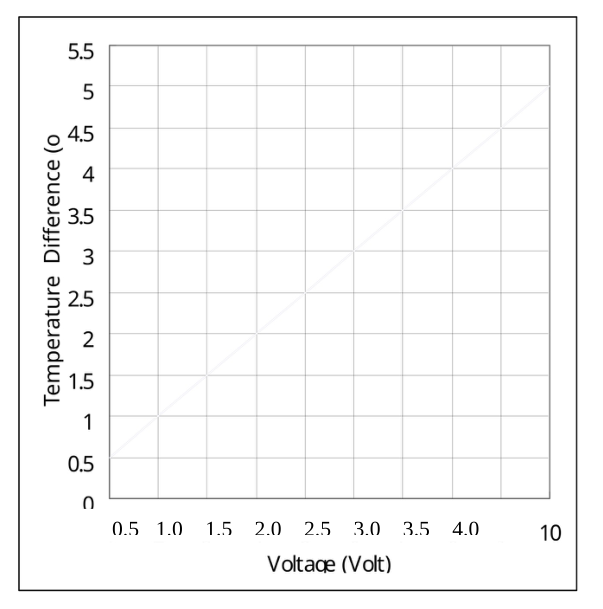
12\. Draw a graph of the temperature difference of water againts the change of the voltage.


0\.5 1.0 1.5 2.0 2.5 3.0 3.5 4.0


Analysis:

If the amount of water is 50ml and the voltage is 1.0 V, predict the temperature of water.


Question illustration

Question illustration

Question illustration

Question illustration

Question illustration

Question illustration

Question 1

Choose the RIGHT statement.

A. For the Moon to cover the Sun and thus to produce a solar eclipse, it must be at a full moon phase.

B. A star sets at 10 PM tonight. Tomorrow it will set earlier.

C. On the opposition, Mars is in its longest distance from the Earth.

D. The Sun never rises at South Pole in December.

E. The Earth moves fastest at its aphelion during its revolution around the Sun.

Question 2

Choose the RIGHT statements (may be more than one).

A. After the Sun, the nearest star to us is Alpha Centauri in the Southern Hemisphere.

B. We always see the same stars all over the year due to the Earth’s revolution.

C. Supernova is a stellar outburst or explosion in which a star suddenly increases its luminosity from hundreds of thousands to hundreds of million times.

D. A circumpolar star is a star which is always above the horizon.

E. Andromeda is the nearest extragalaxy to us.

Question 3

List the distance between two bodies below in right order from the smallest to the largest.

i. The Solar System - Alpha Centauri
ii. The Sun - Pluto
iii. The Earth - the Moon
iv. The Earth - the Sun
v. The Solar System - Andromeda Galaxy

Question 4

What is the latitude of
a. The North Pole
b. The South Pole
c. A place in the Equator

Question 5

What is the phase of the Moon when it is on the meridian (the highest point) at
a. 6 PM
b. Midnight
c. 6 AM

Question 6

Venus is one of the inner planets in our solar system. Is it possible to watch it at midnight? Draw a diagram to explain your answer.

Question 7

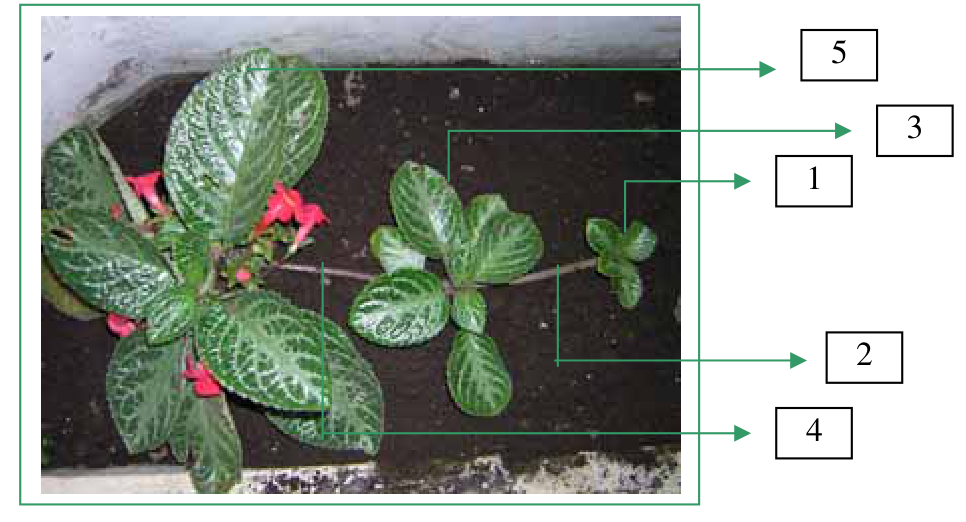
Look at the following picture. Episcia reproduces young plants by runners.

A. How many runners shown in the picture?
B. Which one is the oldest runner?
C. A runner is a special kind of … (choose one right answer: Stem/root/leaf/flower/plants).

Question illustration

Question 8

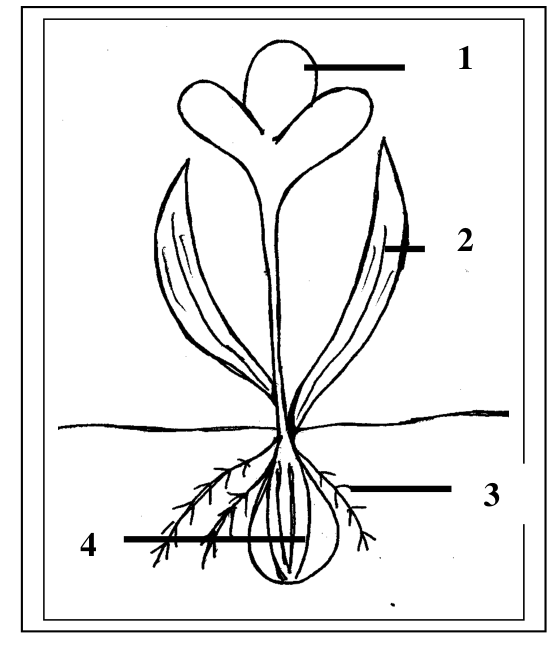
Figure below shows a complete bulb plant.
A. Part of plant which absorb water and mineral is …
B. Part of plant which produces carbohydrates is …
C. Where is the food stored?

Question illustration

Question 9

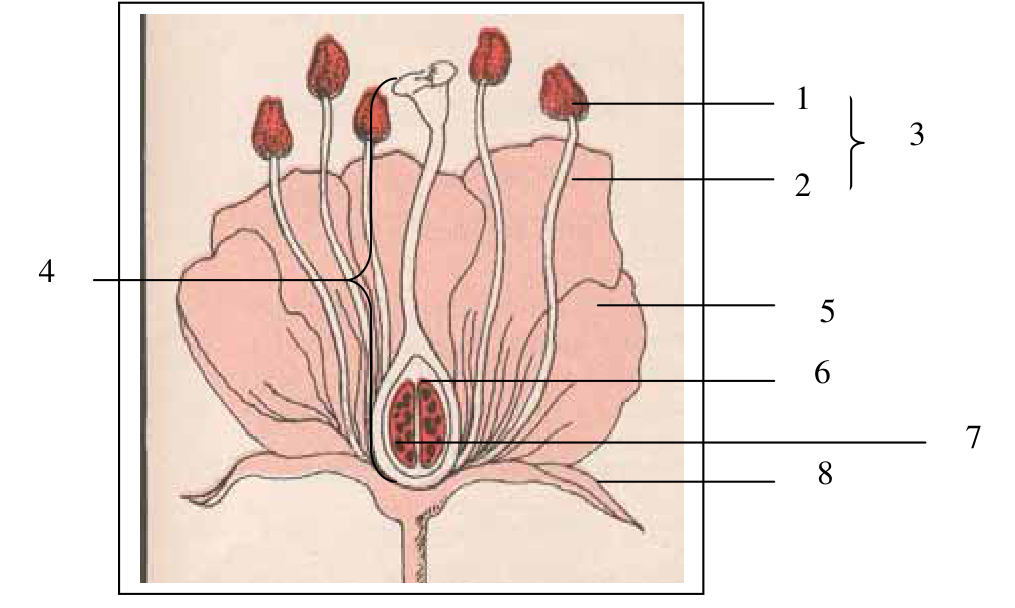
Look at the figure below.
A. Write down the name of parts of the flower!
B. Which part of flower that function to attract the insect?
C. Which part of flower produces the pollen?
D. How many ovary does this flower have?
E. The flower indicates as: a. perfect flower; b. imperfect flower; c. complete flower; d. incomplete flower.

Question illustration

Question 10

Among the following plants that can be classified into the same group are:
  1. corn, coconut, grape
  2. pine tree, lily, coconut
  3. apple, pine tree, peanut
  4. corn, lily, coconut
  5. apple, grape, pine tree

Question 11

What is the name of the process which is responsible for the production of oxygen by green plants?

Question 12

What are plant needed for the process in no. 11 and what substances are produced?

Question 13

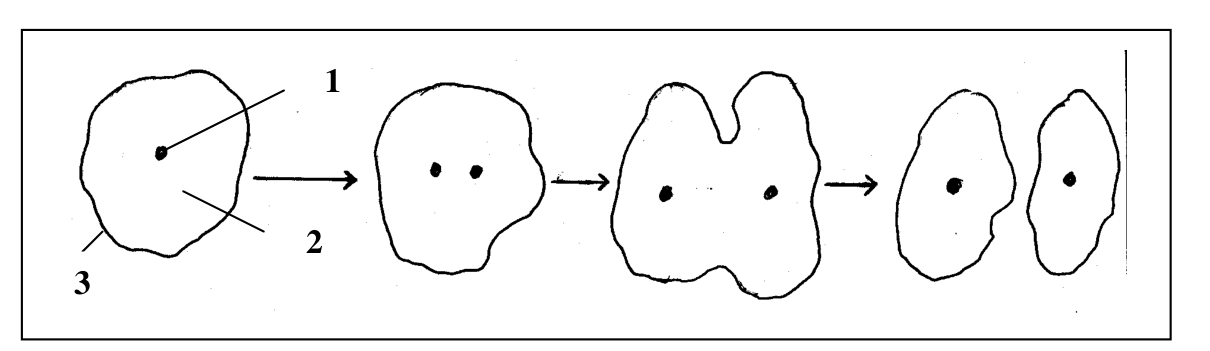
An Amoeba reproduces by binary fission.
A. What are the three parts of the cells shown in figure?
B. Are the daughter cells exactly similar to each other?
C. How many parents involved in binary fission?
D. What kind of reproduction is binary fission?

Question illustration

Question 14

Sexual reproduction in flowering plants
  1. is conducted through bud formation.
  2. requires the presence of petals.
  3. can be accomplished by grafting.
  4. gives rise to genetically diverse offspring.
  5. cannot result from self-pollination.