For a positive integer $n$, let $S(n)$ be the sum of its decimal digits. Any positive integer obtained by removing at least one digit from the right-hand end of its decimal representation is called a stump of $n$. Let $T(n)$ be the sum of all stumps of $n$. Prove that $n=S(n)+9T(n)$.
Find the largest positive integer $N$ such that the number of integers in $\{1,2,\ldots,N\}$ divisible by 3 equals the number divisible by 5 or 7 (or both).
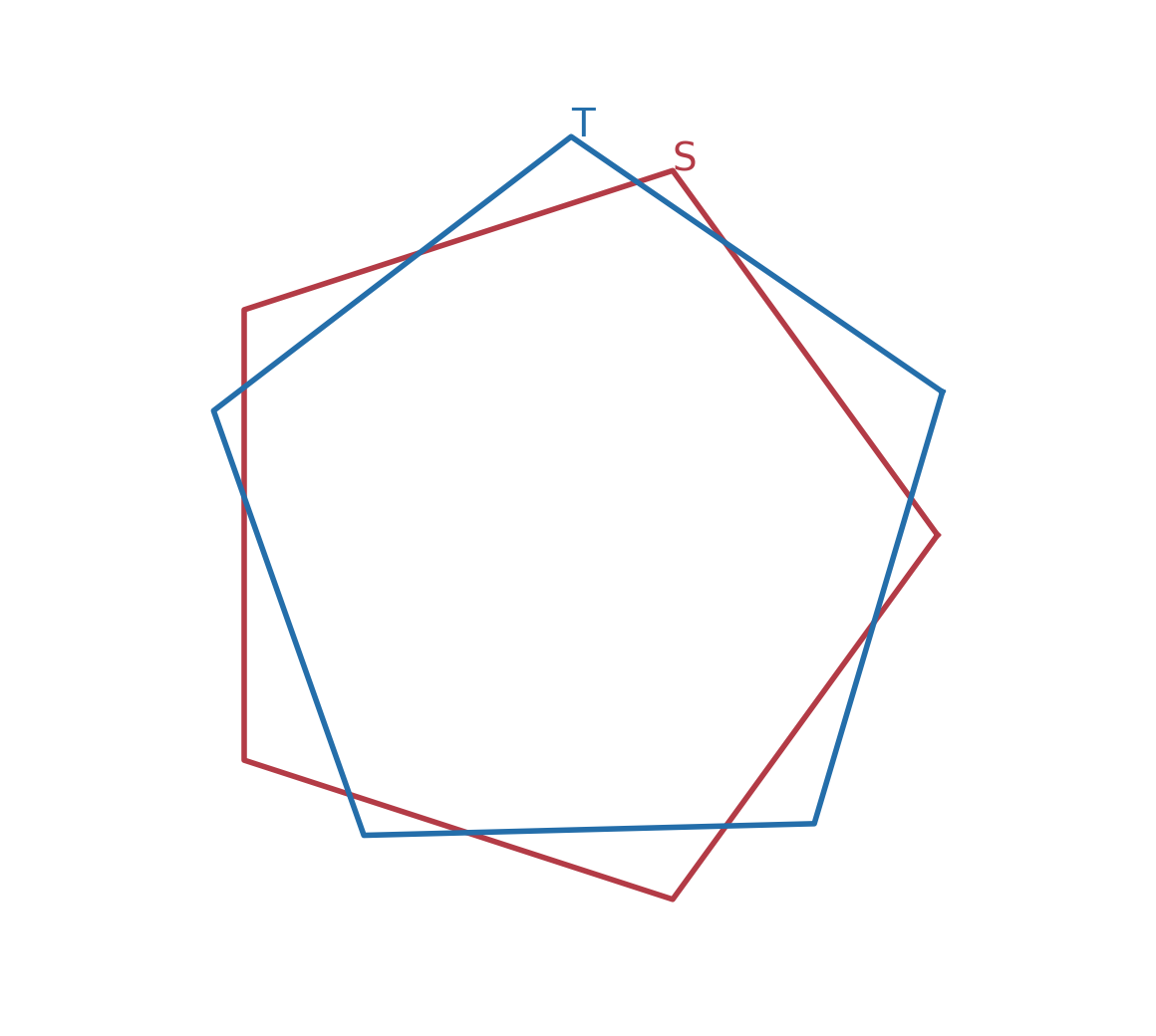
Let two equal regular $n$-gons $S,T$ be located in the plane such that their intersection is a $2n$-gon ($n\ge3$). The sides of $S$ are red and the sides of $T$ blue. Prove that the sum of the lengths of the blue sides of $S\cap T$ equals the sum of the lengths of its red sides.
A point in the Cartesian plane is called mixed if one coordinate is rational and the other irrational. Find all real-coefficient polynomials whose graphs contain no mixed point.
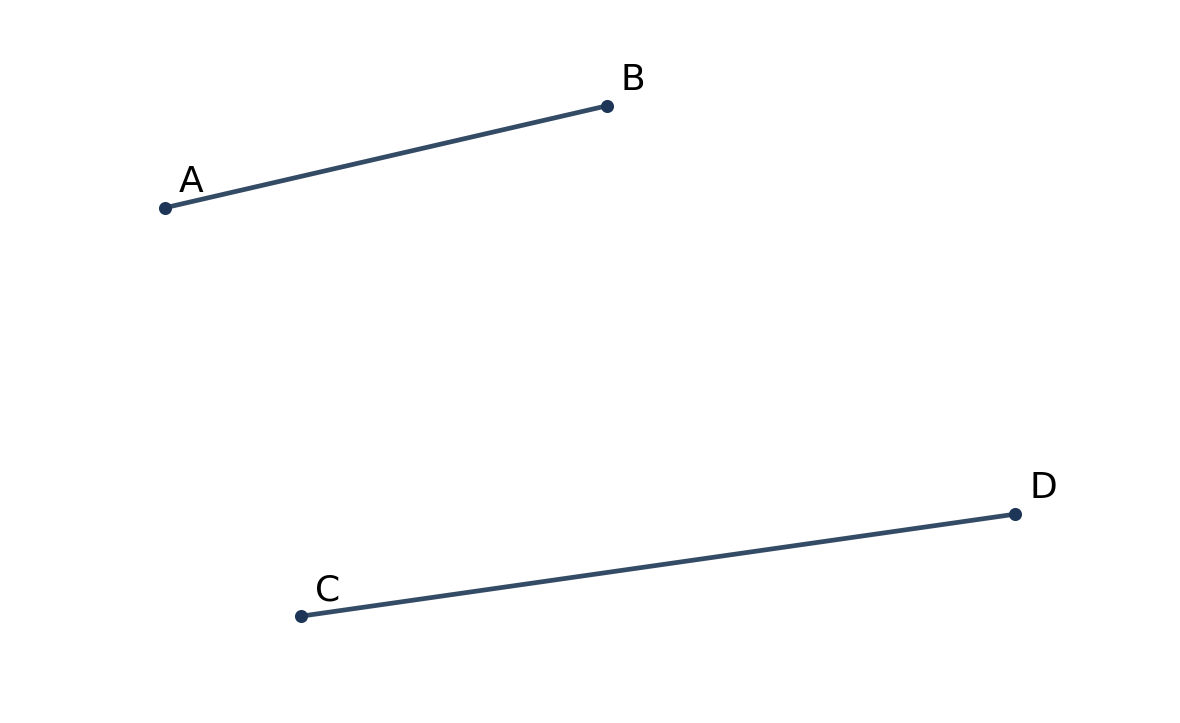
Find the greatest integer $n$ such that there are $n+4$ points $A,B,C,D,X_1,\ldots,X_n$ in the plane with $AB\ne CD$ and, for each $i=1,\ldots,n$, triangles $ABX_i$ and $CDX_i$ are congruent.