The sum of two natural numbers is $17{,}402.$ One of the two numbers is divisible by $10.$ If the units digit of that number is erased, the other number is obtained. What is the difference of these two numbers?
When a student multiplied the number $66$ by the repeating decimal $$
1.\overline{ab} = 1.ababab\ldots,
$$ where $a$ and $b$ are digits, he did not notice the notation and just multiplied $66$ by the terminating decimal $1.ab.$ Later he found that his answer was $0.5$ less than the correct answer.
A deck of cards has only red cards and black cards. The probability of a randomly chosen card being red is $\dfrac13.$ When $4$ black cards are added to the deck, the probability of choosing red becomes $\dfrac14.$ How many cards were in the deck originally?
A sequence of numbers is defined by $D_0 = 0,$ $D_1 = 0,$ $D_2 = 1,$ and $D_n = D_{n-1} + D_{n-3}$ for $n \ge 3.$ What are the parities (evenness or oddness) of the triple of numbers $(D_{2021}, D_{2022}, D_{2023}),$ where $E$ denotes even and $O$ denotes odd?
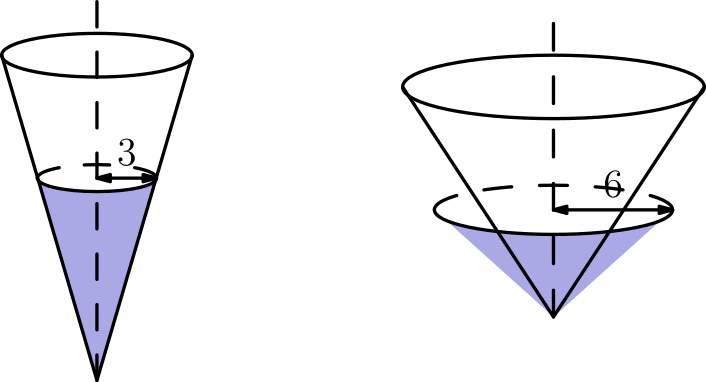
Two right circular cones with vertices facing down as shown in the figure below contain the same amount of liquid. The radii of the tops of the liquid surfaces are $3$ cm and $6$ cm. Into each cone is dropped a spherical marble of radius $1$ cm, which sinks to the bottom and is completely submerged without spilling any liquid. What is the ratio of the rise of the liquid level in the narrow cone to the rise of the liquid level in the wide cone?
A laser is placed at the point $(3, 5).$ The laser beam travels in a straight line. Larry wants the beam to hit and bounce off the $y$-axis, then hit and bounce off the $x$-axis, then hit the point $(7, 5).$ What is the total distance the beam will travel along this path?
What is the value of $$
\begin{aligned} &\left(\sum_{k=1}^{20} \log_{5^k} 3^{k^2}\right) \\ &\quad {}\cdot \left(\sum_{k=1}^{100} \log_{9^k} 25^k\right)? \end{aligned}
$$
A choir director must select a group of singers from among his $6$ tenors and $8$ basses. The only requirements are that the difference between the number of tenors and basses must be a multiple of $4,$ and the group must have at least one singer. Let $N$ be the number of groups that can be selected. What is the remainder when $N$ is divided by $100?$
In the following list of numbers, the integer $n$ appears $n$ times in the list for $1 \le n \le 200.$ $1,$ $2,$ $2,$ $3,$ $3,$ $3,$ $4,$ $4,$ $4,$ $4,$ $\ldots,$ $200,$ $200,$ $\ldots,$ $200$
Trapezoid $ABCD$ has $AB \parallel CD,$ $BC = CD = 43,$ and $AD \perp BD.$ Let $O$ be the intersection of the diagonals $AC$ and $BD,$ and let $P$ be the midpoint of $BD.$ Given that $OP = 11,$ the length $AD$ can be written in the form $m\sqrt n,$ where $m$ and $n$ are positive integers and $n$ is not divisible by the square of any prime. What is $m + n?$
Let $f$ be a function defined on the set of positive rational numbers with the property that $f(a\cdot b) = f(a) + f(b)$ for all positive rational numbers $a$ and $b.$ Suppose that $f$ also has the property that $f(p) = p$ for every prime number $p.$ For which of the following numbers $x$ is $f(x) \lt 0?$
How many solutions does the equation $$
\sin\left(\frac{\pi}{2}\cos x\right) = \cos\left(\frac{\pi}{2}\sin x\right)
$$ have in the closed interval $[0, \pi]?$
Suppose that on a parabola with vertex $V$ and a focus $F$ there exists a point $A$ such that $AF = 20$ and $AV = 21.$ What is the sum of all possible values of the length $FV?$