When a right triangle is rotated about one leg, the volume of the cone produced is $800\pi\text{ cm}^3.$ When the triangle is rotated about the other leg, the volume of the cone produced is $1920\pi\text{ cm}^3.$ What is the length (in cm) of the hypotenuse of the triangle?
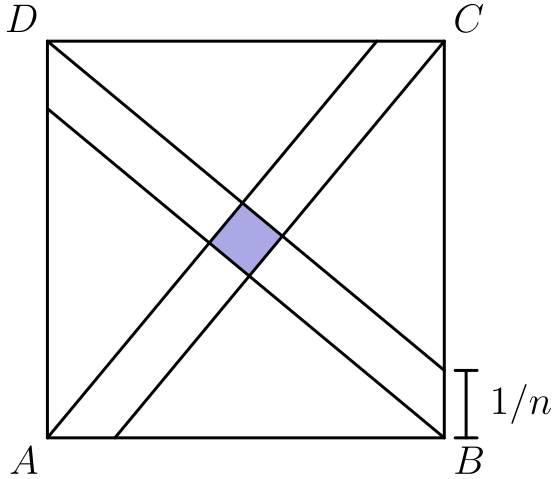
A small square is constructed inside a square of area $1$ by dividing each side of the unit square into $n$ equal parts, and then connecting the vertices to the division points closest to the opposite vertices, as shown. Find the value of $n$ if the area of the small square (shaded in the figure) is exactly $\frac1{1985}.$
A sequence of integers $a_1,$ $a_2,$ $a_3,$ $\ldots$ is chosen so that $a_n=a_{n-1}-a_{n-2}$ for each $n\geq3.$ What is the sum of the first $2001$ terms of this sequence if the sum of the first $1492$ terms is $1985,$ and the sum of the first $1985$ terms is $1492?$
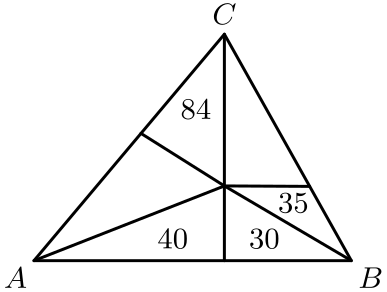
As shown in the figure, triangle $ABC$ is divided into six smaller triangles by lines drawn from the vertices through a common interior point. The areas of four of these triangles are as indicated. Find the area of triangle $ABC.$
The sum of the following seven numbers is exactly $19:$ $$
\begin{aligned} a_1&=2.56,\\ a_2&=2.61,\\ a_3&=2.65,\\ a_4&=2.71,\\ a_5&=2.79,\\ a_6&=2.82,\\ a_7&=2.86. \end{aligned}
$$ It is desired to replace each $a_i$ by an integer approximation $A_i,$ $1\leq i\leq7,$ so that the sum of the $A_i$’s is also $19$ and so that $M,$ the maximum of the “errors” $|A_i-a_i|,$ is as small as possible. For this minimum $M,$ what is $100M?$
In a circle, parallel chords of lengths $2,$ $3,$ and $4$ determine central angles of $\alpha,$ $\beta,$ and $\alpha+\beta$ radians, respectively, where $\alpha+\beta\lt\pi.$ If $\cos\alpha,$ which is a positive rational number, is expressed as a fraction in lowest terms, what is the sum of its numerator and denominator?
How many of the first $1000$ positive integers can be expressed in the form $$
\lfloor2x\rfloor+\lfloor4x\rfloor+\lfloor6x\rfloor+\lfloor8x\rfloor,
$$ where $x$ is a real number, and $\lfloor z\rfloor$ denotes the greatest integer less than or equal to $z?$
Let $A,$ $B,$ $C,$ and $D$ be the vertices of a regular tetrahedron, each of whose edges measures $1$ meter. A bug, starting from vertex $A,$ observes the following rule: at each vertex it chooses one of the three edges meeting at that vertex, each edge being equally likely to be chosen, and crawls along that edge to the vertex at its opposite end. Let $p=\frac{n}{729}$ be the probability that the bug is at vertex $A$ when it has crawled exactly $7$ meters. Find the value of $n.$
The numbers in the sequence $101,$ $104,$ $109,$ $116,$ $\ldots$ are of the form $a_n=100+n^2,$ where $n=1,$ $2,$ $3,$ $\ldots.$ For each $n,$ let $d_n$ be the greatest common divisor of $a_n$ and $a_{n+1}.$ Find the maximum value of $d_n$ as $n$ ranges through the positive integers.
In a tournament each player played exactly one game against each of the other players. In each game the winner was awarded $1$ point, the loser got $0$ points, and each of the two players earned $\frac12$ point if the game was a tie. After the completion of the tournament, it was found that exactly half of the points earned by each player were earned against the ten players with the least number of points. (In particular, each of the ten lowest-scoring players earned half of her or his points against the other nine of the ten.) What was the total number of players in the tournament?
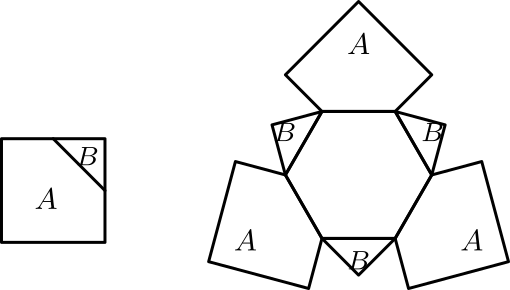
Three $12\text{ cm}\times12\text{ cm}$ squares are each cut into two pieces $A$ and $B,$ as shown in the first figure below, by joining the midpoints of two adjacent sides. These six pieces are then attached to a regular hexagon, as shown in the second figure, so as to fold into a polyhedron. What is the volume (in $\text{cm}^3$) of this polyhedron?