SEAMO self-study edition 2027; not an official 2027 paper. Original source years are retained. 25 questions, 90 minutes; Q1–10: 3 points, Q11–20: 4 points, Q21–25: 6 points, total 100. Original response types and all subparts are preserved. Verified is an editorial convention; source defects, necessary assumptions and unresolved mathematical uncertainty are disclosed.
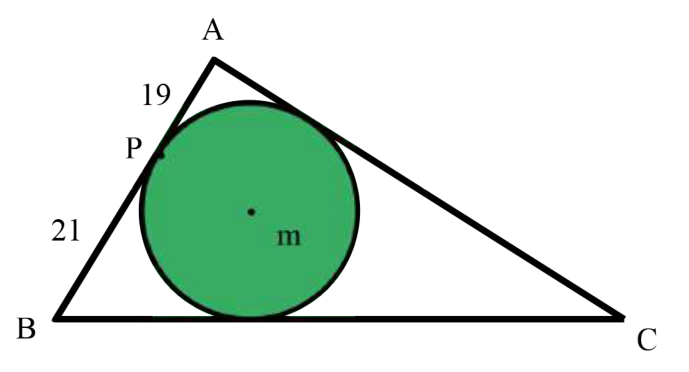
A circle of radius 17 is inscribed in triangle $ABC$ and is tangent to side $AB$ at $P$. Given $AP=19$ and $PB=21$, find the perimeter of $ABC$.
Original source figure (schematic), preserving its mathematical labels and arrangement.
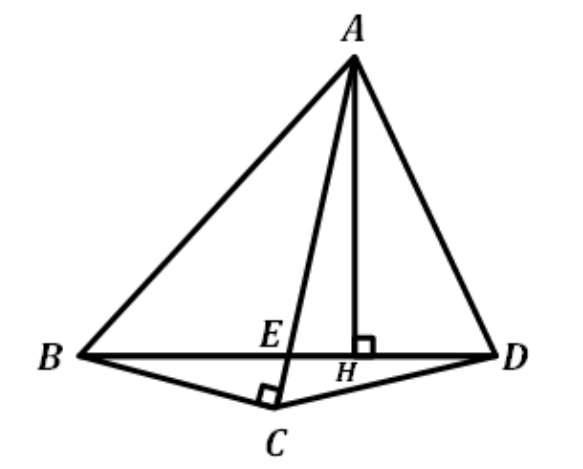
$ABCD$ is a convex quadrilateral whose diagonals $AC$ and $BD$ intersect at $E$. Point $H$ lies on segment $DE$ and $AH\perp DE$. Given $BE=ED$, $CE=9$, $EH=12$, $AH=32$ and $\angle BCA=90^\circ$, find $CD$.
Original source figure (schematic), preserving its mathematical labels and arrangement.
The probability of rain on Saturday is $1/3$, and the probability of rain on Sunday is $1/3$. What is the probability that it rains on the weekend?
Conditional self-study model: interpret “rain on the weekend” as rain on at least one of the two days, and assume the two rain events are independent. Independence is not stated in the source; without it the original question has no unique probability.
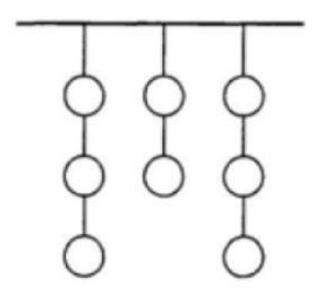
In a shooting tournament, eight clay targets hang in three columns: two columns have three targets each, and one has two. To break the targets, first choose a column and then break its lowest remaining unbroken target. If these rules are followed, in how many different orders can all eight targets be broken?
Original source figure (schematic), preserving its mathematical labels and arrangement.
For $x,y,z\ge0$ subject to $6x+4y+z=1$, suppose $x^3y^2z$ attains its maximum. At that point $xyz=m/n$, where $m,n$ are relatively prime positive integers. Find $m+n$.
A tangent from point $M$ to $x^2+y^2=1$ is perpendicular to a tangent from the same point to $x^2+y^2=3$. The locus of $M$ is a circle. Find its radius.
Functions are defined by $f(x)=1/(2x+1)$, with $x$ different from $-1/2$, and $g(x)=x+1$. Find $x$ for which $ff=gf$, where juxtaposition denotes composition: $f(f(x))=g(f(x))$.
Composition convention: ff means f composed with f, and gf means g composed with f. Use only inputs for which both sides are defined.
Determine the minimum of $\displaystyle\sum_{k=1}^{50}x_k$ over positive numbers $x_1,\ldots,x_{50}$ satisfying $\displaystyle\sum_{k=1}^{50}\frac1{x_k}=1$.