SEAMO self-study edition 2027; not an official 2027 paper. Original source years are retained. 25 questions, 90 minutes; Q1–10: 3 points, Q11–20: 4 points, Q21–25: 6 points, total 100. Original response types and all subparts are preserved. Verified is an editorial convention; source defects, necessary assumptions and unresolved mathematical uncertainty are disclosed.
A network of domestic flights is set up in the country of Utopia. A city is directly connected to at most 3 others, and there is at most 1 transit flight from one city to another. What is the maximum number of cities in Utopia?
Interpret the routes as two-way connections, and “at most 1 transit” as at most one intermediate city: any city must be reachable from any other in at most two flights.
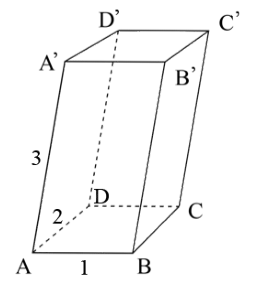
In the figure, $\angle BAD=90^\circ$ and $\angle BAA'=\angle DAA'=60^\circ$. Find the length of $AC'$. The labelled edges are $AB=1$, $AD=2$ and $AA'=3$.
Read the pictured solid as the oblique parallelepiped ABCD–A′B′C′D′. Opposite edges are parallel and equal, as indicated by the conventional diagram.
Original source figure (not to scale), with its printed mathematical labels preserved.
Let $A(2,0)$ be fixed in the plane and let $P(\sin(2t-60^\circ),\cos(2t-60^\circ))$ move as $t$ varies from $15^\circ$ to $45^\circ$. If the area swept out by the segment $AP$ is $S$, find $\lfloor100S\rfloor$. (The source also calls the area $A$; here $S$ avoids confusion with the point.)
Find the number of ordered triples of positive integers $(a,b,c)$ with $1\le a,b,c\le10$ such that
$$a^2+b^2+c^2+2ab+2a(c-1)+2b(c+1)$$
is a perfect square.
The side lengths of a triangle are successive terms of a geometric progression. Let $A$ and $C$ be its smallest and largest interior angles, respectively. Its shortest side has length 16 cm and
$$\frac{\sin A-2\sin B+3\sin C}{\sin C-2\sin B+3\sin A}=\frac{19}{9}.$$
Find its perimeter in centimetres.
It is given that
$$(\log_2 3)^x-(\log_5 3)^x=(\log_2 3)^{-y}-(\log_5 3)^{-y}.$$
Which is the best conclusion?
Take x and y to be real. Follow the source cover instruction to choose the BEST answer: select the strongest conclusion, even if a weaker listed consequence is also true.
A $10\times1$ hallway is to be tiled using an unlimited supply of $1\times1$ red tiles, $2\times1$ red tiles and $2\times1$ blue tiles. Find the number of tilings.
Given
$$x=\lfloor1^{1/3}\rfloor+\lfloor2^{1/3}\rfloor+\lfloor3^{1/3}\rfloor+\cdots+\lfloor7999^{1/3}\rfloor,$$
find $\lfloor x/100\rfloor$. Here $\lfloor y\rfloor$ is the greatest integer less than or equal to $y$; for example, $\lfloor2.1\rfloor=2$, $\lfloor30\rfloor=30$, $\lfloor-10.5\rfloor=-11$.