SEAMO self-study edition 2027; not an official 2027 paper. Original source years are retained. 25 questions, 90 minutes; Q1–10: 3 points, Q11–20: 4 points, Q21–25: 6 points, total 100. Original response types and all subparts are preserved. Verified is an editorial convention; source defects, necessary assumptions and unresolved mathematical uncertainty are disclosed.
Suppose $a,b,c,d$ are real numbers such that
$$a+b+c+d=0,\qquad abcd\left(\frac1a+\frac1b+\frac1c+\frac1d\right)=4.$$
Find $a^3+b^3+c^3+d^3$.
The supplied key conflicts with the printed equation. Use the equation as printed; the solution explains the discrepancy. All reciprocals must be defined.
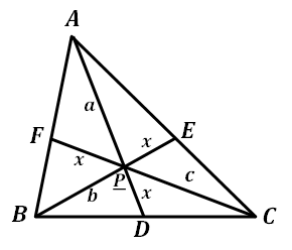
In triangle $ABC$, the cevians $AD,BE,CF$ meet at the interior point $P$, with $D\in BC$, $E\in CA$ and $F\in AB$, as shown. Suppose $AP=a$, $BP=b$, $CP=c$ and $DP=EP=FP=x$. Given $x=3$ and $a+b+c=20$, find $abc$.
Original source image, preserving the printed mathematical labels and any disclosed source discrepancy.
Felicia has a fair six-sided die with four faces numbered $1,2,3,4$ and two blank faces. Nathan has a fair six-sided die numbered 1 to 6. Patrick has a fair twelve-sided die numbered 1 to 12. They take turns in the order Felicia, Nathan, Patrick until someone wins by rolling 1. If Felicia rolls a blank, she keeps rolling until a number appears. Find the probability that Patrick wins.
Use independent rolls of the fair dice. A blank on Felicia’s die does not end her turn.
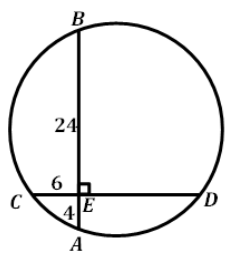
$A,B,C$ and $D$ are four distinct points lying on the circumference of a circle such that chords $AB$ and $CD$ are perpendicular at point $E$.
The source prose states that $EA=4$, $EB=2$ and $EC=6$. Its diagram labels $EB=24$. Find the radius of the circle, using the convention stated below.
Source discrepancy: the prose gives $EB=2$, whereas the printed diagram labels $EB=24$. Both are retained. For the main answer, follow the diagram and use $EB=24$; the solution also treats the literal prose value.
Original source image, preserving the printed mathematical labels and any disclosed source discrepancy.
Let $a,b,c,d$ be positive numbers such that
$$\frac{a^2}{1+a^2}+\frac{b^2}{1+b^2}+\frac{c^2}{1+c^2}+\frac{d^2}{1+d^2}=1.$$
The source defines $k_1$ as the maximum value of $abcd$ and $k_2$ as the minimum value of $a+b+c+d$. Which of the following is true?
The source calls $k_2$ a minimum, but its existence on the strictly positive domain must not be assumed. Assess the listed assertions on the actual domain; the solution distinguishes a minimum from an infimum.
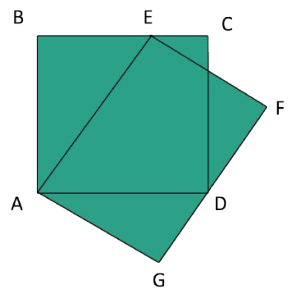
$ABCD$ is a square with $AB=m$, and $AEFG$ is a rectangle such that $E$ lies on side $BC$ and $D$ lies on side $FG$. Given that $AE=n$, what is the length of side $EF$?
Original source image, preserving the printed mathematical labels and any disclosed source discrepancy.
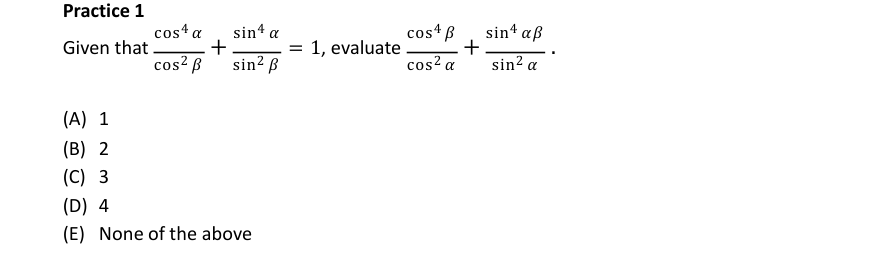
Given that
$$\frac{\cos^4\alpha}{\cos^2\beta}+\frac{\sin^4\alpha}{\sin^2\beta}=1,$$
evaluate the expression printed in the source as
$$\frac{\cos^4\beta}{\cos^2\alpha}+\frac{\sin^4\alpha\beta}{\sin^2\alpha},$$
using the explicit notation correction stated below.
Notation correction for answering: the original second target numerator is printed as $\sin^4\alpha\beta$, an ambiguous extra-symbol expression. Read it here as $\sin^4\beta$, so the target is $\dfrac{\cos^4\beta}{\cos^2\alpha}+\dfrac{\sin^4\beta}{\sin^2\alpha}$. This is an explicit editorial interpretation, not an exact transcription of that numerator. All options remain as printed, and all denominators must be nonzero.
Original source image, preserving the printed mathematical labels and any disclosed source discrepancy.
Let $CD$ be a chord of circle $T_1$, and let $AB$ be a diameter of $T_1$ perpendicular to $CD$ at $N$, with $AN>NB$. Circle $T_2$, centred at $C$ with radius $CN$, intersects $T_1$ at $P$ and $Q$, and segments $PQ$ and $CD$ intersect at $M$. Given that the radii of $T_1$ and $T_2$ are 61 and 60, respectively, find $AM$.
$ABCD$ is a quadrilateral with $AB=BC=CD=DA$ and $\angle ABC\lt 90^\circ$. Points $E$ and $F$ are on lines $BC$ and $CD$, respectively, and
$$AB=AE=AF=FE.$$
Find $\angle BEF$, using the interior-point convention stated below.
The printed wording says “on lines”, which allows extensions and does not determine a unique angle. For the main answer, explicitly assume $E$ and $F$ lie strictly inside sides $BC$ and $CD$, respectively. The solution explains the ambiguity of the literal wording.