Skip to content / Đến nội dung
ThichHocToan.com

SEAMO 2027 - Paper F - SET 01 - Self-study

Question 1

SEAMO self-study edition 2027; not an official 2027 paper. Original source years are retained. 25 questions, 90 minutes; Q1–10: 3 points, Q11–20: 4 points, Q21–25: 6 points, total 100. Original response types and all subparts are preserved. Verified is an editorial convention; source defects, necessary assumptions and unresolved mathematical uncertainty are disclosed.

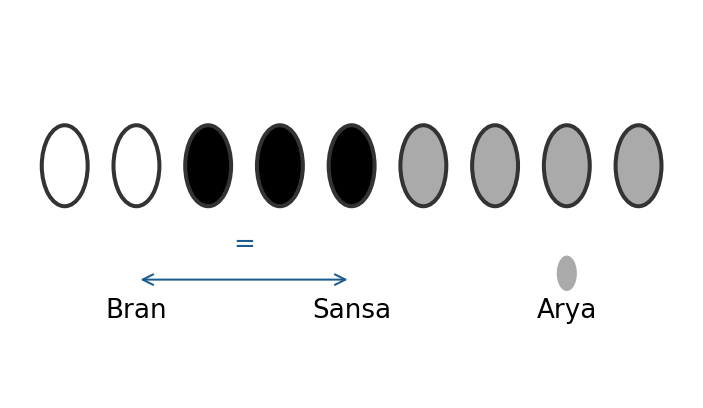
Two white, three black and four grey marbles are shared equally among nine students. Find the number of ways to distribute them so that Bran and Sansa receive the same colour and Arya receives a grey marble.

Counting convention: students are distinct and marbles of the same colour are indistinguishable.

Question illustration
  1. 120
  2. 130
  3. 140
  4. 150
  5. None of the above

Question 2

How many positive integers $k<100$ make $2(5^{6n})+k(2^{3n+2})-1$ divisible by 7 for every positive integer $n$?
  1. 12
  2. 14
  3. 18
  4. 19
  5. None of the above

Question 3

Given that $x_1,x_2$ are real roots of $2x^2-4mx+2m^2+3m-2=0$, find $m$ for which $x_1^2+x_2^2$ is minimum.

Convention: real roots may coincide; a repeated real root is counted twice.

Question 4

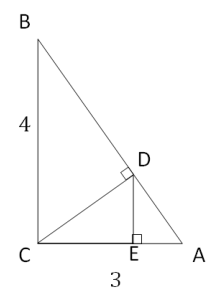
In triangle $ABC$, $\angle C=90^\circ$, $CA=3$ and $CB=4$. Point $D$ lies on $AB$ with $CD\perp AB$. Point $E$ lies on $AC$ with $DE\perp CA$. If $DE=m^2/n^2$, where $m,n$ are relatively prime, find $m+n$.

Convention: $m,n$ are positive coprime integers.

Question illustration
  1. 3
  2. 5
  3. 7
  4. 11
  5. None of the above

Question 5

Let $x_0$ be the largest real root of $x^4-16x-12=0$. Evaluate $\lfloor10x_0\rfloor$.
  1. 25
  2. 27
  3. 30
  4. 32
  5. None of the above

Question 6

Find the smallest four-digit number that has the same number of factors as 2022.
  1. 1000
  2. 1001
  3. 1003
  4. 1005
  5. None of the above

Question 7

Evaluate $\dfrac1{\log_{ab}(abc)}+\dfrac1{\log_{bc}(abc)}+\dfrac1{\log_{ac}(abc)}$.

Domain convention: all logarithms and their reciprocals must be defined over the reals. In particular, $ab,bc,ac$ are positive bases other than 1, and $abc$ is positive and different from 1.
  1. $-1$
  2. 0
  3. 1
  4. 2
  5. None of the above

Question 8

In the expansion of $f(x)=(1+ax)^4(1+bx)^5$, where $a,b$ are positive integers, the coefficient of $x^2$ is 66. Evaluate $a+b$.

Source-consistency warning: the printed numerical data and supplied answer key are inconsistent. Retain the expression and all data exactly as printed, and assess the listed choices from those data.
  1. 2
  2. 3
  3. 4
  4. 5
  5. None of the above

Question 9

Fill a $3\times3$ table with the integers 1 to 9, each used once. In each row colour its median red. Given that the median of the three red numbers is 5, in how many different ways can the table be filled?

Question 10

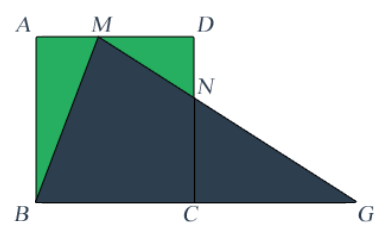
In the diagram, $ABCD$ is a square and $NC=2DN$. Point $M$ lies on $AD$ such that $\angle NMB=\angle MBC$. Find $\tan\angle ABM$.

Question illustration
  1. $2/3$
  2. $1/2$
  3. $1/3$
  4. $1/4$
  5. $1/5$

Question 11

Find the remainder when $10^{10^1}+10^{10^2}+10^{10^3}+\cdots+10^{10^{10}}$ is divided by 7.
  1. 4
  2. 5
  3. 6
  4. 3
  5. None of the above

Question 12

If $e_1,e_2$ are the eccentricities of the ellipse $9x^2+4y^2=36$ and the hyperbola $9x^2-4y^2=36$, respectively, which option is correct?
  1. $e_1^2+e_2^2>3$
  2. $e_1^2+e_2^2=2$
  3. $e_1^2+e_2^2=4$
  4. $e_1^2+e_2^2<4$
  5. Both (A) and (D)

Question 13

Determine the largest value of $x$ for which $|x^2-4x-39601|\ge|x^2+4x-39601|$.
  1. 201
  2. 202
  3. 203
  4. 204
  5. None of the above

Question 14

A circular coin $A$ rolls without sliding along the circumference of a stationary circular coin $B$, whose radius is twice that of $A$. Let $x$ be the number of degrees through which coin $A$ rotates about its own centre until it first returns to its initial position. Find $x$.

Interpretation: the coins roll in external contact, and “first returns to its initial position” means the moving coin’s centre completes its first full orbit.

Question 15

Find the sum of all positive integers $n$ for which $\dfrac{4n^3-16n^2+29n+60}{2n-3}$ is an integer.
  1. 42
  2. 69
  3. 75
  4. 81
  5. None of the above

Question 16

In triangle $ABC$, let $BC=a$, $CA=b$, $AB=c$. Given $9a^2+9b^2-19c^2=0$, find $\dfrac{\cot C}{\cot A+\cot B}$.
  1. $5/9$
  2. $6/9$
  3. $7/9$
  4. $8/9$
  5. 1

Question 17

In the expansion of $(1+x)^m(1-x)^n$, the coefficients of $x$ and $x^2$ are 3 and $-6$, respectively. What is $n$?
  1. 5
  2. 6
  3. 7
  4. 8
  5. 9

Question 18

Three girls $A,B,C$ and seven boys are lined up in a row. Let $n$ be the number of arrangements in which $B$ lies between $A$ and $C$, and exactly four boys separate $A$ and $B$. Determine $\left\lfloor n/5!\right\rfloor$.

Counting convention: all ten people are distinct. The brackets denote the floor, the greatest integer not exceeding the enclosed value.

Question 19

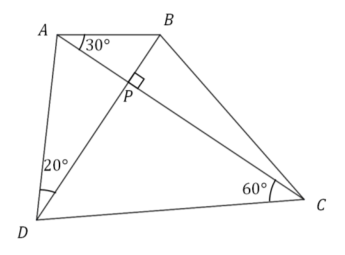
In quadrilateral $ABCD$, diagonals $AC$ and $BD$ intersect perpendicularly at $P$. If $\angle BAC=30^\circ$, $\angle ACD=60^\circ$ and $\angle ADB=20^\circ$, find $\angle ABC$ in degrees.

Use the convex quadrilateral shown: $P$ is inside both diagonal segments.
Question illustration

Question 20

Find the remainder when $(x-2)^{10}+(x-3)^{20}$ is divided by $x^2-5x+6$.
  1. $x+1$
  2. $x$
  3. 1
  4. 2
  5. None of the above