The first five terms of a sequence are $5,9,16,28,47$. Find the sum of the 8th and 7th terms. For this self-study question, continue the pattern in which the third differences are constant.
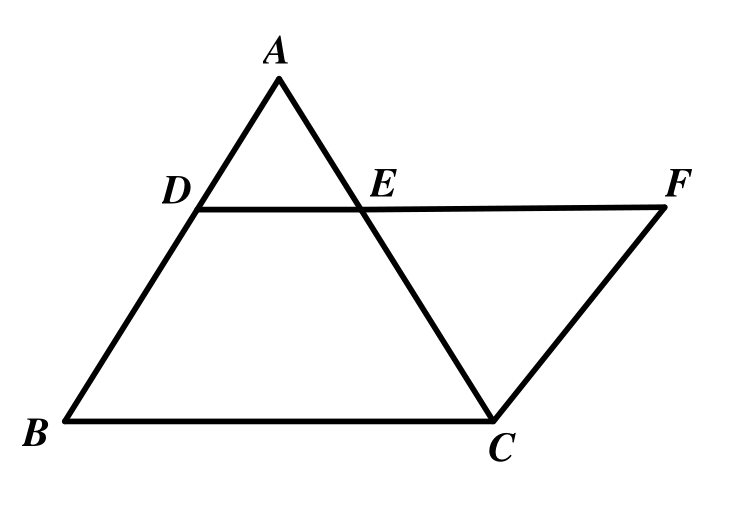
In triangle $ABC$, $D$ lies on $AB$ with $BD=3AD$. Point $E$ lies on $AC$ with $DE\parallel BC$. Point $F$ lies on the line $DE$ with $CF\parallel AB$. Find $EF$ if $BC=16$.
A number has only the digit 1 when written in base 3, but its last digit is 0 when written in base 2. What is the largest four-digit number in base 10 with this property? Enter its ordinary base-10 value, without padding it with a leading zero.
Find $p+q+r$ for positive integers $p,q,r$ satisfying
$$\gcd(p,q)=45,\quad\gcd(q,r)=21,\quad\gcd(p,r)=3,$$
$$\operatorname{lcm}(p,q)=4725,\quad\operatorname{lcm}(q,r)=11025,$$
$$\operatorname{lcm}(p,r)=6615.$$
Here gcd means greatest common divisor and lcm means least common multiple. Enter the integer sum only.
Let $f(x)=2^x+86$ and $g(x)=3x^2+x-4$. Find $g\bigl(f^{-1}(g(14))\bigr)$. Here $f^{-1}$ means the inverse function of $f$, not a reciprocal. Enter the numerical value.
Adding 1 to the numerator and 5 to the denominator of a fraction gives the same result as subtracting 5 from its numerator and 1 from its denominator. Its decimal value is 1.5. Which displayed fraction is it? The stated changes apply to the displayed numerator and denominator before reduction.
Seven unique awards are to be handed to seven exceptional students, one award per student. The probability that every award goes to an incorrect recipient is $\frac ab$ in simplest form. Find $a+b$. You are given that the corresponding probabilities for five and six awards are $\frac{11}{30}$ and $\frac{53}{144}$.
**Probability convention:** Each award has a different intended recipient, and all one-to-one assignments are equally likely. Enter the integer $a+b$.
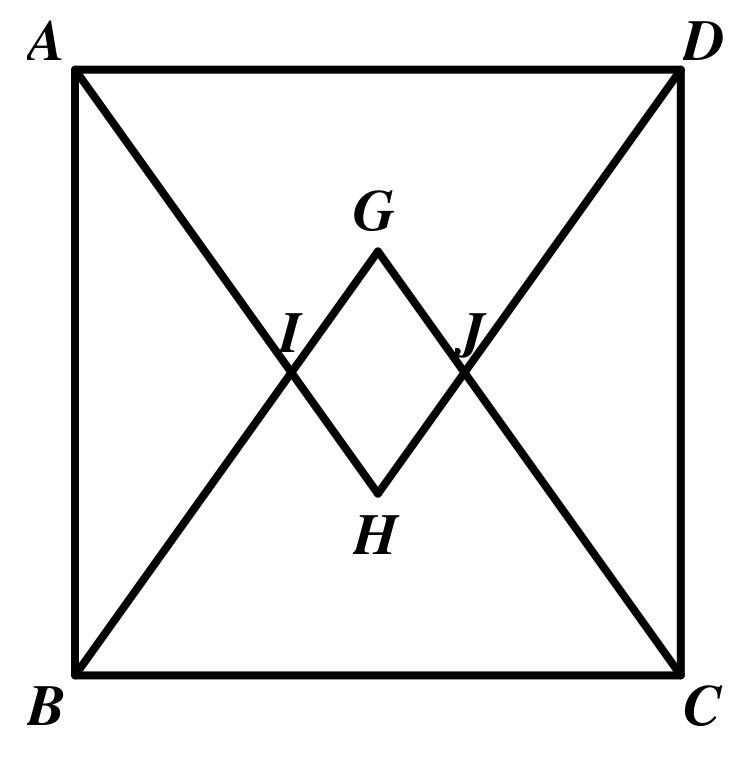
In the diagram, $ABCD$ is a square of side 6, and $AHD$ and $BCG$ are equilateral triangles inside it. Points $I$ and $J$ are the intersections shown: $I=AH\cap BG$ and $J=DH\cap CG$. Find the area of rhombus $IGJH$. Choose one option.
How many times does the digit 0 appear in the list of integers from 1000 to 2021, including both endpoints? Count every occurrence, even if a number contains more than one zero. Enter the integer only.
Rationalise the denominator of
$$\frac1{\sqrt6-\sqrt3+\sqrt2+1}.$$
The printed source offers the following expressions, retained unchanged for comparison:
- A. $\dfrac{\sqrt6+\sqrt3-\sqrt2+1}{2}$
- B. $\dfrac{\sqrt6-\sqrt3+\sqrt2+1}{2}$
- C. $\sqrt6-\sqrt3+\sqrt2+1$
- D. $\sqrt6+\sqrt3-\sqrt2+1$
- E. $\sqrt6-\sqrt3-\sqrt2+1$
For this edition, submit your rationalised expression rather than an option letter. Write the result as $(a+b\sqrt2+c\sqrt3+d\sqrt6)/e$, where the five coefficients are integers with no common factor greater than 1 and $e>0$. Enter a;b;c;d;e in that order, separated by semicolons, with no spaces. Keep every sign, including negative coefficients.
**Domain convention:** Treat $x$ as an algebraic root, allowing complex numbers. The equation has no real root. You do not need to find the roots or perform calculations with complex numbers; use a polynomial identity. Enter the resulting number only.
A tangential quadrilateral $ABCD$ is a convex quadrilateral whose sides are tangent to a circle. Given $AD=16$, $BC=8$, and circle radius 4, find the area of the quadrilateral. Choose one option.